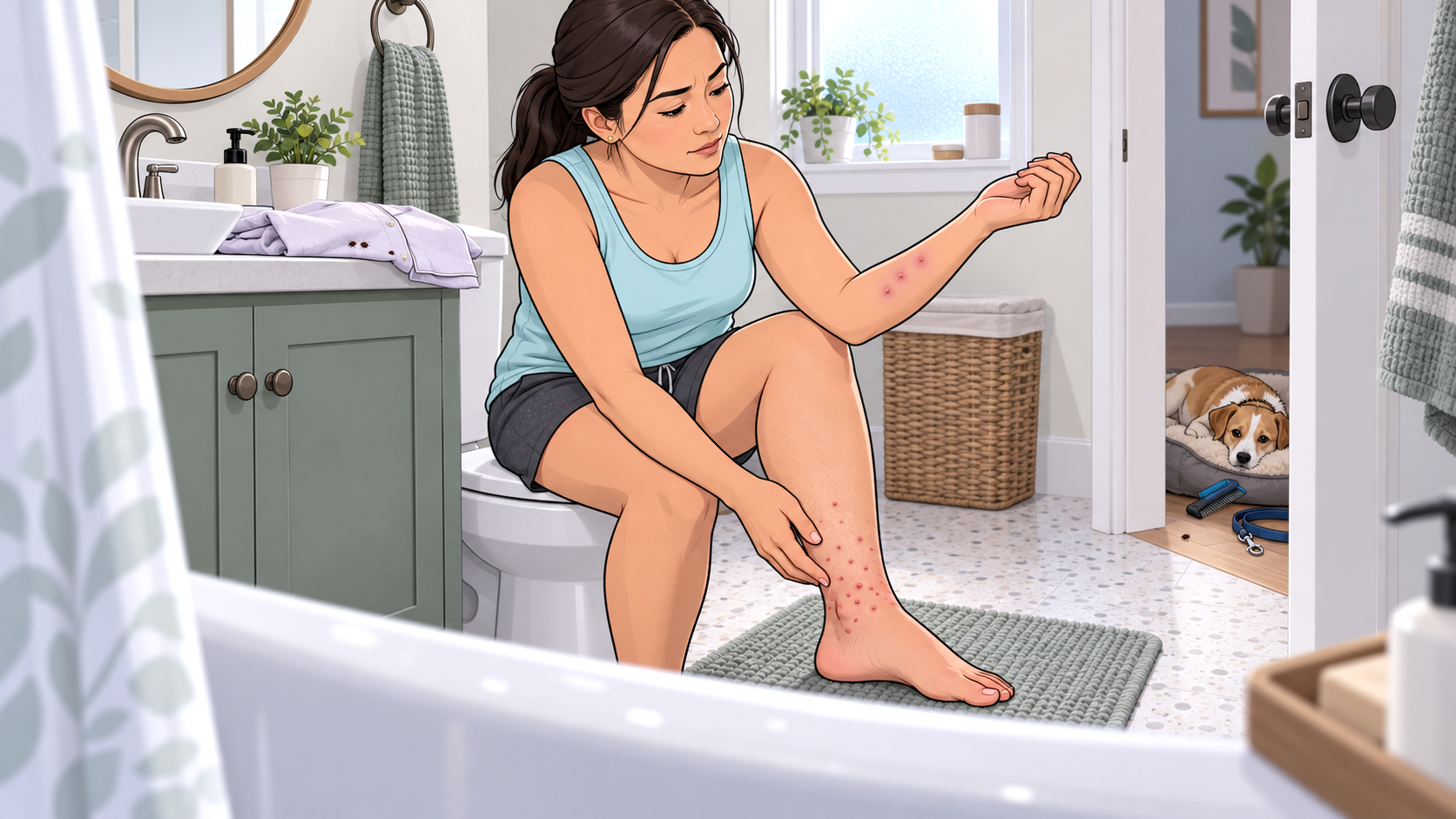
A few itchy red bumps around your ankles might make fleas seem obvious. Wake up with a row of welts on your arm and bed bugs may become the immediate suspect. Unfortunately, neither clue is as decisive as it sounds. Bed bug bites and flea bites can look remarkably similar. Both can produce small, red, itchy bumps that occur in clusters, and appearance alone often cannot identify the insect responsible. Bite location and when the marks appeared can provide clues, but the strongest distinction comes from finding evidence of fleas, bed bugs, or their sources in your surroundings.
So if you are trying to solve bed bug bites vs. flea bites, the skin is a useful place to begin. It is a poor place to finish.
The Bumps Themselves May Not Settle the Question
Bed bug bites are commonly described as slightly swollen, red areas that itch or feel irritated. They may occur randomly or in a line, and some people develop much stronger reactions than others. Others show little or no visible reaction after being bitten.
Flea bites also commonly produce itchy skin lesions. The problem is that the body’s reaction to an arthropod’s saliva can make bites from different insects overlap visually. Clinical guidance notes that bites from both bed bugs and fleas can occur as clusters of red papules.
That overlap limits how much confidence you should place in internet bite photographs. Two people bitten by the same pest may react differently, while two different insects can produce lesions that look frustratingly alike.
This is particularly important with bed bugs because the inflammatory reaction to their bites is not considered diagnostic. A dermatologist may evaluate the reaction on your skin, but identifying the pest usually requires evidence beyond the welt itself.
Location Is a Clue, Not a Rule
Where the bites occur can make one explanation more plausible, but location should never become a rigid identification rule.
Flea bites are frequently associated with the legs, particularly when fleas are emerging from floors, carpets, pet resting areas, or other places close to ground level. Fleas can jump onto a passing host, feed, and move again. Depending on the circumstances, however, bites are not restricted to the ankles.
Bed bugs commonly feed while people are sleeping. Consequently, exposed areas such as the face, neck, arms, hands, and legs can be affected. Bed bug bites can also appear elsewhere when skin is accessible.
This gives us a useful weighting system rather than a diagnostic formula. Numerous bites concentrated around the lower legs and ankles make fleas worth investigating carefully, especially in a home with pets. New marks appearing on exposed skin after sleeping make bed bugs worth investigating around the bed.
Neither pattern proves the answer.
A bed bug can reach your leg, and a flea can bite somewhere other than your ankle. We would therefore use bite location to decide where to investigate next, not to declare which insect is responsible.
The Famous Bite Pattern Is Less Useful Than People Think
Rows and clusters receive an enormous amount of attention in bed bug discussions. You may even have heard that three bites in a row automatically mean bed bugs.
That shortcut is unreliable.
Bed bug bites can appear in lines or clusters, and repeated feeding by a single bed bug can produce multiple lesions. Our guide to bed bug bite clusters explains why the number of marks cannot simply be converted into a number of insects.
Flea bites can cluster too. A published comparison of arthropod-associated skin lesions notes that both flea and bed bug lesions may frequently occur in groups.
That means three itchy bumps are still three itchy bumps, not a species identification.
We would be particularly skeptical of diagrams claiming that one pest always produces a neat line while another produces random dots. Human skin reactions are too variable, and feeding does not create a perfect geometric signature every time.
Timing Gives Bed Bugs a Slightly Different Puzzle
The moment you notice a bite is not necessarily the moment you were bitten.
Bed bugs often feed while a person sleeps, and their bites may not be felt as they happen. They inject salivary substances during feeding, and visible marks can appear later. The CDC notes that bed bug bite marks may take one to several days to become noticeable, with reactions sometimes taking even longer.
This creates a common investigative mistake. Someone wakes up on Tuesday with marks and assumes the bites must have occurred Monday night. That connection may be correct, but the skin reaction does not provide a precise timestamp.
Therefore, “I woke up with bites” supports investigating the sleeping environment, but it does not prove bed bugs. Similarly, noticing itching after spending time around a flea-infested animal or environment makes fleas plausible without turning timing into proof.
The delay is one reason our bed bug bite identification guide treats skin appearance as supporting evidence rather than confirmation.
Pets Change the Flea Side of the Investigation
If a dog or cat lives in the home, the investigation gains an important branch that does not exist in quite the same way with bed bugs.
Common cat and dog fleas are blood-feeding insects associated with animal hosts. Adult cat and dog fleas are small, laterally compressed insects measuring roughly 3 to 4 mm long. Flea populations can become established around pets and in the environments where those animals spend time.
A pet that is scratching does not automatically prove fleas, since itching has many possible causes. However, a confirmed flea on the animal or flea evidence in its bedding gives the lower-leg bite pattern much more context.
Look beyond the animal as well. Flea eggs can fall from a host into the environment, while immature stages develop away from the pet. Carpets, pet bedding, upholstered furniture, floor cracks, and protected areas where an infested animal rests can therefore matter to the infestation.
Bed bugs work differently. Although bed bugs can feed on dogs and cats, they are not the same kind of pet-centered parasite problem. In a typical human dwelling, the strongest bed bug evidence is more likely to be concentrated around human sleeping and resting areas.
That difference can be far more revealing than whether an individual welt looks slightly larger or redder.
No Pets Does Not Automatically Rule Out Fleas
The opposite shortcut also fails. A home without a dog or cat cannot simply cross fleas off the list.
There are thousands of flea species worldwide, and fleas can be associated with a range of mammals. Wildlife or rodents can sometimes provide the host population behind a flea problem. A previous animal infestation can also leave developing flea stages in the environment.
So “we don’t own pets” is useful history, but it is not a flea test.
If bites are concentrated around the lower body and you suspect fleas, investigate the environment rather than stopping at the pet question. Evidence of rodents or wildlife around a structure can change the investigation considerably.
This matters medically as well because fleas are not merely a nuisance in every circumstance. Some flea species can transmit pathogens. The health importance of fleas varies with the flea species, host, pathogen, and location, which is another reason correct identification matters.
Let the Room Break the Tie
When the skin refuses to give you a confident answer, stop examining the bites and examine the environment.
For suspected bed bugs, concentrate first on the places where people sleep and rest. Inspect mattress seams and tags, the box spring, headboard, bed frame, furniture joints, and nearby cracks. Look for live insects, pale shed skins, eggs, dark fecal spotting, and rusty-colored stains. These physical signs are much more persuasive than a row of welts.
Our guide to how to check for bed bugs walks through that inspection in detail. If you find an insect, preserve it for identification rather than crushing it immediately.
For suspected fleas, shift the search toward animals and the places they spend time. Check pets appropriately for fleas and investigate pet bedding, carpets, upholstered resting spots, floor edges, and other areas associated with animal activity. If there are no pets, consider whether rodents or other animal hosts could be involved.
The insects themselves are also dramatically different. Adult bed bugs are broad, flattened from top to bottom, wingless, and reddish-brown. Fleas are narrow when viewed from above because their bodies are compressed from side to side, and their enlarged hind legs allow them to jump.
If the mystery insect suddenly launches itself away, that observation is considerably more useful than counting the red dots on your ankle. Bed bugs cannot jump or fly.
Treat the Pest You Find, Not the Bite Pattern You Think You See
The biggest practical risk in confusing flea bites with bed bug bites is not misnaming a rash. It is treating the wrong environment.
A flea problem associated with a pet requires attention to the animal and the environmental stages of the flea population. A bed bug infestation requires a very different inspection and control strategy focused on bed bug harborages and movement around sleeping and resting areas.
Spraying a mattress because you have ankle bites does not solve a flea infestation. Treating a pet for fleas will not eliminate bed bugs hiding in a bed frame.
Before either response, try to establish what is actually present. Finding the insect is ideal. When that is difficult, combine environmental evidence, likely host relationships, and professional identification rather than relying on the skin alone.
If you have bite-like marks but repeatedly find no signs of bed bugs, keep other explanations open instead of forcing the evidence to fit bed bugs.
For the skin itself, most uncomplicated bed bug bites require only symptomatic care and good hygiene. Excessive scratching can damage the skin and contribute to secondary infection. Seek medical advice for severe reactions, signs of infection, or symptoms that concern you rather than relying on pest identification to diagnose a skin condition.
Other Questions About Bed Bug Bites and Flea Bites
Are flea bites always on the ankles?
No. The lower legs and ankles can be common locations because fleas may encounter people from floors and other low areas, but flea bites are not anatomically restricted to the ankles. Location should be treated as a clue rather than a rule.
Are bed bug bites bigger than flea bites?
Size is not a dependable way to separate them. The visible lesion reflects your body’s reaction as well as the feeding event, so reactions can vary substantially between people. A larger welt does not automatically mean bed bug, and a tiny red bump does not automatically mean flea.
Can bed bugs and fleas infest the same home?
Yes. The presence of one does not prevent the other from being present. If you find confirmed fleas but also find bed bug-specific evidence around a mattress or bed frame, investigate both rather than assuming every symptom has one cause.
Which bites are more likely to appear in a straight line?
Bed bug bites can occur in lines, but this pattern is not reliable enough to identify them. Both flea and bed bug bites can occur in groups, so a straight or clustered pattern should lead to further inspection rather than a diagnosis from the skin.
Can a doctor tell whether I was bitten by a flea or bed bug just by looking?
Sometimes the distribution, history, and surrounding circumstances can make one cause more likely, but the appearance of an arthropod bite is often nonspecific. For bed bugs in particular, the skin reaction is not diagnostic. Identifying the pest or finding characteristic environmental evidence provides much stronger confirmation.
6 thoughts on “Bed Bug Bites vs. Flea Bites: How to Tell Them Apart”