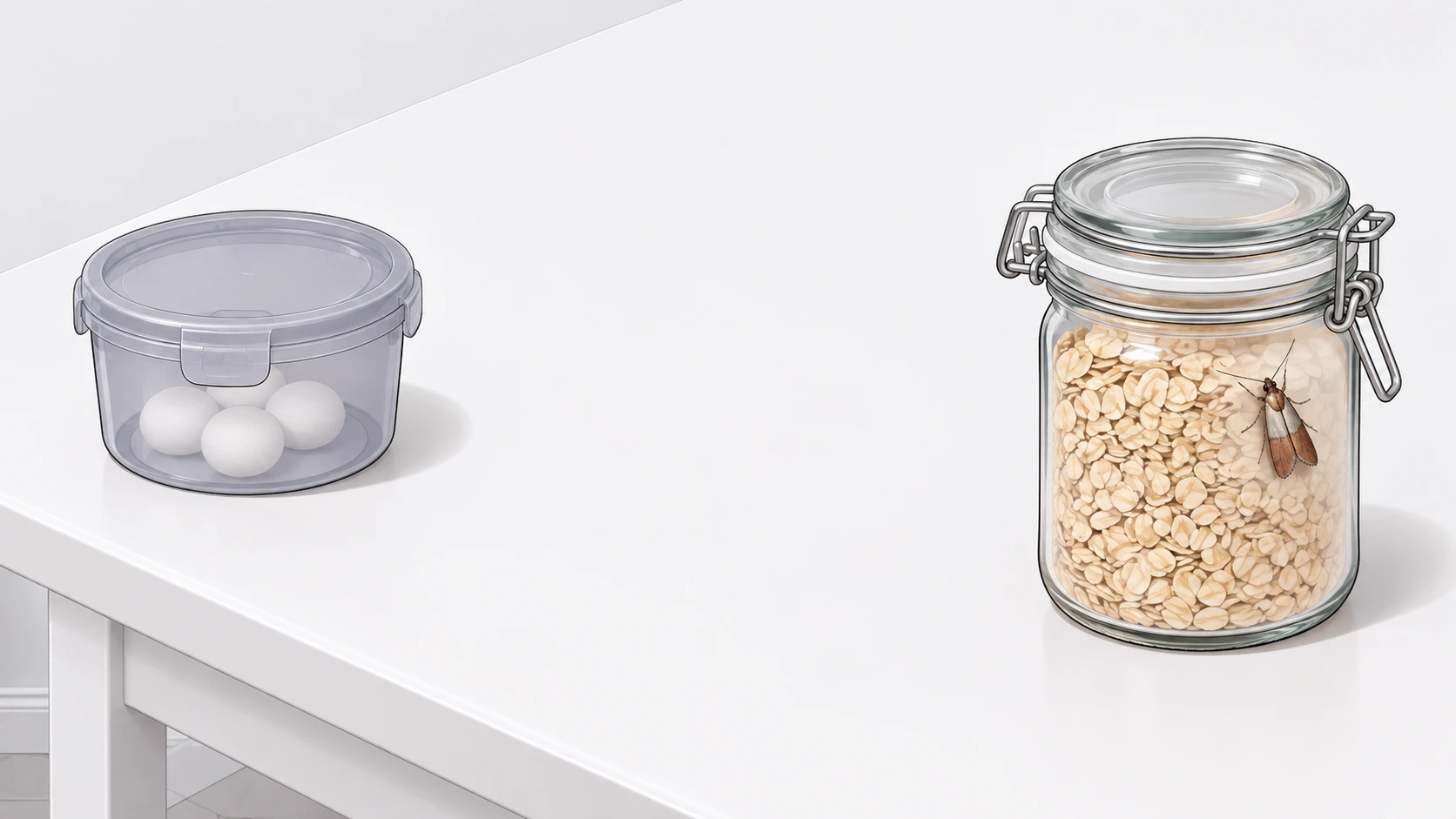
Mothballs contain insecticides capable of killing susceptible insects, but they are not a safe or recommended treatment for Indian meal moths in a kitchen or pantry. Their effectiveness depends on sufficient pesticide vapor accumulating in a suitable enclosed space, while their labeled uses generally target clothes moths and other fabric pests rather than insects developing inside stored food.
Indian meal moths (Plodia interpunctella) are stored-product pests. Their larvae develop in food materials, and the winged adults may be found flying around cupboards, ceilings, and other rooms. This creates a tempting but dangerous assumption: because the insects are moths, a product called a mothball must be suitable for controlling them.
In reality, using mothballs around groceries can expose people and pets to toxic pesticide vapors and contaminate food-storage areas. Placing a few mothballs on pantry shelves does not reproduce the enclosed conditions under which these products are intended to work.
Do not put mothballs in pantries, food containers, kitchen cabinets, or bags of stored food. Their documented insecticidal properties do not justify those uses.
What Is Inside a Mothball?
Conventional insecticidal mothballs in the United States typically contain one of two active ingredients: naphthalene or paradichlorobenzene, also called 1,4-dichlorobenzene or PDB.
Both are solid chemicals that gradually release vapor at ordinary room temperatures. This process is called sublimation, meaning that a solid changes directly into a gas.
The chemicals themselves are the active pesticide ingredients. Traditional mothballs are often composed almost entirely of one active ingredient rather than containing a small amount diluted in a large quantity of harmless filler.
The chemical composition and behavior of mothballs explain why they become smaller over time even when nobody touches them. Their material is slowly entering the surrounding air.
The same process creates their characteristic smell and their exposure hazards.
Naphthalene Mothballs
Naphthalene is an aromatic chemical that releases pesticide vapor as it sublimates.
It is associated with several health hazards, especially when swallowed or inhaled at sufficiently high concentrations. Significant naphthalene exposure can damage red blood cells and cause other serious effects. Certain people, including those with glucose-6-phosphate dehydrogenase (G6PD) deficiency, can be particularly vulnerable to its effects.
These risks make naphthalene mothballs especially inappropriate for locations where food is stored or prepared.
There is also no reason to assume that a naphthalene product labeled for clothing protection has been tested and authorized for Indian meal moths developing in grain, flour, or animal feed.
Paradichlorobenzene Mothballs
Paradichlorobenzene is another volatile insecticidal chemical used in mothballs, crystals, and related products.
Its vapors can kill susceptible fabric pests when the product is used under suitable enclosed conditions. However, the presence of this active ingredient does not authorize its use in food-storage areas.
Paradichlorobenzene exposure can also produce adverse health effects. The risks depend on the amount inhaled or otherwise absorbed, the duration of exposure, and the circumstances.
Neither ingredient should be considered safe around food simply because mothballs have been sold for household use for many years.
How Do Mothballs Kill Insects?
Mothballs work by releasing pesticide vapor into an enclosed space. When the vapor accumulates to an effective concentration and insects remain exposed long enough, susceptible insects can be killed.
The critical conditions are concentration and exposure time.
A tightly sealed, label-authorized clothing-storage container can retain vapor. By contrast, an open pantry shelf allows the vapor to disperse into the room and potentially into occupied areas.
This difference helps explain why a mothball can be effective in an appropriate clothing-storage enclosure yet fail to control moths elsewhere in a house.
The amount of active ingredient, the enclosure, its ability to retain vapor, and the product’s labeled instructions all affect performance.
The fact that a mothball produces a strong smell does not tell you whether its vapor concentration is sufficient to kill Indian meal moths. Odor is evidence of chemical release, not a reliable measure of pest mortality.
Can Mothball Fumes Kill Indian Meal Moth Adults?
Indian meal moth adults may be harmed by exposure to sufficiently concentrated insecticidal vapors, but that possibility is not an established household treatment.
The insecticidal action of mothballs has been demonstrated for the fabric pests named on appropriate labels. It would be inaccurate to assume that the same dose, duration, and conditions have been validated for adult Indian meal moths in a kitchen.
An adult flying through an open room might receive some exposure to vapor without encountering a lethal concentration.
Increasing the number of mothballs to make the smell stronger is not an acceptable solution. Doing so can increase pesticide exposure to household occupants while leaving the treatment outside its authorized uses.
The flight and movement of adult Indian meal moths also make their location an unreliable indicator of the infestation source. Killing a few exposed adults would not necessarily affect developing insects elsewhere.
Do Mothballs Kill Indian Meal Moth Eggs and Larvae?
There is no dependable basis for recommending ordinary mothballs to kill Indian meal moth eggs or larvae inside stored food.
Mothball products may kill particular stages of labeled fabric pests under appropriate conditions. That evidence cannot automatically be transferred to Indian meal moth eggs embedded in the folds of food packaging or larvae feeding within dry products.
The concentration reaching an insect inside a food package may differ substantially from the concentration in the surrounding room.
More importantly, attempting to expose food and its packaging to toxic pesticide vapor introduces a contamination problem.
A package of flour or birdseed should never be treated as an experimental fumigation chamber for household mothballs.
The feeding behavior of Indian meal moth larvae explains why the damaging insects are often protected within stored material rather than openly exposed on cupboard shelves.
Can Mothballs Kill Indian Meal Moth Pupae?
Mothball treatment has not been established as a reliable household method for killing Indian meal moth pupae.
Mature larvae can leave their feeding material and form cocoons in protected locations. A pupa inside a sheltered fold or narrow crevice may not receive the same exposure as a moth in open air.
Even if a chemical is capable of killing a particular insect stage, successful treatment requires adequate delivery to that insect.
The cocoons and larvae found on ceilings and walls illustrate how Indian meal moths can occupy locations separate from the food where their larvae developed.
A few mothballs placed in a cupboard provide no dependable assurance that those sheltered individuals will be killed.
Why Mothballs Must Be Used in Airtight Containers
The airtight-container requirement is central to the intended operation of conventional mothballs.
The pesticide must remain within an authorized enclosure long enough to build up an effective concentration. If the container leaks, vapor escapes and the insecticidal concentration may become insufficient.
That escaping vapor can also enter the surrounding living space.
The proper-use requirements for mothballs warn against use in containers that are not airtight and against use around food or food preparation areas.
This creates a practical problem for anyone thinking about putting mothballs in kitchen cupboards.
Ordinary cupboards are not airtight. They open frequently, have joints and gaps, and often communicate freely with the surrounding kitchen air.
An open box of mothballs inside a cupboard therefore combines uncertain pest exposure with avoidable human exposure.
Would Sealing Mothballs Inside a Food Container Work?
Do not place mothballs inside a food container, even if it has an airtight lid.
A sealed food container may retain vapor, but that does not make it an authorized or safe pesticide treatment chamber. The product label must permit the intended pest, material, and use location.
Conventional mothballs are designed for particular fabric-storage applications. Their use beside edible products is fundamentally different.
The pesticide or its vapors may contaminate the contents, and simply removing the mothball afterward does not establish that the food is safe.
A label that permits a mothball inside a sealed clothing container should never be interpreted as permission to put it inside a sealed container of cereal, rice, flour, or pet food.
Why Mothballs Are a Bad Choice for Pantry Moths
Indian meal moth infestations usually involve developing insects associated with stored materials. The adult moths people notice are only one part of the population.
A mothball on a pantry shelf does not reliably reach those developing stages. Meanwhile, its vapor may spread into the room and contact food-storage surfaces.
The contrast is easier to see when different placements are compared.
| Proposed placement | Can vapor accumulate? | Main problem | Appropriate for pantry moths? |
|---|---|---|---|
| Loose mothballs on an open pantry shelf | Not reliably | Vapors escape into living space and food area | No |
| Mothballs inside an ordinary kitchen cupboard | Not reliably | Cabinet is generally not airtight and contains food-contact areas | No |
| Mothballs inside a sealed flour or cereal container | Vapor could accumulate | Food contamination and unauthorized pesticide use | No |
| Mothballs beside stored pet food or birdseed | Not reliably | Animal-feed contamination and exposure risks | No |
| Mothballs in a properly sealed clothing-storage container | Yes, under suitable conditions | Must follow the specific product’s permitted uses and instructions | Potentially appropriate for labeled fabric pests, not as a pantry-moth treatment |
This comparison is based on the known vapor-release mechanism and documented label restrictions. It does not imply that each placement has been experimentally tested against Indian meal moths.
The conclusion remains the same even if you have already seen moths dying near an improperly placed mothball. A visible insecticidal effect does not make the placement safe or lawful.
Are Mothballs Allowed in Kitchens or Food-Storage Areas?
Conventional mothballs should not be used around food or food preparation areas. Their labels specify where and how they may be used, and consumers must follow those instructions.
In the United States, mothballs are pesticides regulated by the Environmental Protection Agency. A pesticide label is a legal use document, not an optional recommendation.
Using a product for a pest or in a location not covered by its label may violate pesticide law and expose others to preventable hazards.
In Canada, pest-control products must be used in accordance with their Health Canada-approved labeling and applicable regulations. You should not assume that a product registered in another country has the same authorization in Canada.
The controlling document is the current label on the particular product and, where relevant, its official registration.
Do not rely on a general statement such as “kills moths” printed prominently on the front of the package. The detailed directions determine which moths, items, locations, and application methods are covered.
What Should You Check on a Mothball Label?
Before using any mothball product for its intended purpose, identify the active ingredient and read the entire label.
Pay particular attention to the registered target pests, permitted storage items, approved container requirements, treatment quantities, warnings about occupied spaces, and instructions for handling and disposal.
A product marketed for clothes moths is not automatically labeled for Indian meal moths.
Likewise, a label that permits use in a clothing-storage enclosure does not permit use in an ordinary kitchen cabinet simply because both are enclosed spaces.
The distinction between a sealed clothing container and an open food-storage cupboard changes the exposure pattern and the safety implications.
If a label does not specifically authorize the proposed Indian meal moth treatment, do not attempt to adapt the directions yourself.
Do Mothballs Repel Indian Meal Moths?
There is no reliable evidence that placing mothballs in an open pantry creates dependable protection against Indian meal moths.
Mothballs are principally designed to act through toxic vapor exposure under specified conditions. They should not be treated as general-purpose odor repellents.
A strong smell may be unpleasant to people, but that does not prove female Indian meal moths will avoid a cupboard or stop depositing eggs on suitable products.
The limits of using mothballs as repellents are explicit: use is restricted to labeled applications, and mothballs have little or no dependable value as general repellents.
This matters because a repellent claim can encourage ongoing exposure. Someone may leave mothballs behind food packages for weeks, believing the odor is preventing moth activity.
In practice, the vapor can continue entering the surrounding air while larvae remain protected in an untreated product.
Does a Strong Mothball Smell Mean the Moths Are Dying?
No. A strong mothball odor means volatile chemical is present in the air, not that Indian meal moths have received a lethal exposure.
The amount a person can smell does not provide a trustworthy measurement of the concentration reaching an insect.
There is an additional safety concern: if you smell mothballs, you are inhaling some of the pesticide vapor.
Odor intensity alone cannot determine whether an exposure is medically harmful, but it should never be treated as reassurance that a treatment is working safely.
Do not add more mothballs to strengthen the odor.
Can Mothballs Contaminate Food?
Mothball vapors can expose food and food-storage materials to pesticide chemicals. Direct contact creates an even more obvious contamination hazard.
A mothball sitting next to a bag of flour can release vapor into the same cabinet air. If the bag is open, loosely closed, or made from permeable packaging, assuming that its contents are protected would be unsafe.
The absence of a noticeable mothball smell in the food does not prove that no contamination occurred.
Likewise, a product developing an obvious chemical smell should not be eaten, fed to pets, or offered to wildlife.
Do not try to make potentially contaminated food safe by airing it out, heating it, freezing it, or transferring it into a fresh container. Those steps are not verified methods for removing mothball pesticide residues from food.
If mothballs have been used around groceries or animal feed, stop using them there and seek advice from your local poison control service or appropriate food-safety authority about the exposed products. Discard products known to have had direct contact with mothballs.
This concern is separate from the damage Indian meal moth larvae cause to stored food. Insect contamination and pesticide contamination require different assessments, and treating one problem should not create the other.
Are Mothballs Dangerous to Children and Pets?
Mothballs can be especially dangerous if swallowed. Their small, rounded appearance may cause a child or animal to mistake them for candy or food.
Exposure to naphthalene can cause nausea, vomiting, dizziness, and other symptoms. Significant exposure may lead to more serious effects, including damage to red blood cells.
Paradichlorobenzene products also carry toxicity risks, particularly with substantial exposure.
Children and pets may encounter mothballs that are left loose in accessible cupboards, beneath shelving, or near animal-feed containers.
Health Canada’s precautions for protecting pets from pesticides advise keeping mothballs in their original sachets and using them only within sealed, airtight containers. They should never be left where pets can reach them.
If a child or adult may have swallowed a mothball, contact poison control immediately. Do not induce vomiting unless instructed by a medical professional. For an exposed pet, contact a veterinarian or animal poison service promptly.
In the United States, Poison Control is available at 1-800-222-1222. In Canada, 1-844-764-7669 (1-844-POISON-X) connects callers with poison centre services in participating jurisdictions. Severe symptoms require emergency medical assistance.
Keep the product packaging available because the ingredient affects the medical assessment.
What If You Already Put Mothballs in Your Pantry?
If mothballs have been placed in a pantry, stop using them in that location.
Do not crush, burn, heat, or vacuum up mothballs. Avoid unnecessary contact with the chemical, and follow the product label for safe handling. Use appropriate protective measures, especially if mothballs are broken or scattered.
Remove the product from the unauthorized location without creating further exposure, and keep it secured away from children and animals while arranging disposal in accordance with its label and local hazardous-waste instructions.
Ventilate the area safely if pesticide odor remains. If you have substantial vapor exposure, symptoms, or uncertainty about contaminated food, contact poison control or the relevant public health authority.
Do not return potentially contaminated food to use merely because the odor has diminished.
Once the pesticide issue is addressed, evaluate the Indian meal moth infestation separately. The presence of mothballs does not establish that eggs or larvae were killed, and visible adult moths may continue to emerge.
There is no benefit in repeating the treatment or replacing the removed mothballs with another pesticide product that is not labeled for the intended food-storage use.
Why Are Indian Meal Moths Still Appearing After Mothballs Were Used?
Indian meal moths may continue appearing because their developing stages were never exposed to an effective treatment.
An adult might have been flying near the cupboard while larvae remained inside a package of dry food. If mothballs were sitting on a shelf, the insects inside the package could have remained protected.
Other individuals may already have left their original feeding material and pupated elsewhere.
The problem therefore cannot be measured by whether a few adults disappear or by whether a cupboard smells strongly of mothballs.
For these insects, the evidence that identifies an Indian meal moth infestation is more useful than the presence or absence of mothball odor.
Visible larvae, silk, and contaminated stored material indicate that the source still needs attention. Mothballs should not be used to conceal or compensate for that evidence.
What Works Better Than Mothballs?
For a household Indian meal moth infestation, dealing with the affected stored material is more dependable than trying to fill a cupboard with pesticide vapor.
The principal reason is biological. Indian meal moth larvae feed within suitable products, so removing an infested product can remove many developing insects directly.
A properly sealed, pest-resistant container can also protect unaffected food from subsequent access. These steps address the environment in which larvae develop without introducing mothball pesticides into the food-storage space.
Where a suspect product is worth retaining and its condition permits treatment, controlled freezing may be an option. The appropriate freezing and heat exposure for Indian meal moths depends on both temperature and duration.
The distinction is clear: properly applied cold can reach insects inside a small food package without deliberately contaminating the food with mothball chemicals.
No single treated package guarantees that every moth elsewhere in the home has disappeared, but this approach targets the actual feeding stage rather than using an unauthorized vapor treatment.
Frequently Asked Questions
Do Mothballs Kill Pantry Moth Larvae on Contact?
There is no established household contact-kill recommendation for Indian meal moth larvae using conventional mothballs. Their intended insecticidal action comes from vapor accumulating under approved conditions, not from using a mothball as a direct-contact treatment on food or insects.
Can I Place Mothballs Behind Pantry Shelves?
No. The space behind a pantry shelf is generally not an airtight, label-authorized clothing-storage enclosure. Vapors can escape into the surrounding kitchen and expose food-storage areas. A hidden placement does not make the use safer.
Will One Mothball Keep Indian Meal Moths Away?
A single mothball placed in an open pantry is not a dependable repellent or control method. It can release pesticide vapor without achieving a lethal concentration around the insects. Do not increase the number of mothballs to compensate.
Are Cedar Mothballs the Same as Chemical Mothballs?
No. Some products marketed as cedar balls are pieces of aromatic wood rather than naphthalene or paradichlorobenzene insecticides. Their name and shape do not make them equivalent to registered chemical mothballs, and their usefulness against Indian meal moths should not be assumed.
Can You Put Mothballs in a Bag of Birdseed?
No. Birdseed is animal feed, and mothballs should not be used to treat or protect it. Chemical contamination can create risks for birds and other animals. An affected bag must be evaluated without introducing pesticide into the seed.
Do Mothballs Work Better if the Pantry Door Stays Closed?
Closing an ordinary pantry door does not turn the pantry into an airtight, authorized pesticide enclosure. Vapor can still escape through gaps, and household food remains exposed. Keeping the door shut does not make mothball treatment appropriate.
The Bottom Line
Mothballs are real insecticides. Conventional products containing naphthalene or paradichlorobenzene release toxic vapors capable of killing susceptible insects under sufficiently concentrated, label-authorized conditions.
But that does not make mothballs an effective or acceptable treatment for Indian meal moths in food-storage areas.
An open pantry does not retain vapor like a properly sealed clothing-storage container, and larvae developing inside food may remain protected. Meanwhile, people, pets, and stored products can be exposed to pesticide chemicals.
Do not place mothballs in cupboards, food packages, or animal-feed containers. Use only pesticide products whose actual labels permit the intended application.
For Indian meal moths, attention belongs on the infested stored material. A product designed to protect clothing should not become a chemical hazard in the kitchen.