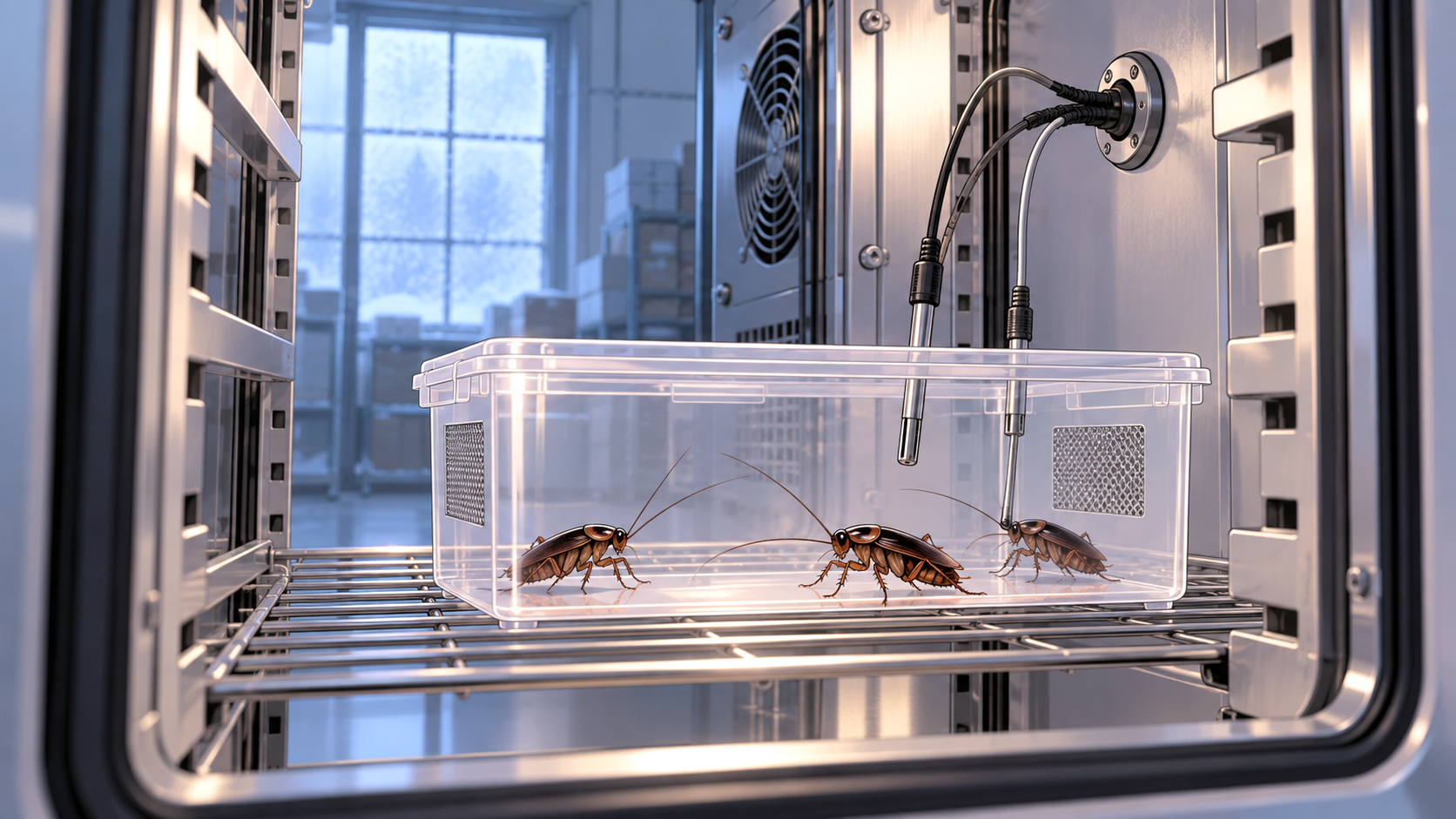
Both extreme heat and sustained freezing can kill cockroaches. For German cockroaches, laboratory data show complete adult mortality after 120 minutes at 44°C (111°F), with much faster mortality as temperatures rise. Cold can also work: guidance for German cockroaches recommends 48 to 72 hours in a 0°F (-18°C) freezer for infested items. Neither result means heating or freezing an occupied home is a simple DIY treatment.
Temperature control depends on two variables working together: how hot or cold the cockroach becomes and how long it remains there. A brief temperature spike may accomplish far less than sustained exposure, while sheltered insects can experience very different conditions from the air surrounding them. Species also vary in thermal tolerance, so a single number cannot accurately describe every cockroach.
Heat Can Kill German Cockroaches Surprisingly Fast
German cockroaches have been tested across several high-temperature exposures. A review of alternative cockroach-management methods found that all adult German cockroaches died after 120 minutes at 44°C, while comparable mortality occurred after only 25 minutes at 51°C (124°F). Earlier experimental work also found that at 43.3°C (110°F), complete mortality required 147 minutes when heat was used alone.
Those numbers reveal why “heat kills cockroaches” needs more precision. Raising the temperature by several degrees can sharply reduce the required exposure period. The cockroach itself must also experience the lethal conditions for the necessary duration. Heating the visible air while a crack, cabinet void, wall cavity, or insulated object remains cooler can leave a refuge.
Cockroaches actively select protected microhabitats. Recent research on German cockroach harborage selection found that heat influences where they choose to shelter. A mobile cockroach exposed to uncomfortable heat may move before receiving a lethal dose if a cooler refuge is accessible. Professional structural heat therefore involves controlled heating and temperature monitoring rather than pointing a portable heater toward the place where cockroaches were last seen.
Your Oven, Hair Dryer and Space Heater Are Not Cockroach Heat Treatments
The lethal-temperature data can make improvised heating sound easier than it is. We would not use an oven, hair dryer, heat gun, space heater, or unattended heating appliance as a cockroach treatment. These devices do not provide controlled, uniform exposure throughout cockroach harborages, and misusing heating equipment can create fire, burn, or property-damage risks.
A room also contains materials that absorb and transfer heat differently. Cabinets, appliances, wall voids, furniture, and stored objects can create cooler zones while exposed surfaces become much hotter. Whole-area thermal treatment therefore has to account for the coldest protected locations, not merely the thermostat reading in the room.
Small movable belongings present a more manageable situation because the treated space can be controlled. Heat chambers designed for pest treatment are different from improvised containers or household appliances. An item also needs to tolerate the required temperature without melting, warping, igniting, or damaging electronics, batteries, medicines, pressurized containers, or other heat-sensitive contents.
Freezing Works Best When the Infested Object Fits in a Freezer
Cold is far more practical for a small object than for a room. The U.S. Navy’s current shipboard pest-management manual recommends placing infested food packages and similar containers in a freezer, stating that cockroaches are killed within 48 to 72 hours at 0°F (-18°C). That gives freezing a useful but narrow role: treating suitable belongings that can remain frozen long enough.
Cold tolerance is not identical across cockroaches. German cockroaches are poorly adapted to cold, yet they can remain active at surprisingly low nonfreezing temperatures. German cockroach nymphs have even been documented living inside a refrigerator where temperatures remained around 7°C to 12°C (45°F to 54°F). A refrigerator can therefore slow cockroach activity without providing the deep cold needed for dependable freezing control.
Cockroaches adapted to colder environments complicate broad claims further. The alpine cockroach Celatoblatta quinquemaculata, for example, is freeze tolerant to approximately -9°C (16°F). Another cockroach studied under freezing stress showed substantial survival after freezing, with mortality increasing over subsequent days. Household pest species and alpine species occupy very different environments, but the comparison demonstrates why “all cockroaches die below freezing” is too crude to use as a control rule.
Winter Weather Does Not Turn a House Into a Freezer
Leaving windows open during cold weather is not equivalent to placing an object in a 0°F freezer for several days. Indoor cockroaches occupy cracks, cabinets, appliances, plumbing areas, wall spaces, and other sheltered locations where temperatures can remain considerably warmer than the outdoor air. A building can become uncomfortable or suffer damage before every protected cockroach experiences a lethal cold exposure.
German cockroaches illustrate this well. They are not very cold tolerant, yet they persist in heated buildings in extremely cold climates. Health Canada notes that German cockroaches have been found in buildings as far north as Nunavut. Their survival there does not demonstrate resistance to Arctic temperatures. It demonstrates how indoor shelter allows a warmth-dependent species to avoid them.
Cold also creates practical risks unrelated to the insects. Intentionally chilling a home during freezing weather can threaten plumbing and damage temperature-sensitive property. We would reserve freezing for appropriate objects that can safely remain in a freezer rather than trying to use winter air as a whole-house cockroach treatment.
Temperature Has to Reach the Cockroach, Not Just the Room
The main weakness of temperature treatment is coverage. A cockroach on an exposed surface and another several centimeters inside a protected void may experience different temperatures even though they occupy the same room. Egg cases can also be concealed away from visible activity, and cockroach eggs are commonly protected inside an ootheca. A temperature treatment that misses protected life stages leaves an opportunity for activity to continue afterward.
The same coverage issue explains why temperature can be excellent for one infested object yet awkward for an entire infestation. A freezer provides a small, controlled environment. Structural heat requires specialized equipment and monitoring. Ordinary household heating and cooling rarely provide comparable control over temperature at every harborage.
When temperature is being considered because conventional pesticides are undesirable, it can form one part of a broader non-conventional cockroach-control approach. Its limitations still need to be respected. Nonchemical does not mean effortless, and a method capable of killing a cockroach under controlled exposure is not automatically capable of reaching an entire hidden population.
Use Temperature Where You Can Control the Exposure
Freezing makes the most sense for small, freezer-safe belongings suspected of carrying cockroaches. Seal the item appropriately to prevent insects escaping during transport, keep it at freezer temperature for the full exposure period, and allow sensitive objects to return to room temperature in a way that limits condensation damage. Items that cannot tolerate freezing need another approach.
Heat is less suitable for DIY improvisation. Localized high temperatures may kill directly exposed cockroaches, but attempting to heat an occupied room or structure evenly introduces safety and coverage problems. If a serious infestation requires whole-area treatment, professional cockroach treatment allows the infestation and available methods to be assessed without experimenting with dangerous heating equipment.
Temperature also does not replace monitoring. After treating an item, cockroach traps can help reveal continuing activity elsewhere, while droppings, shed skins, egg cases, and repeated sightings can indicate an established cockroach infestation. Persistent activity calls for a broader cockroach-control plan rather than repeatedly heating or freezing whatever object happens to contain a visible insect. Integrated pest management combines monitoring, sanitation, exclusion, and appropriate treatment instead of relying on one intervention alone. (epa.gov)
Temperature Questions Worth Knowing Before You Try It
Will putting an infested cardboard box outside during winter kill the cockroaches?
Not dependably. Outdoor temperature fluctuates, sunlight can warm objects, and the center of a packed box may cool more slowly than the surrounding air. A controlled freezer provides a known temperature and sustained exposure that leaving an item outdoors cannot guarantee.
Can cockroaches survive inside a refrigerator?
Yes. Refrigeration is not the same as freezing. German cockroaches have been documented surviving and moving in refrigerated spaces at temperatures well above 0°C, particularly where door seals and equipment provide access to sheltered areas.
Can I freeze electronics that may contain cockroaches?
Do not assume an electronic device can tolerate freezing or the condensation that may occur afterward. Check the manufacturer’s permitted storage temperatures first. If the device falls outside those limits, use another pest-management method rather than risking damage.
Does hot water kill a cockroach?
Sufficiently hot water can expose a directly contacted cockroach to lethal heat, but pouring very hot water into cracks, appliances, walls, or plumbing is not a controlled infestation treatment and can cause burns or property damage. The structural heat data cannot be converted into a safe DIY hot-water recipe.