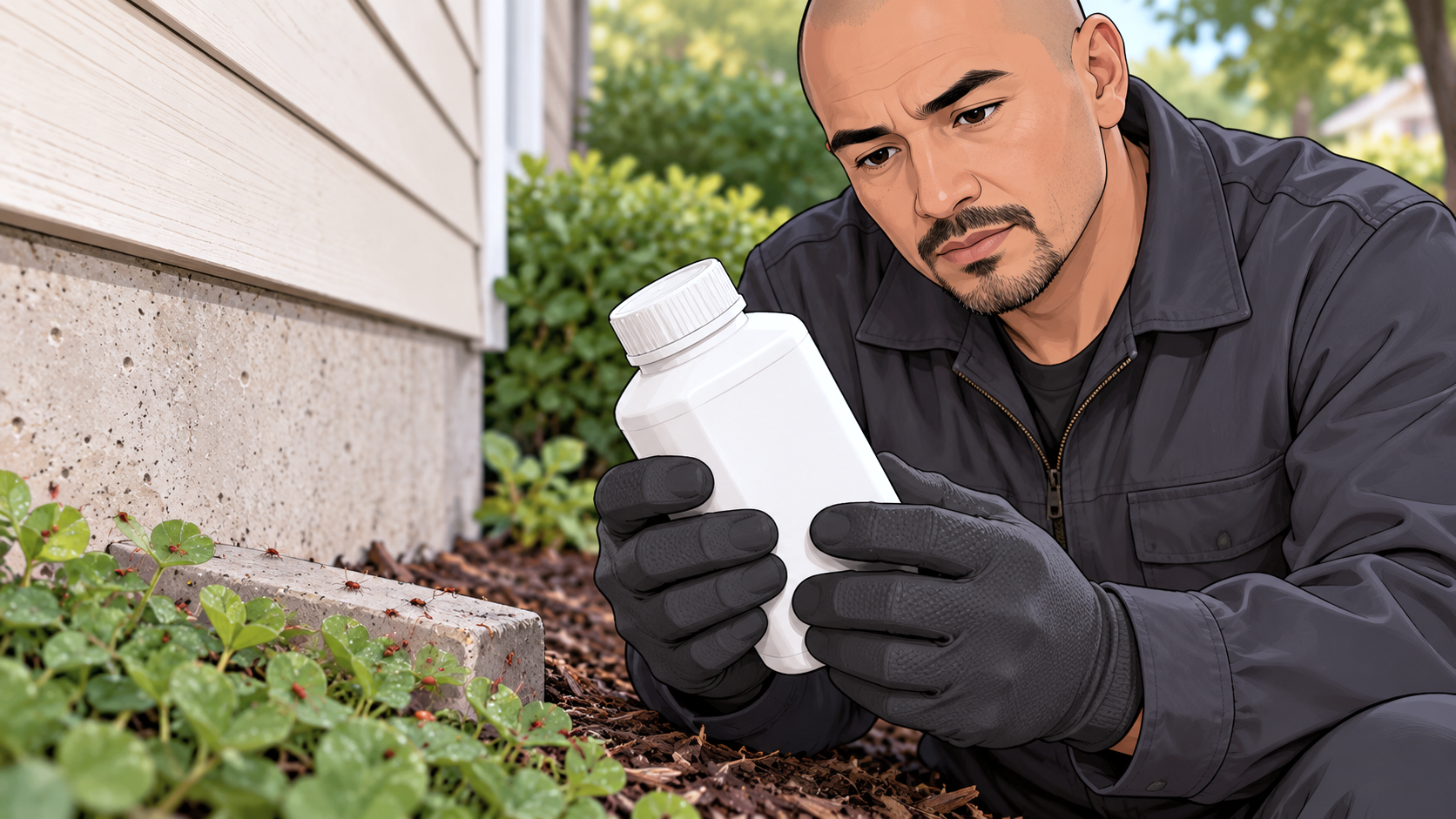
Permethrin kills clover mites. This is not an inference based on its effect on other mites. Clover mites appear as a target pest on permethrin pesticide labels, including products that permit treatment of exterior building surfaces where the mites are active or entering. Permethrin is a synthetic pyrethroid that interferes with normal nerve function in arthropods and can act through contact or ingestion. For a homeowner watching hundreds of mites move from the landscape onto a foundation, permethrin can therefore be a legitimate treatment option. The useful question is not whether the active ingredient can kill them, but whether the particular permethrin product is labeled for clover mites at the place you intend to apply it.
The Label May Put Permethrin Exactly Where Clover Mites Are Migrating
Some permethrin products specifically direct treatment toward the exterior of buildings for clover mites, including foundations, porches, screens, window frames, eaves, patios, garages, and other areas where the pests congregate or may enter. One registered formulation, for example, instructs users to treat the foundation and exterior building surfaces for clover mites.
That application pattern fits a common clover mite problem remarkably well. Mites may leave nearby vegetation and accumulate across brick and siding before squeezing through small structural openings. A labeled exterior treatment can intercept active mites along that route. It should not expand into indiscriminate spraying simply because mites have been seen somewhere on the property. Current pesticide labels can be searched by active ingredient, product name, or registration number, allowing the exact permitted sites to be checked before application.
Permethrin Can Remain Active After the Spray Dries
Permethrin differs substantially from household contact remedies such as alcohol. It does not evaporate rapidly after application, and residues can remain on treated surfaces. In environmental studies, permethrin has shown persistence on surfaces and plant foliage after application, although sunlight, microorganisms, weather, the treated material, and formulation all influence how quickly it breaks down.
Residual activity can be useful when clover mites are arriving over a period of time rather than all at once. It does not guarantee permanent control. A property where clover mites repeatedly reappear may continue producing new migrants after an earlier application has weakened or weathered. Retreatment intervals and maximum application frequencies come from the individual label, not from a general schedule for permethrin.
A Permethrin Product for One Site Cannot Be Borrowed for Another
Permethrin is registered in an unusually wide range of products. Depending on the formulation, it can appear in agricultural pesticides, structural pest products, animal treatments, mosquito-control products, and even insect-repellent clothing. Those uses are not interchangeable.
A product intended for clothing is not a lawn treatment. A livestock formulation is not a foundation spray. A permethrin product labeled for exterior structural pests does not automatically belong on houseplants carrying clover mites. Even products containing the same active ingredient can differ in concentration, formulation, permitted surfaces, dilution instructions, and precautions. Selecting a clover mite insecticide therefore requires reading the entire product label rather than shopping by active ingredient alone.
Keep Permethrin Away From Water and Blooming Plants Unless the Label Allows the Use
Permethrin is highly toxic to fish and aquatic invertebrates. Once it reaches aquatic environments, much of it can bind strongly to sediment, so preventing contaminated runoff is more useful than assuming the chemical will simply disappear after application. Its aquatic toxicity is substantial even at low concentrations.
Bees and other beneficial insects can also be harmed by permethrin. Broad treatment of flowering vegetation to eliminate a nuisance mite can therefore affect organisms that have nothing to do with the infestation. If clover mites are emerging from lawns or other outdoor vegetation, use only treatment sites, timing, rates, and environmental precautions permitted by the chosen label. Targeted applications reduce unnecessary exposure compared with treating every green surface around the house.
Killing the Migrating Mites and Changing the Property Can Work Together
Large numbers of clover mites approaching a house can justify a residual foundation treatment, and permethrin is among the active ingredients recommended for that situation. At the same time, maintaining an 18- to 24-inch vegetation-free strip beside the foundation can discourage clover mites from reaching the building.
The two measures do different jobs. Permethrin controls exposed mites within a labeled treatment area, while closing gaps and reducing favorable vegetation beside the structure lowers the opportunity for later populations to enter. Mites already inside can simply be vacuumed from indoor surfaces rather than extending an exterior pesticide application throughout the room.
Permethrin Questions That Affect Treatment
Does permethrin repel clover mites as well as kill them?
Permethrin can have repellent properties in addition to its contact and ingestion activity, but the degree of repellency depends on the pest and treatment circumstances. A clover mite application should be based on the control directions on the chosen product rather than assuming repellency will create an invisible barrier.
Can permethrin be sprayed directly onto every plant with clover mites?
Only when the specific product label permits application to that plant or site and provides directions covering the target pest. Clover mites feed on many grasses and ornamental plants, but their presence does not authorize use of a structural permethrin product on vegetation.
Can permethrin be applied immediately before rain?
Follow the weather and runoff restrictions on the product label. Preventing pesticide from entering drains and surface water is particularly important with a chemical that is highly toxic to aquatic organisms.
Are permethrin and bifenthrin the same pesticide?
No. Both are synthetic pyrethroids, but they are different active ingredients with their own formulations, environmental behavior, labels, and permitted uses. A direction printed on a bifenthrin product cannot be applied to permethrin simply because both belong to the same insecticide class.