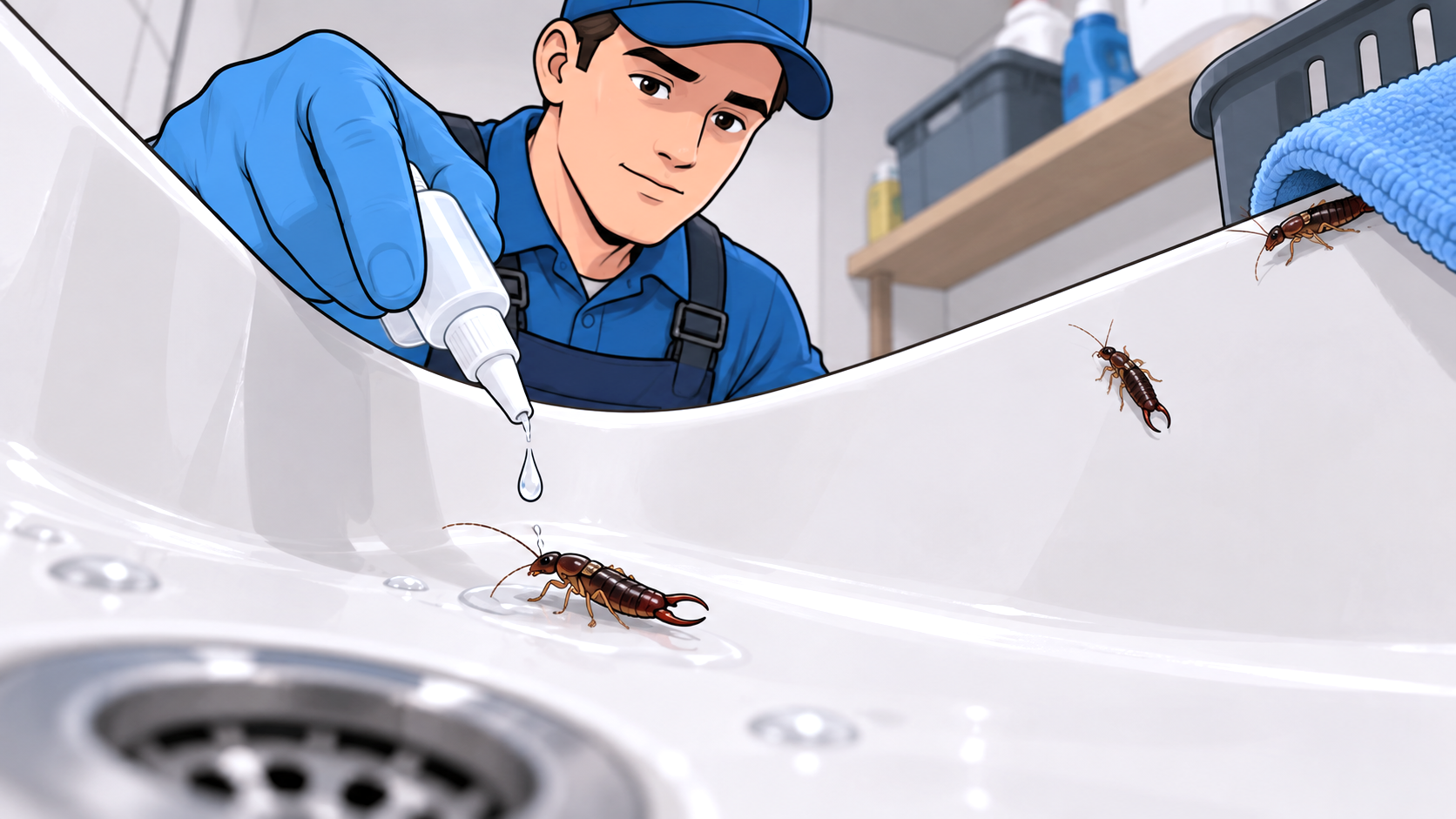
Rubbing alcohol creates an easy trap in pest control. A household liquid can kill an insect when sprayed directly on it, so it starts to look like a treatment for the pest itself. Those are two different standards. With earwigs, the more useful question is not whether an alcohol-soaked insect can die, but whether spraying rubbing alcohol around your home or garden gives you a sensible way to control earwigs.
Rubbing alcohol can kill insects through direct contact, but we do not recommend using household rubbing alcohol as an earwig treatment. It evaporates quickly, provides no useful residual control, and is highly flammable. Killing an exposed earwig does not address the sheltered outdoor population or entry conditions responsible for continuing activity.
A Direct Kill Does Not Make Rubbing Alcohol a Good Earwig Treatment
Earwigs spend much of the day in protected locations and become more active at night. They can shelter beneath mulch, boards, plant debris, flowerpots and other dark, protected objects. Their flattened bodies also allow them to use narrow spaces for shelter. A liquid that only matters when it reaches the insect therefore starts with a major limitation.
Rubbing alcohol illustrates that problem well. Isopropyl alcohol can kill insects it contacts, but it is highly volatile. Once it evaporates, you have not created the kind of lasting treatment that continues killing earwigs moving through the area later. The same limitation has led to warnings against using rubbing alcohol for other household insects because a contact kill does not eliminate an infestation.
That distinction is especially important with earwigs because seeing one indoors does not normally mean you need to treat an indoor breeding population. European earwigs do not reproduce indoors. When they enter houses, they are generally nuisance invaders arriving from outside. Spraying one with alcohol may remove that individual, but it does nothing about the route another earwig could use tomorrow.
In our view, that makes rubbing alcohol a solution to the least difficult part of the problem. An exposed earwig can already be vacuumed, swept up or physically removed. The real work begins when you want the sightings to stop.
The Fire Risk Changes the Calculation
The biggest reason not to turn rubbing alcohol into a homemade earwig spray is its flammability. Isopropyl alcohol produces flammable vapor and should be kept away from ignition sources. Using it as a widespread indoor pest spray creates a hazard that is hard to justify when simpler earwig-control methods are available.
This is not merely a theoretical warning attached to alcohol because it sounds cautious. Improper use of rubbing alcohol for insect control has been associated with house fires. Guidance for household pest products also stresses keeping flammable liquids away from furnaces, grills, vehicles and other ignition sources.
That makes some seemingly convenient application locations particularly poor choices. Spraying alcohol around a kitchen, utility area, garage or anywhere close to heat, sparks or open flames trades a nuisance insect for an avoidable fire hazard. Spraying large amounts throughout rooms also increases unnecessary vapor exposure.
There is another distinction worth keeping clear. Isopropyl alcohol can appear as an ingredient in formulated products, but that does not mean a bottle of rubbing alcohol from the medicine cabinet should be repurposed as a household insecticide. Registered pesticide products come with directions specifying where and how the product can be used. Household rubbing alcohol does not acquire those instructions simply because alcohol can affect an insect.
Earwig Biology Makes Contact Sprays a Poor Match
Imagine finding six earwigs beneath a damp board beside the house. You could try to spray each one individually with rubbing alcohol, but the discovery itself is more useful than the kill. The board has shown you where earwigs are finding daytime shelter.
Earwigs favor protected hiding places and can become abundant where suitable shelter and moisture overlap. Instead of chasing each exposed insect, remove unnecessary hiding places and investigate why that particular area is supporting them. Our guide to what attracts earwigs explains how shelter, moisture and available food can combine around a property.
Trapping also fits their behavior better than an improvised alcohol spray. Corrugated cardboard, rolled newspaper and similar refuge traps give earwigs a protected place to hide during the day. Checking those traps regularly can both reduce numbers and reveal where activity is concentrated. Our DIY earwig trap guide covers this approach in more detail.
Where earwigs are damaging plants, the first step is still to confirm that they are responsible. Their feeding can resemble damage from other garden pests, so checking affected plants at night with a flashlight is more informative than spraying every earwig-sized insect you encounter. Treatment makes more sense when it responds to confirmed, unacceptable plant damage.
Rubbing Alcohol Is an Especially Poor Choice for Plants
Alcohol sometimes appears in houseplant advice because carefully applied alcohol can be used against certain small plant pests, particularly mealybugs. That specific use should not be expanded into a general rule that alcohol is suitable for any insect found on a plant.
Alcohol can injure plant tissue. Guidance for managing houseplant pests warns that alcohol applied to plants may cause leaf burn. Earwigs make the tradeoff even less attractive because they are large enough to remove physically, and finding one around a container does not prove the plant needs to be sprayed at all.
Potted plants can provide the dark, protected conditions earwigs use for shelter. Consequently, an earwig beneath a pot or around its base may simply be hiding there during the day. Our guide to getting rid of earwigs in potted plants focuses on distinguishing sheltering from actual plant feeding before choosing a control method.
If earwigs are damaging outdoor plants, reducing nearby hiding places and using traps can target the insects without experimenting with rubbing alcohol on leaves. Where pesticide treatment becomes necessary, use a product labeled for the pest and the intended site. The pesticide label determines how the product may be used, including the locations, precautions and application directions that apply.
For Indoor Earwigs, Find the Next One Before It Arrives
Repeatedly spraying earwigs after they enter a house puts you permanently one insect behind. A better approach is to use repeated sightings as a reason to investigate the exterior.
Start near the part of the house where activity keeps appearing. Earwigs can enter through small gaps around doors, windows and other exterior openings. Outdoor shelter close to those locations can increase the opportunity for insects to reach the building. Our guide to why earwigs appear in the house explains why indoor sightings often point back outside rather than toward an established indoor population.
Physical removal is enough for individual stragglers. For continuing activity, exclusion matters more. Seal accessible gaps, improve poorly fitting doors or screens where necessary, and reduce unnecessary protected debris close to likely entry areas. These steps are central to keeping earwigs out of the house because they interfere with entry instead of waiting for an insect to appear indoors.
This is also why we would choose a vacuum over rubbing alcohol for an earwig crossing the living-room floor. Both can remove the individual insect from the immediate situation, but only one avoids introducing a flammable liquid for a job that never required it.
Skip the Alcohol and Treat the Actual Earwig Problem
Rubbing alcohol is a poor earwig-control strategy even though direct contact can kill insects. Its effect depends on reaching the insect, it evaporates rapidly, and its flammability adds a serious disadvantage that ordinary physical removal does not have.
For one earwig indoors, remove it. For repeated indoor sightings, investigate entry points and nearby outdoor shelter. In a garden, confirm actual plant damage and concentrate trapping or other control around the affected area. A larger outdoor population is better addressed by reducing favorable hiding places and using established earwig-control methods than by chasing individual insects with a spray bottle.
That is the practical test we would use for household remedies. Killing the earwig in front of you matters much less than changing whatever keeps putting earwigs in front of you.
Other Questions About Rubbing Alcohol and Earwigs
Can rubbing alcohol repel earwigs?
Do not rely on rubbing alcohol as an earwig repellent. Its rapid evaporation makes it unsuitable as a persistent barrier around doors, windows, garden beds or other areas where you want continuing protection. If your goal is deterrence rather than killing individual insects, our guide to deterring earwigs focuses on changes to shelter and conditions that remain relevant after a sprayed liquid has dried.
Should I pour rubbing alcohol into cracks where earwigs are hiding?
No. Pouring a flammable household liquid into cracks creates unnecessary risk and still does not correct why earwigs are using that location. Where a crack is functioning as an entry point into the house, exclusion is the more useful long-term response.
Can I mix rubbing alcohol with another homemade earwig killer?
We would not recommend creating chemical mixtures for earwig control. Household products can have hazards that change when they are combined, and an improvised mixture has no pesticide label telling you where it can be applied or how it should be handled. Use established nonchemical methods or a pesticide specifically labeled for the intended pest and location.
What should I use instead when I find several earwigs at once?
The location should determine your response. Indoors, vacuuming gives you a quick way to remove multiple earwigs without spraying a flammable liquid. Outdoors, several earwigs concentrated beneath an object or near a plant make that area worth inspecting for shelter, moisture and plant damage. Traps can then help reduce activity without requiring you to spray each insect individually.
One thought on “Does Rubbing Alcohol Kill Earwigs?”