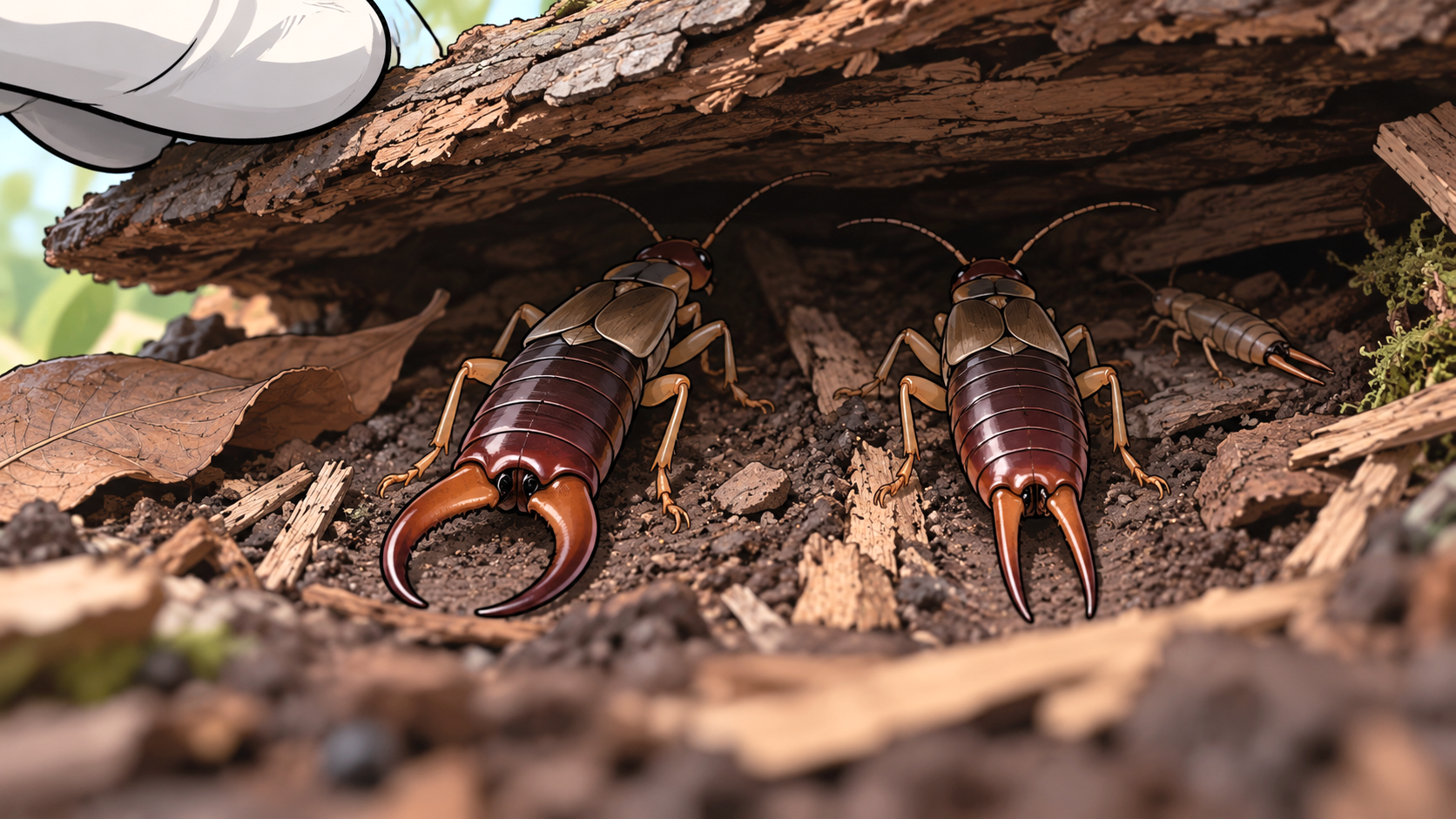
The easiest way to tell a male earwig from a female is to look at the pincers at the rear of the abdomen. In adult European earwigs, males have thicker, strongly curved forceps, while females have narrower forceps that are much straighter. Body color alone is not a reliable way to separate the sexes.
That difference is obvious once you know where to look. In fact, you usually don’t need to examine the antennae, wings, or overall body shape at all. The forceps provide such a useful distinction that they’re the first feature we’d check on a clear photo of an adult European earwig.
Male Earwigs Have Curved Pincers
Adult male European earwigs, Forficula auricularia, have strongly curved forceps at the end of the abdomen. Viewed from above, the pair bends inward and can form a broad arc behind the insect. The structures are technically called cerci, although “pincers” and “forceps” are the more familiar names.
Male cerci can also be surprisingly variable. Some males have relatively short, sharply curved forceps, while others develop much longer ones. In European earwigs, male forceps have been measured at about 5 to 9.5 millimeters long, so two males can look noticeably different even when their bodies are similar in size.
That variation is the main reason we wouldn’t use pincer length by itself to sex an earwig. Curvature and overall shape are more useful than simply asking which insect has the longest pincers. A short-forceps male can still show the characteristic male curve.
Female Earwigs Have Straighter Pincers
Female European earwigs have slender forceps that are comparatively straight. They may bend slightly, particularly toward the tips, so “straight” shouldn’t be interpreted as perfectly parallel rods. The contrast becomes clearest when a female and male are placed side by side.
From above, a female’s cerci generally extend backward with much less of the pronounced inward bow seen in males. That gives the female rear end a narrower appearance, while the male’s curved forceps can make his rear profile look considerably broader.
The difference is useful enough that sex can often be determined from a good photograph. You need to see the back of the insect clearly, though. A side view, blurry image, or earwig partially hidden beneath an object can make the cerci appear more or less curved than they really are.
The Quickest Male vs. Female Earwig Check
When we want to distinguish the sexes, we would start at the rear of the insect rather than comparing the entire body. A mature European earwig with strongly curved, robust forceps is male, while an adult with slimmer, nearly straight forceps is female. The same distinction appears consistently in identification descriptions of the species. (extension.unr.edu)
This approach is much more dependable than trying to judge sex from color. Both males and females share the reddish-brown coloration characteristic of adult European earwigs, so a darker individual isn’t automatically male and a lighter one isn’t automatically female. If color is what caught your attention, our guide to earwig colors deals with that variation separately.
Body length isn’t a good shortcut either. Adults naturally vary, and male forceps themselves can add substantial apparent length to the insect. If you’re trying to judge the insect’s actual size, how big earwigs get explains why measuring the body and measuring the whole insect can give very different impressions.
Why Male Earwig Pincers Are So Different
The difference isn’t just cosmetic. Male European earwigs use their cerci during interactions with other earwigs, including fights with rival males. Their forceps are therefore part of a sexually dimorphic structure, meaning the same body part develops differently in adult males and females.
Research on European earwigs has found substantial variation even within males. Some develop relatively modest curved forceps, while others have much more exaggerated versions. That makes an especially large pair impressive to look at, but it doesn’t represent what every male must look like.
The cerci have other functions as well. Earwigs use them for defense and other behaviors, so their role extends beyond sex identification. Those functions are covered in more detail in what earwig pincers are actually for.
Baby Earwigs Can Complicate the Comparison
The male-versus-female pincer rule works best with adult earwigs. Nymphs haven’t yet developed the distinctive adult forceps shape, and young European earwigs have straighter cerci. That can make an immature male resemble an adult female if you focus only on the rear appendages.
Size and overall development provide important context. Nymphs are smaller than adults, and their bodies change through successive molts before reaching the mature form. Their wings aren’t fully developed either, which gives you another clue that you’re looking at an immature insect rather than a small adult female.
This is one place where people can easily make the wrong call from a photograph. Before labeling a straight-pincered specimen female, first make sure it actually looks mature. Our guide to what baby earwigs look like covers the immature stages in more detail.
Male and Female Earwigs Otherwise Look Quite Similar
Once you move away from the forceps, separating the sexes becomes much less straightforward. Adult males and females share the same basic elongated earwig body plan, long antennae, six legs, short forewings, and reddish-brown coloration. The rear cerci are therefore doing most of the useful work in a visual sex identification.
That’s why we wouldn’t recommend trying to sex an earwig from a photograph that doesn’t show the tip of the abdomen. You may still be able to identify the insect as an earwig using its overall anatomy, but determining male or female becomes much less reliable without a clear view of the forceps.
If identification itself is uncertain, start with what earwigs look like before trying to determine sex. Sexing the wrong insect perfectly still leaves you with the wrong identification.
Does One Sex Look More Dangerous?
A male can certainly look more intimidating because his curved forceps are often larger and more conspicuous. That appearance doesn’t mean male earwigs should be treated as a separate danger category. The difference in pincer shape reflects sex and the roles those structures play in earwig behavior, not a special adaptation for attacking people.
This is a useful distinction because people naturally equate larger pincers with a more dangerous insect. With European earwigs, those dramatic forceps tell you far more about the animal’s sex than about the level of threat it presents.
Questions about human contact are better answered separately. Our guide to whether earwigs bite or pinch covers what those forceps can actually do when an earwig is handled or threatened.
How to Sex an Earwig Without Handling It
There’s rarely a reason to pick up a live earwig simply to find out whether it’s male or female. A clear overhead photograph usually gives you a much better view of the forceps anyway. Place or photograph the insect against a plain background if possible, then enlarge the image and concentrate on the shape of the cerci.
For an adult European earwig, strongly bowed forceps point toward a male, while narrow and nearly straight ones point toward a female. If the insect is very small and its forceps haven’t developed the adult shape, treat age as the first question rather than forcing a male-or-female identification.
We find that approach more useful than trying to memorize every variation. You’re really making two decisions in order: first, whether the specimen is mature, and second, what shape the adult forceps have.
Other Questions About Male and Female Earwigs
Can male and female earwigs both fly?
Adult European earwigs of both sexes possess wings, although the species rarely flies. The wings are folded beneath very short forewings, which is why they can be difficult to notice on either sex. Our guide to earwig wings and flight explains how they fit beneath those small covers.
Which sex looks after the eggs?
The female does. Female European earwigs remain with their eggs in an underground nest and care for them, including tending the clutch before it hatches. Maternal care continues into the early nymph period, making earwigs unusual among the household insects people commonly encounter.
Can one male earwig have much bigger pincers than another male?
Yes. Adult male European earwigs show substantial natural variation in forceps length and shape. A male with relatively short curved forceps and one with very long curved forceps can both be normal adult males, so the curve matters more than simply comparing length.
Can you tell whether an earwig is male or female from its color?
Color isn’t a dependable sex characteristic in European earwigs. Both sexes share the species’ general adult coloration, so the rear forceps provide a much better visual clue.
2 thoughts on “Male vs. Female Earwigs: How to Tell Them Apart”