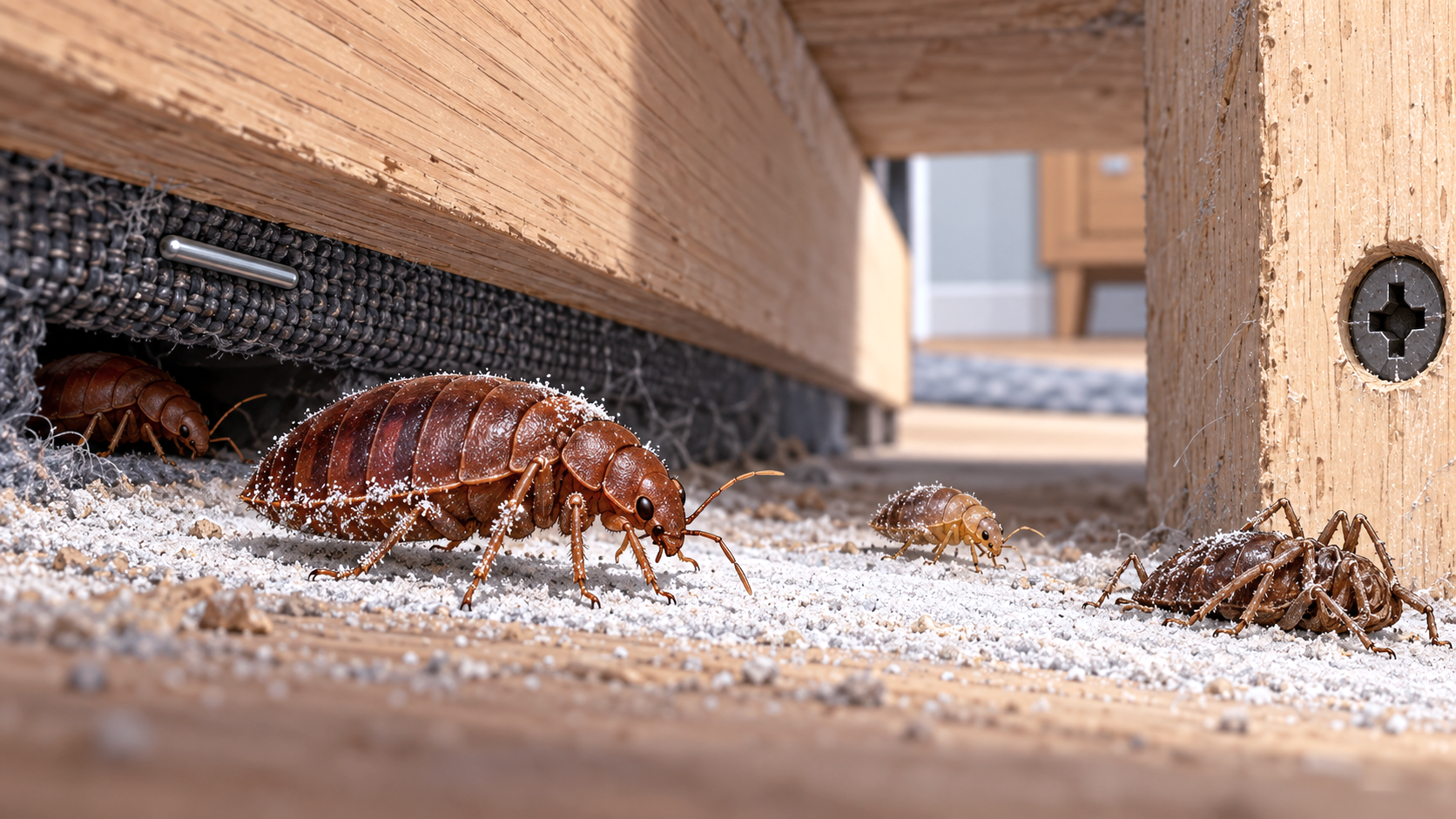
The words “silica gel” usually bring to mind the tiny packets packed inside shoe boxes, electronics, and medicine bottles. That creates an odd situation with bed bugs because silica really can be a highly effective bed bug killer, but that does not make a packet from a new pair of shoes a DIY pesticide.
Yes, silica gel can kill bed bugs when it is formulated as a pesticide dust labeled for bed bug control. It works as a desiccant, damaging the insect’s protective waxy layer so it loses water and dies from dehydration. Research on silica-based insecticide dust has found very high mortality after bed bugs contact treated surfaces.
The more useful question, then, is not simply whether silica works. It is which silica product you are talking about and whether bed bugs will actually encounter it.
The Silica Gel Packet in Your Drawer Is Not the Treatment
Silica gel is a form of silicon dioxide used for many purposes because it can absorb moisture. Pest-control formulations take advantage of its drying properties, but a consumer desiccant packet and a registered insecticide dust are not interchangeable products.
That distinction is easy to miss. Someone searching “does silica gel kill bed bugs?” may already have packets around the house and assume the contents can simply be scattered around a mattress. We would not make that substitution. For pest control, use a pesticide product specifically registered and labeled for bed bugs, and use it only in the locations and manner permitted by its label.
A real-world example is CimeXa Insecticide Dust, which contains 92.1% silicon dioxide as amorphous silica and is formulated as an insecticide dust. Its manufacturer describes the material as engineered to adhere to crawling insects and absorb the oils and moisture associated with their protective outer layer.
That is a very different proposition from opening miscellaneous consumer silica packets. The product formulation and pesticide label are part of what makes an insecticide dust a bed bug treatment.
Silica Does Not Need to Poison a Bed Bug
Silica dust is interesting because it attacks one of the bed bug’s basic physical defenses rather than relying on the kind of neurotoxic action associated with many conventional insecticides.
A bed bug’s exterior has a waxy protective coating that helps limit water loss. Desiccants damage that protective outer coating. Once the barrier is compromised, the insect progressively loses water and dies from dehydration.
This gives silica-based dust a useful role in a pest that has developed substantial resistance to several insecticide classes. In laboratory research involving pyrethroid-resistant and susceptible common bed bugs, a silica gel dust produced complete mortality at the tested label rate. More recent work with resistant tropical bed bugs has likewise found silica-based desiccant dust particularly effective under multiple exposure conditions.
This does not mean every dusty substance that dries things out will control bed bugs. It means a properly formulated silica desiccant has a well-established physical route to killing them.
A Bed Bug Only Has to Cross the Dust
One of the easiest mistakes with insecticide dust is assuming more powder must mean better control. Silica does not need to look like a miniature snowdrift around the bed.
The useful event is contact. A bed bug leaves a hiding place, crosses a treated area, and picks up fine particles on its body. Research comparing several insecticidal dusts found that the silica gel product CimeXa caused 100% mortality even in the study’s brief-exposure test. Exposed bed bugs could also transfer dust to untreated bugs in the laboratory.
That changes how we think about silica treatment. You are not trying to smother a bed bug beneath powder. You are trying to create label-compliant deposits where moving bed bugs are likely to contact them.
Bed bugs spend much of their time hidden in narrow protected spaces around sleeping and resting areas. Our guides to bed bugs in baseboards, bed bugs on mattress areas, and bed bugs in wood furniture show why treatment has to account for where the insects actually hide and travel.
However, pesticide placement is not something to improvise. The product label determines which cracks, crevices, voids, furniture areas, or other locations can legally and safely receive a particular dust.
Silica Gel and Diatomaceous Earth Are Not the Same Dust
Silica gel and diatomaceous earth often get bundled together because both are desiccant dusts. They are not the same material, and research has repeatedly found meaningful differences in how quickly particular formulations kill bed bugs.
In one comparison of multiple insecticidal dusts, silica gel was the only tested product to produce 100% mortality across all three exposure methods. The study included a 100% diatomaceous earth product among the alternatives. Another experiment comparing silica gel with a diatomaceous earth product against susceptible and pyrethroid-resistant bed bugs found that both ultimately produced complete mortality at the tested label rates, but the silica formulation killed substantially faster.
That does not make diatomaceous earth useless against bed bugs. It means “desiccant dust” is a category rather than a guarantee that every product in it performs identically.
The distinction also matters when shopping. Ingredient names, formulations, labels, and permitted uses deserve more attention than a front label simply promising that a powder “dries out insects.”
Silica Has an Advantage Against Insecticide-Resistant Bed Bugs
Resistance is one reason silica dust deserves more attention than many improvised bed bug remedies. Bed bugs can develop resistance to insecticides that depend on specific biochemical targets. A desiccant instead attacks the physical protection that keeps the insect from losing water.
Tests involving field populations resistant to deltamethrin found that exposure to silica gel dust still caused greater than 95% mortality after 72 hours. That makes silica particularly useful within a broader control program where resistance can undermine some conventional insecticides.
There is a nuance worth keeping. Bed bug cuticle characteristics can affect how quickly desiccants act under some exposure conditions. Research has documented delayed mortality in resistant strains with cuticle-related differences, especially at reduced exposure. However, silica-based dust has continued to perform strongly in studies involving resistant bed bugs.
So we would not describe silica as magical or resistance-proof in the sense that every bed bug dies at exactly the same speed. Its strength is that its physical mode of action sidesteps the conventional chemical-resistance problem that can make some bed bug pesticides perform poorly.
Killing Bed Bugs With Silica Is Not the Same as Eliminating an Infestation
A laboratory result tells us whether exposed insects die. A bedroom presents a harder question: how many of the bed bugs actually cross treated material?
Bed bugs can occupy mattress seams, bed frames, upholstered furniture, baseboards, wall voids, and other protected spaces. Eggs and bugs hidden away from a treated route can remain part of the infestation. That is why we would not turn a strong silica efficacy result into the claim that spreading one dust automatically gets rid of bed bugs.
Field research illustrates the difference. In apartments receiving nonchemical control plus silica gel dust, mean bed bug counts fell by 99% after six months. Yet complete eradication occurred in only 40% of those apartments during the study. The combined program outperformed nonchemical treatment alone, but the results also show why “kills bed bugs” and “eliminates every infestation” should never be treated as the same claim.
This is one of the strongest reasons to combine control methods. Inspection establishes where activity is occurring. Vacuuming can physically remove accessible bugs, encasements can change how beds are managed, interceptors can help monitor activity, and appropriately selected pesticides can target additional hiding and travel areas. Our broader guide to DIY versus professional bed bug treatment covers that decision in more depth.
The Biggest Silica Mistake Is Turning a Fine Dust Into an Exposure Problem
Silica insecticide dust works because its particles are extremely fine. That same physical form is why careless application is a bad idea.
Pesticide labels determine where a dust can be applied and what precautions are required. Bed bug desiccants should not simply be spread across living surfaces because a homeowner wants maximum coverage. Current bed bug safety guidance emphasizes using only registered products and following the exact locations and application directions on the pesticide label.
This also rules out the idea that any random desiccant powder is suitable. Bed bug control guidance specifically recommends using desiccants registered as pesticides rather than repurposing materials intended for unrelated uses.
We think that is the practical dividing line for this entire topic. Silica is not a questionable home remedy in the same category as baking soda, salt, or improvised household sprays. Silica-based insecticide dust is a legitimate bed bug control tool. However, its legitimacy comes with an actual pesticide label, not permission to scatter arbitrary silica around a bedroom.
Use Silica as a Route Treatment, Not a Room-Wide Powder
Before applying anything, first check carefully for bed bugs and identify the areas where activity is concentrated. Finding the harborages and likely travel routes gives a desiccant treatment a purpose. Otherwise, even an effective dust can end up sitting where few bed bugs ever contact it.
Then choose a registered silica-based pesticide that specifically lists bed bugs and follow its current label. Do not substitute silica packets, industrial silica, cat litter, or another silica-containing material simply because the ingredient sounds similar. The pesticide formulation is the product being evaluated and regulated, not the word “silica” by itself.
Finally, keep monitoring after treatment. Bed bug control rarely rewards the assumption that one application finished the job. Interceptors and repeat inspections can help determine whether activity is declining, while continued sightings can reveal untreated harborages or a larger infestation that needs a more comprehensive approach. Our guide to how to tell if bed bug treatment worked explains what evidence matters after treatment.
Other Questions About Silica Gel and Bed Bugs
Can I put silica gel packets under my mattress to kill bed bugs?
Silica packets are designed to control moisture in packaging, not to serve as bed bug pesticide treatments. Keeping intact packets under a mattress should not be confused with placing a labeled insecticide dust where bed bugs will contact it.
Does silica gel kill bed bug eggs?
Do not rely on silica dust as a direct egg treatment. Desiccant control depends heavily on insects contacting treated deposits, while bed bug eggs remain attached where females deposit them. Continued monitoring matters because newly hatched nymphs may later move across treated routes.
Can silica dust stop working if it gets wet?
Moisture can interfere with a dry desiccant treatment, so the specific product’s label and storage directions matter. Silica insecticide dust is best treated as a label-directed pesticide rather than a powder that can be applied indiscriminately in damp or wet locations.
Will silica gel keep bed bugs from biting immediately?
No. A silica-based dust kills after contact and dehydration, so it should not be treated as an instant protective barrier around a sleeping person. Someone who needs immediate control of an active infestation should focus on a complete bed bug treatment strategy rather than expecting silica alone to stop bites that night.
Can I use silica gel together with other bed bug treatments?
Bed bug management commonly combines multiple compatible methods, but pesticide combinations and placement must follow each product’s label. More products do not automatically produce better control, especially when poor placement leaves the actual harborages untreated.
One thought on “Does Silica Gel Kill Bed Bugs?”