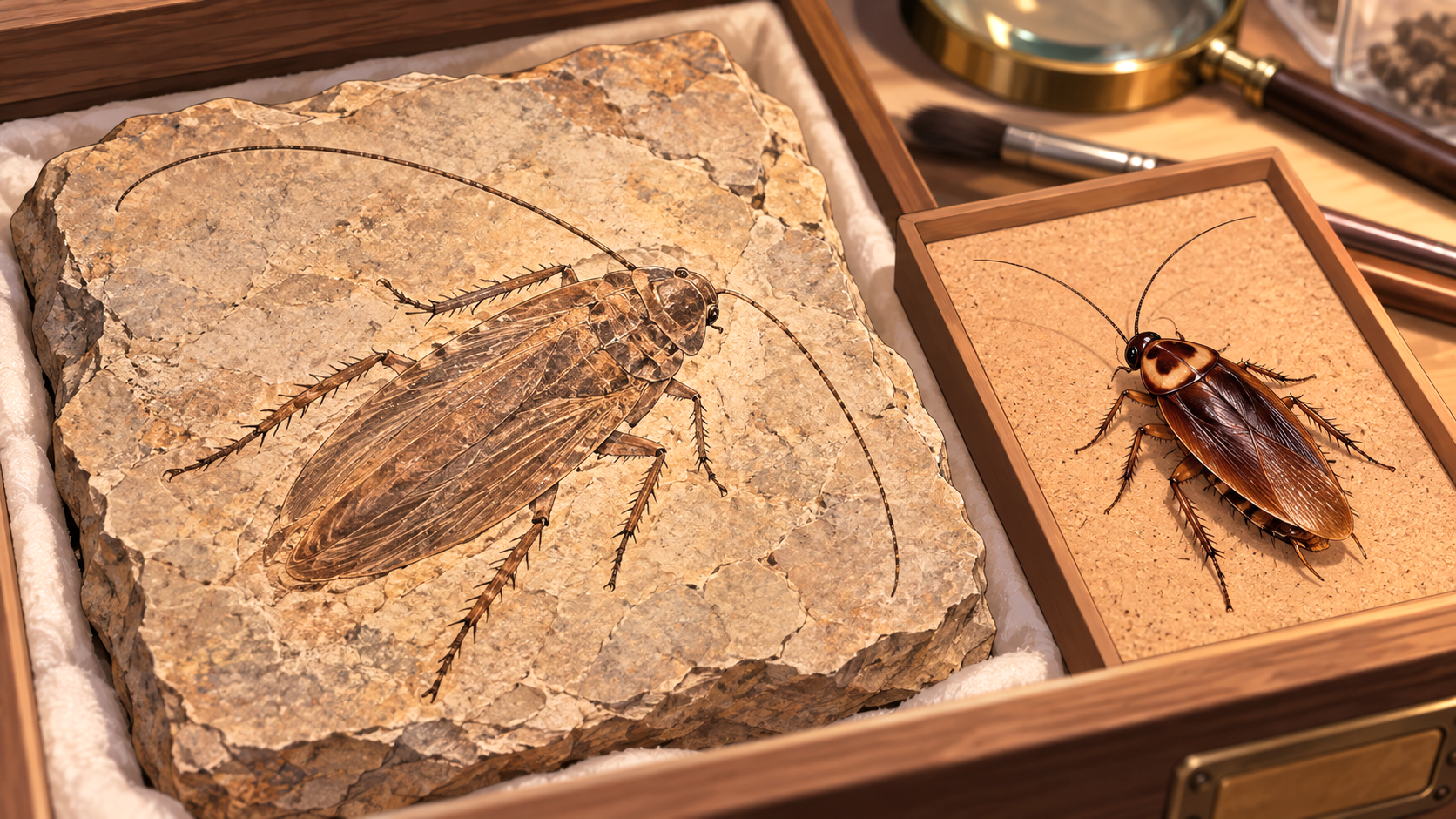
Cockroach-like insects have existed for approximately 320 million years, dating back to the Carboniferous Period, long before dinosaurs appeared. However, the insects preserved in those ancient rocks were not necessarily the same as modern cockroaches. Many belonged to extinct evolutionary branches that also share ancestry with praying mantises and termites.
Modern cockroach lineages developed considerably later. Fossils recognizable as members of living cockroach groups appear in Mesozoic deposits, and genetic studies place the ancestry of modern cockroaches somewhere around 200 million years ago, although estimates differ. The familiar claim that cockroaches have remained unchanged for 300 million years is therefore misleading.
The First Cockroach-Like Insects Appeared During the Carboniferous
The earliest widely recognized cockroach-like fossils date to approximately 315–320 million years ago, during the late Carboniferous Period. At that time, extensive swamp forests occupied parts of the ancient continents, and arthropods were already diverse.
Paleontologists commonly call these ancient insects roachoids or blattopterans. Their flattened bodies, wings, and general appearance resembled cockroaches, which explains why they were historically classified alongside them.
The 2018 study of cockroach diversification and geographic history places the appearance of fossil roachoids around 315–318 million years ago. Their abundance in some Carboniferous deposits contributed to the longstanding idea that cockroaches originated during this period.
However, the anatomical similarities do not establish that those fossils belonged to the modern cockroach lineage. Many retained structures that distinguish them from living cockroaches, while others lack enough preserved anatomical detail for confident classification.
Their fossils establish the antiquity of the broader cockroach-like body form, not an uninterrupted history of today’s species.
Why Ancient Roachoids Were Not Necessarily True Cockroaches
One prominent difference concerns reproduction.
Many Carboniferous roachoids possessed a long external ovipositor, an appendage used to deposit eggs. Living cockroaches lack this prominent external egg-laying structure and instead package their eggs inside protective cases called oothecae.
The distinction provides paleontologists with an important anatomical clue. A fossil resembling a cockroach in its wings and body shape may nevertheless belong outside the evolutionary group containing modern cockroaches.
Researchers examining fossil evidence and genetic estimates of dictyopteran evolution explain that the relationships of many ancient roachoids remain disputed. Some may represent early relatives of the common ancestor of cockroaches and mantises rather than ancestors belonging specifically to the modern cockroach branch.
Wing venation also provides evidence, although similar arrangements can occur in related extinct groups. Fossils preserving only wings are consequently difficult to place with certainty.
The development of cockroach egg cases reflects a reproductive arrangement different from that of many ancient roachoid insects, even though both groups share broader evolutionary ancestry.
When Did Modern Cockroaches First Evolve?
Modern cockroaches emerged after their ancient cockroach-like relatives, but scientists disagree about the exact date.
A major 2019 phylogenomic study estimated that the common ancestor of living cockroaches and termites existed approximately 205 million years ago, around the boundary between the Triassic and Jurassic periods. Its researchers also concluded that many major branches of the group diversified during the Cretaceous.
The study published in Proceedings of the Royal Society B combined nuclear genetic data, fossils, and evolutionary dating methods to reconstruct these relationships.
A separate analysis published in 2015 proposed substantially older dates for some ancestral branches. Its authors estimated that the lineage shared by cockroaches and termites diverged from its relatives roughly 275 million years ago. Differences in fossil calibration and evolutionary assumptions contributed to the competing timelines.
A 2022 reanalysis of cockroach phylogeny using mitochondrial genomes estimated a Middle Jurassic origin for the crown group of Blattodea, emphasizing how uncertain dates can become when fossils are assigned to disputed evolutionary branches.
These estimates concern ancestral lineages rather than the first appearance of individual modern species. No scientist can identify the precise year in which the first modern cockroach evolved.
What the Fossil Record Reveals About Cockroach History
Fossils provide physical evidence of the insects that existed at particular times, whereas molecular dating estimates when ancestral lineages diverged.
The two approaches do not always produce identical ages.
| Geological period | Approximate dates | Significance for cockroach evolution |
|---|---|---|
| Carboniferous | 359–299 million years ago | Numerous cockroach-like insects appear in the fossil record |
| Permian | 299–252 million years ago | Ancient roachoid lineages continue diversifying |
| Triassic | 252–201 million years ago | Important ancestral branches are inferred to have existed |
| Jurassic | 201–145 million years ago | Molecular studies place major cockroach ancestry and diversification within or near this interval |
| Cretaceous | 145–66 million years ago | Recognizable members of modern cockroach lineages are preserved in fossils |
| Cenozoic | 66 million years ago to present | More recent cockroach lineages continue diversifying |
The oldest widely accepted fossils representing living cockroach families occur in Early Cretaceous deposits, approximately 140 million years old, according to research on cockroach biogeography and fossil history.
Much younger fossils can provide exceptionally detailed anatomical evidence. One species, Stavba jarzembowskii, was described from approximately 99-million-year-old amber in Myanmar. The 2020 fossil description in Cretaceous Research documented its eyes, wings, and other features preserved in resin.
Amber specimens are particularly valuable because they may preserve three-dimensional details that compression fossils do not. Even so, an exceptionally complete specimen represents an extinct insect, not necessarily a direct ancestor of any cockroach alive today.
Cockroaches Existed Long Before Dinosaurs
The first dinosaurs appeared approximately 230 million years ago, during the Late Triassic. Cockroach-like insects had already existed for roughly 90 million years by then.
During the Jurassic and Cretaceous, ancestral cockroach lineages continued evolving alongside dinosaurs and other animals. Their descendants survived the mass extinction approximately 66 million years ago that eliminated non-avian dinosaurs.
This does not mean individual cockroach species lived continuously through those geological periods. Species disappeared, populations diverged, and new lineages emerged. The evolutionary relationships within Blattodea show extensive diversification rather than a single unchanged form persisting through time.
Termites are a particularly revealing part of this history. Genetic studies demonstrate that they evolved within the cockroach lineage, with wood-feeding cockroaches such as Cryptocercus among their closest living relatives. The evidence linking termites to wood-feeding cockroaches changed how scientists understand the group’s evolutionary tree.
The modern scientific classification of cockroaches consequently places termites within Blattodea rather than treating them as a completely separate evolutionary order.
Have Cockroaches Really Remained Unchanged for 300 Million Years?
Although the characteristic cockroach body shape has persisted for an exceptionally long time, cockroaches have continued evolving.
The flattened body, long antennae, and running legs found among numerous living species are successful features that have persisted across related lineages. Their resemblance to ancient fossils is evidence of morphological continuity, not evolutionary inactivity.
Modern cockroaches differ considerably in reproductive biology, wing development, social behavior, habitat specialization, and physiology. Many of these features evolved after the earliest roachoids appeared.
Phylogenomic research has identified major evolutionary changes in the cockroach lineage, including different reproductive strategies and the emergence of specialized wood-feeding and social forms. The 2019 reconstruction of ancestral cockroach characteristics found evidence of substantial changes across major branches.
Even within living cockroaches, species are far from interchangeable. The differences in cockroach body size and the varied ability of cockroaches to fly reflect different evolutionary adaptations.
A modern American cockroach is therefore not a surviving Carboniferous species. It belongs to a lineage with ancient ancestry but a much more recent evolutionary identity.
How Old Are the Cockroaches Found in Houses Today?
The age of the cockroach lineage should not be confused with the age of individual household pest species.
German cockroaches (Blattella germanica), American cockroaches (Periplaneta americana), and Oriental cockroaches (Blatta orientalis) belong to evolutionary branches that developed long after the Carboniferous roachoids. Their present-day species identities cannot simply be assigned an age of 320 million years.
Recent research has begun reconstructing the much younger history of some household pests. A 2024 study published in Proceedings of the National Academy of Sciences investigated the origin and global spread of the German cockroach using genomic evidence. Researchers estimated that Blattella germanica diverged from its closest studied relative, the Asian cockroach Blattella asahinai, approximately 2,100 years ago.
That estimate describes a much more recent species-level divergence, not the origin of cockroaches themselves. Molecular estimates also carry uncertainty and should not be interpreted as exact dates.
The adaptability that makes household cockroaches difficult to eliminate reflects biological characteristics shaped by evolution, including relatively recent changes within populations.
Cockroaches thus have an evolutionary history spanning hundreds of millions of years, while the particular pest species encountered in modern buildings have their own, substantially younger histories.