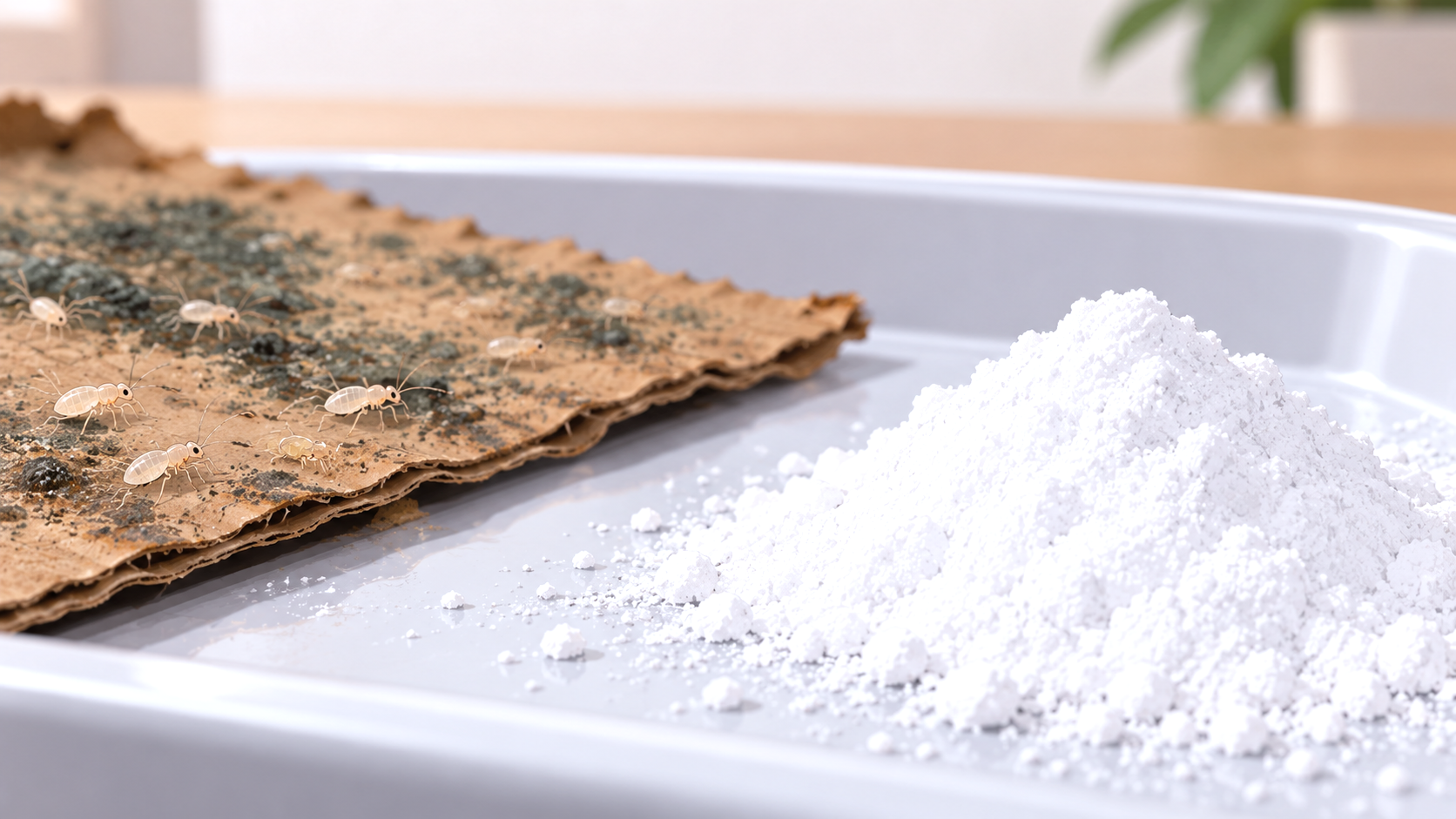
Baking soda appears in countless homemade pest-control recipes, so it is easy to assume that sprinkling it over booklice will kill them. Sodium bicarbonate does have legitimate pesticidal applications, but those uses do not establish ordinary household baking soda as an effective insecticide for booklice.
Baking soda is not an established treatment for booklice. There is no reliable basis for recommending household sodium bicarbonate as a way to kill booklice or their eggs. Booklice are controlled much more effectively by lowering humidity, correcting leaks and condensation, removing damp or contaminated materials, and vacuuming visible insects.
Why Baking Soda Gets Recommended for Booklice
Baking soda is sodium bicarbonate, a mildly alkaline compound used for cooking, cleaning, odor control, and numerous other household purposes. It also has real applications in pest management, which makes claims about it sound more convincing than many DIY remedies.
The important detail is what it controls.
Sodium bicarbonate is used in some pesticidal applications, particularly against fungal plant diseases. A substance having one pesticidal use does not mean the same substance is an effective treatment for every insect.
That distinction matters with booklice because the insects themselves are relatively easy to remove. The harder part is changing the damp environment that allows them to remain and reproduce.
Does Baking Soda Kill Booklice on Contact?
There is no established household treatment protocol showing that sprinkling baking soda onto booklice provides dependable contact control.
That is different from assuming that any dry powder will automatically dehydrate, cut, poison, or otherwise kill an insect that walks through it. Those mechanisms should not be transferred to baking soda without evidence.
This is also where baking soda is sometimes confused with diatomaceous earth. They are completely different materials. Diatomaceous earth and its effects on booklice need to be considered separately rather than assuming sodium bicarbonate works in the same way.
If a booklouse is already visible on a shelf or wall, vacuuming or wiping it away gives you an immediate result without depending on an unproven powder treatment.
Does Baking Soda Kill Booklice Eggs?
Baking soda should not be relied on to kill booklice eggs.
Booklice eggs are extremely small and may be deposited in protected locations where loose powder applied to an exposed surface never reaches them. More importantly, there is no established household baking-soda application rate or exposure period for killing booklice eggs.
Trying to coat every possible hiding place is therefore unnecessary. Environmental control works on the population differently. Booklice depend strongly on moisture, so sustained dry conditions make the habitat less suitable for their continued survival and reproduction without requiring you to locate every individual egg.
Baking Soda Does Not Work Like Diatomaceous Earth
The resemblance between two white powders can lead to bad pest-control assumptions.
Diatomaceous earth consists largely of silica-rich remains of microscopic aquatic organisms. In insecticidal applications, appropriate forms can interfere with an insect’s protective outer layer and promote water loss.
Baking soda is sodium bicarbonate. It does not become diatomaceous earth simply because both materials are fine powders.
Borax is different again. Borax and baking soda are separate compounds with different chemical properties and uses.
These distinctions matter because homemade pest-control advice often treats interchangeable-looking powders as though they share the same insecticidal mechanism. They do not.
Will Baking Soda Dehydrate Booklice?
There is no good reason to use baking soda as a substitute for actually drying the room.
Booklice are strongly associated with humid conditions. Common indoor species occur in warm, damp locations where molds and fungi can grow, and reducing moisture is one of the most important ways to manage them.
Sprinkling baking soda on a shelf does not create the same environmental change. It does not meaningfully lower relative humidity throughout a room, dry damp drywall, ventilate a cupboard, or remove moisture trapped around plumbing.
If humidity is supporting a booklice population, the useful intervention is to reduce that humidity or correct the localized moisture source rather than trying to dry individual insects with household powder.
Baking Soda Will Not Fix Mold Behind a Booklice Problem
Booklice commonly feed on molds and other microscopic fungi, which helps explain their close relationship with damp buildings and belongings.
Baking soda is sometimes used for household cleaning and odor control, but scattering it around an infested area does not remove the moisture that allowed fungal growth to develop. A leaking pipe, wet wall cavity, condensation problem, or persistently humid basement remains wet underneath the powder.
Because booklice can feed on mold, the useful response begins with the conditions supporting that growth. Repair leaks, improve ventilation, lower excessive humidity, and clean or remove affected materials as appropriate.
Once the area remains dry, both the insects and much of the fungal food supporting them lose favorable conditions.
Should You Sprinkle Baking Soda on Books?
There is no booklice-control reason to coat books in baking soda.
Loose powder can settle between pages, enter bindings, and create another material that eventually has to be removed. It also does nothing to correct excessive storage humidity.
Booklice associated with books often occur because the collection or surrounding room is damp enough to support microscopic fungi. Some species can also consume suitable starchy materials associated with bindings, although booklice and their relationship with paper and books is more complicated than simply describing them as paper-eating insects.
Move affected books into a dry environment when appropriate, lower the surrounding humidity, isolate affected material where necessary, and carefully remove visible insects.
For suitable materials, freezing can be used against booklice, although the suitability of freezing depends on the item being treated.
What About Baking Soda in Kitchen Cabinets?
A pantry full of white powder makes finding the actual source of the insects harder, not easier.
Booklice can occur around flour, grains, cereals, dry pet food, cardboard packaging, and other stored materials. If they are concentrated in a cupboard, inspect the food and packaging before treating the shelf.
Contaminated stored food should be discarded rather than treated with baking soda. Unaffected dry foods can be transferred to tightly closing containers, while cabinet joints and corners can be vacuumed and cleaned.
Also inspect beneath sinks and around plumbing. A cabinet with recurring booklice may have a moisture problem rather than a food infestation.
That source-first approach is more useful when getting rid of booklice in the kitchen than sprinkling baking soda throughout the cupboards.
What About Baking Soda in the Bathroom?
Baking soda can be useful for certain household cleaning jobs, but its cleaning role should not be confused with booklice control.
Repeated booklice around a bathroom window, vanity, shower, baseboard, or sink suggest that the surrounding conditions deserve attention. Condensation, poor ventilation, and plumbing leaks can all maintain localized dampness.
Remove visible insects and dry the affected area. Run an effective exhaust fan during and after bathing, improve airflow, dry recurring condensation, and investigate leaks.
When booklice keep appearing in the bathroom, lowering moisture addresses a condition the insects actually depend on. Leaving piles of baking soda around the room does not.
Baking Soda Does Not Lower Room Humidity
This is probably the most important practical difference between baking soda and a real booklice-control strategy.
A small open container of baking soda is commonly used for odor control, but it is not a substitute for a dehumidifier. It cannot remove enough water from the air to manage a humid room or a significant building-moisture problem.
Booklice control works best when the environment itself becomes unsuitable for them. When excessive ambient humidity is responsible, ventilation, air conditioning, or a properly sized dehumidifier can help. Localized water sources such as leaking pipes, roofs, or windows require repair instead.
The humidity reading and source of the moisture matter far more than the amount of baking soda sitting in a dish.
What Actually Works Better Than Baking Soda?
Start by finding where the booklice are concentrated.
Vacuum exposed insects and inspect the immediate area for dampness, condensation, leaking plumbing, wet cardboard, stored food, fungal growth, or other moisture sources. Physical removal may be sufficient for small numbers while you investigate why they are there.
Next, reduce the moisture. Indoor booklice are strongly dependent on humid conditions, and moisture reduction is central to household booklice management. Correct leaks and condensation and reduce excessive indoor humidity where necessary.
Chemical treatment is often unnecessary when the environmental problem can be corrected. Even killing the visible insects provides only a temporary answer if damp conditions remain suitable for another population.
The broader process for getting rid of booklice therefore revolves around identification, physical removal, moisture correction, cleaning, and continued drying rather than finding another household powder to scatter.
Why Booklice Might Disappear After You Use Baking Soda
Sometimes a home remedy receives credit for a change caused by something else.
Imagine booklice appearing during several weeks of humid summer weather. Baking soda gets sprinkled around the affected cupboard. The weather then becomes drier, an air conditioner runs more frequently, the cupboard is cleaned, and damp cardboard is thrown away.
The population falls.
It would be easy to conclude that the baking soda killed the infestation even though several much stronger booklice-control factors changed at the same time.
Instead of judging a remedy by whether sightings eventually stopped, monitor the environment. A hygrometer can show whether humidity has fallen, while repeated inspection can reveal whether a leak, contaminated package, or damp material was removed.
That gives you better evidence about why the booklice disappeared rather than relying on the timing of a home remedy.
If Booklice Keep Appearing
Repeated sightings after baking soda has been applied do not mean you need more baking soda.
Follow the insects. A recurring cluster around one window deserves a condensation check. Booklice concentrated beneath a sink warrant a plumbing inspection. Insects among cardboard or stored food point toward those materials, while widespread sightings during humid weather suggest room-level humidity deserves attention.
Identification should also be revisited when environmental control produces no change. Springtails, mites, and other tiny arthropods can be mistaken for booklice. Checking what booklice actually look like can prevent weeks of treating the wrong pest.
Once booklice are confirmed, a dry home offers them far less opportunity to maintain a persistent population. That is a much stronger control strategy than baking soda.
Safety note: Household baking soda is not interchangeable with a pesticide product simply because sodium bicarbonate has some pesticidal applications. Avoid deliberately creating airborne dust, keep household products away from children and pets where appropriate, and use registered pest-control products only according to their labels.
Other Questions About Baking Soda and Booklice
Can I mix baking soda and vinegar to kill booklice?
There is no established reason to use the mixture for booklice control. Baking soda and vinegar react with each other, producing carbon dioxide while neutralizing much of the acid and base. The fizz does not establish the mixture as an effective booklice treatment.
Will a box of baking soda absorb enough moisture to stop booklice?
No. A box or bowl of baking soda is not a practical method for controlling the relative humidity of a damp room. Use ventilation, air conditioning, or a properly sized dehumidifier when ambient humidity needs to be reduced.
Can baking soda keep booklice from returning?
Baking soda does not provide a dependable preventive barrier. Keeping susceptible areas dry, fixing water problems, storing dry foods properly, and preventing damp cardboard or paper from accumulating are more useful preventive measures.
Should I vacuum up baking soda that I already sprinkled down?
There is no booklice-control reason to leave layers of baking soda around living spaces. Clean the area appropriately without creating unnecessary airborne dust, then monitor the location for new insects while correcting any moisture problem you find.