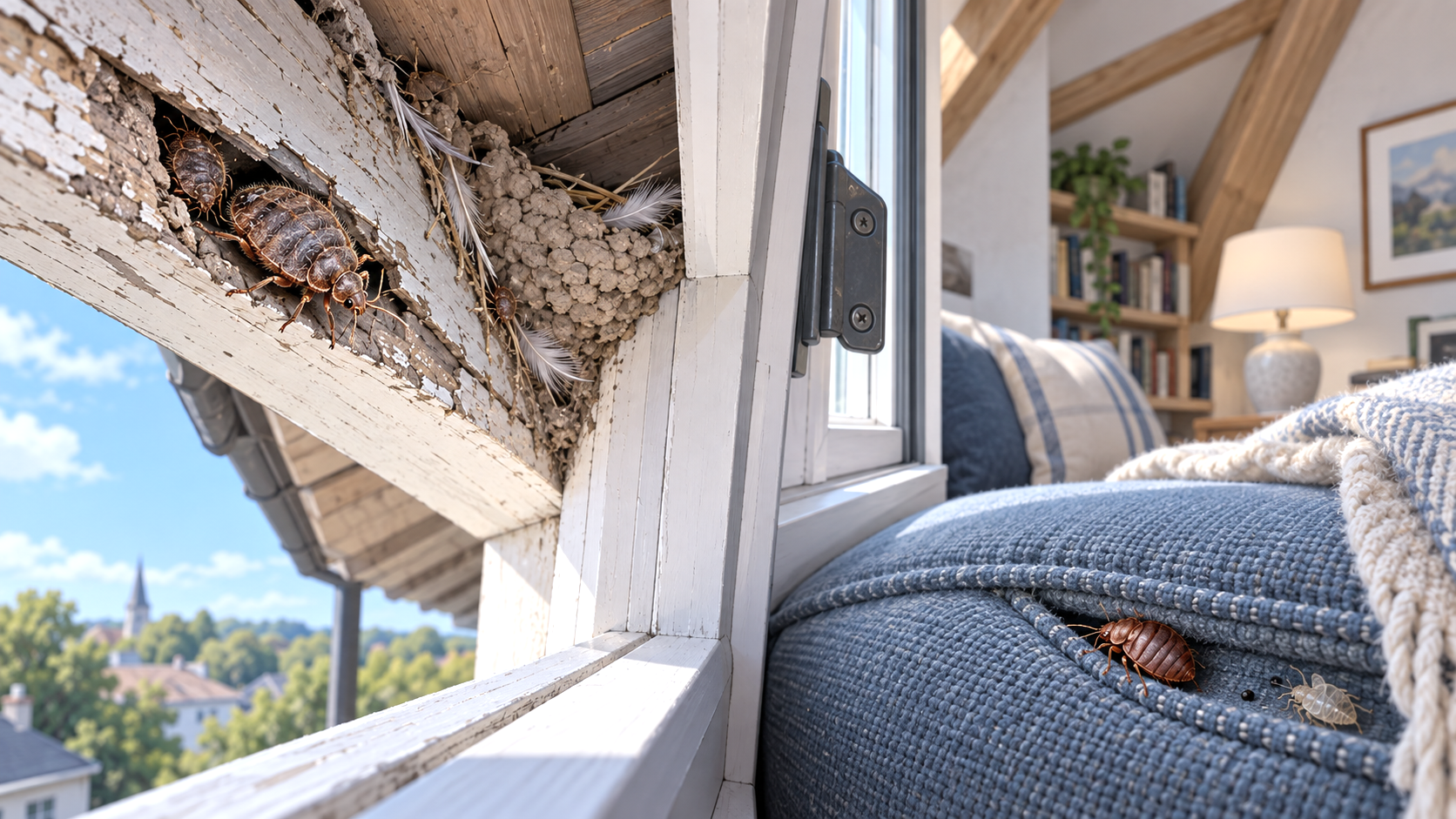
Finding what looks like a bed bug beside an old mud nest under the eaves changes the identification question considerably. It may not be a common bed bug at all.
Swallow bugs and bed bugs are closely related blood-feeding insects in the family Cimicidae, but they normally depend on different hosts. Swallow bugs primarily parasitize cliff swallows and live around their nests, while common bed bugs primarily feed on people and establish infestations around places where people sleep. Swallow bugs can still bite humans, particularly when they enter buildings from nearby swallow nesting sites. Their close relationship also makes appearance alone a poor way to separate them.
Swallow Bugs Are Close Relatives of Bed Bugs
Unlike many insects that merely resemble bed bugs, swallow bugs genuinely belong to the same family.
The North American swallow bug is commonly identified as Oeciacus vicarius in older literature. More recent taxonomic work places it within Cimex, making Cimex vicarius the current combination used in modern research.
That relationship explains why the two insects look so similar. Both are wingless, flattened blood feeders adapted to hide near a host and emerge when an opportunity to feed appears.
The crucial difference is which host normally supports them.
Common bed bugs, Cimex lectularius, are strongly associated with humans. Swallow bugs are obligate ectoparasites primarily associated with cliff swallows and their colony sites.
They feed on adult and nestling birds during the breeding season and spend the rest of their time concealed in and around the birds’ mud nests.
Swallow Bugs Can Bite People
This is where the distinction is sometimes overstated.
Swallow bugs primarily feed on swallows, but they can bite humans.
A documented hospital infestation provides particularly clear evidence. Cliff swallows had built nests along the building’s window eaves, and gaps around the windows allowed swallow bugs and swallow ticks to enter patient rooms, hallways and stairwells. The investigators specifically reported that swallow bugs are known to bite humans.
So a human bite does not automatically distinguish a bed bug from a swallow bug.
Host association is more useful. Repeated bugs emerging from an area connected to swallow nests point in a very different direction from bugs concentrated around mattresses, box springs, bed frames and other human sleeping areas.
The Nest Is One of the Strongest Identification Clues
Swallow bugs have an unusually tight relationship with cliff-swallow colonies.
The insects feed while the birds occupy their nests and remain around colony sites after the birds migrate. Research on cliff-swallow colonies has found that swallow bugs can remain in the nests year-round.
That makes the discovery location extremely useful.
A bed-bug-like insect appearing near mud swallow nests, exterior eaves, window openings connected to nests or other swallow nesting sites warrants consideration of swallow bugs. If insects are repeatedly appearing around a bed with no bird nesting activity nearby, common bed bugs become a different and more relevant possibility.
Location alone still should not be treated as a definitive species identification. It tells you where to direct the investigation.
Telling the Two Apart Can Require Magnification
We would not rely on color or general body shape to distinguish these insects.
Both have the flattened, oval appearance associated with cimicid bugs. The differences used for species identification include much finer anatomical features.
Swallow bugs have notably long body hairs, and identification keys also use characteristics involving the antennae, mouthparts and spacing of the coxae. Those are not the kinds of details most people can reliably evaluate from a bug crawling across a wall.
A clear specimen examined under magnification is considerably more useful than trying to identify one from a distant photograph.
This is similar to the identification problem with bat bugs versus bed bugs, another comparison where closely related cimicids can look almost identical without examining the right anatomical features.
Swallow Bugs Can Move Indoors From Bird Nests
Finding swallow bugs indoors does not mean they have established an ordinary bed bug infestation.
The hospital case demonstrates how the transition can happen. Swallows nested on the exterior of the building, while breaks in window seals gave their ectoparasites a route inside.
That pattern makes the building exterior part of the investigation.
If swallow bugs are suspected, inspect for active or abandoned swallow nests and determine whether cracks, gaps, vents, windows or other openings connect those nesting areas with the interior.
With common bed bugs, the inspection starts somewhere very different. Mattresses, box springs, bed frames and nearby furniture are among the first places to examine because the insects usually remain close to human resting areas. The physical evidence used to confirm bed bugs includes live bugs, eggs, shed skins and characteristic fecal spotting.
A swallow nest outside the wall can therefore be more informative than the bedroom mattress when the insect involved is actually a swallow bug.
Don’t Remove an Active Bird Nest Without Checking the Rules
Finding swallow bugs around a nest does not mean the nest should immediately be knocked down.
Many native birds and their active nests receive legal protection. In the United States, the Migratory Bird Treaty Act protects native migratory birds, and removing or destroying an active nest can violate federal law when the action results in prohibited take of protected birds, eggs or young.
Local and regional requirements can add further restrictions, so the legal status of the nest and whether it is active should be established before removal.
Once the bird issue has been handled lawfully, the pest problem still needs attention. Bugs can remain around nesting structures after the birds leave, and openings that allow them into the building may need to be sealed.
If bed bugs have not been conclusively ruled out, don’t assume removing a bird nest solves everything. Correct species identification determines which source actually needs to be addressed.
Questions About Swallow Bugs and Bed Bugs
Can swallow bugs survive after the swallows leave?
Yes. Swallow bugs remain at colony sites while their migratory hosts are absent and can survive extended periods between feeding opportunities. Finding bugs around an abandoned nest therefore does not rule them out.
Can a swallow bug infestation occur inside a building?
Swallow bugs can enter buildings from nearby nesting sites and appear in occupied rooms. A published hospital infestation documented large numbers entering through gaps associated with cliff-swallow nests on exterior window eaves.
Can you identify a swallow bug from a bite?
No. Both swallow bugs and common bed bugs can bite humans, and a skin reaction cannot reliably identify which insect caused it. The specimen and the circumstances surrounding where it was found are much more useful.
Does finding a swallow bug mean you also have bed bugs?
No. They are separate species with different normal hosts. A confirmed swallow bug does not by itself establish the presence of common bed bugs, although an unidentified cimicid should be properly identified before either possibility is dismissed.
One thought on “Swallow Bugs vs. Bed Bugs: How to Tell Them Apart”