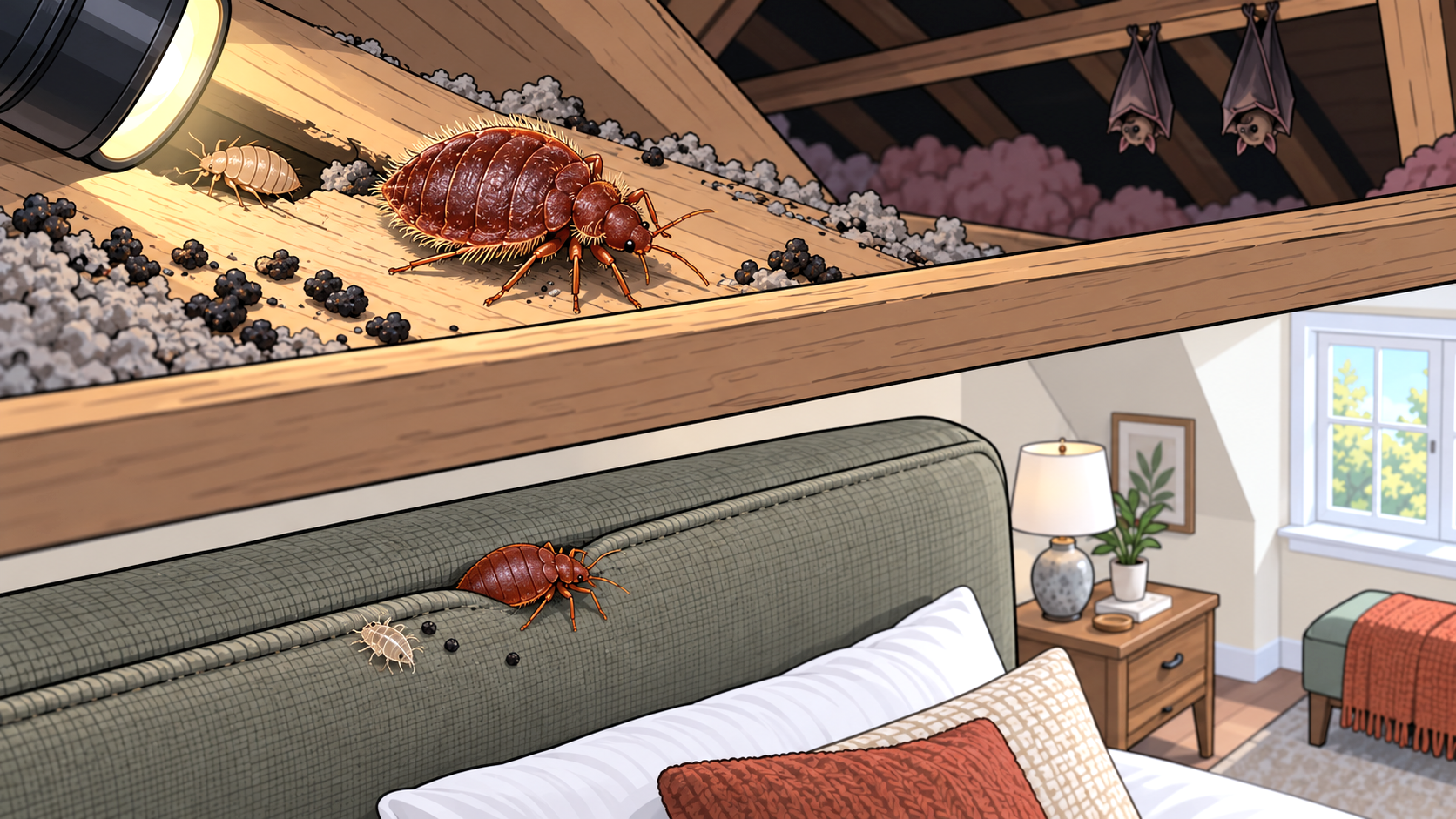
Put a bat bug beside a bed bug on a table and most people will not be able to tell which is which. That is not a failure of observation. These insects are close relatives with such similar body shapes that one of their most useful identifying differences involves hairs that are difficult to evaluate without magnification.
Bat bugs and bed bugs are nearly identical small, flattened, reddish-brown insects. The most useful physical difference is the longer hair around a bat bug’s head and pronotum. Their location provides another major clue. Bed bugs usually occur around people, while bat bugs are associated with places where bats roost, particularly attics and wall spaces. Bat bugs have longer hairs near the head than bed bugs. That makes this one of the harder entries among the many bugs that look like bed bugs. A flea, tick, or carpet beetle eventually gives you fairly obvious features to work with. A bat bug can still look like a bed bug after you have taken a close photo and zoomed in.
Bat Bugs and Bed Bugs Belong to the Same Family
The similarity makes more sense once you know their relationship. Bed bugs and bat bugs belong to the family Cimicidae, a group of blood-feeding insects associated with birds and mammals. The common bed bug is Cimex lectularius. One bat-associated species found in North America is the Eastern bat bug, Cimex adjunctus. Both belong to the same family of closely related blood-feeding bugs.
Both have broad, oval bodies that appear flattened when they have not recently fed. They are wingless and have six legs. Their brown to reddish-brown appearance also overlaps enough that color alone will not solve the identification. Our guide to what bed bugs look like covers the normal appearance of Cimex lectularius in more detail.
Size does not rescue you either. Adult bed bugs are small insects, and bat bugs occupy a similar size range. One university identification guide lists adult bat bugs at about 1/5 inch long, while adult bed bugs are commonly around 1/4 inch. Adult bat bugs can be about 1/5 inch long. A small brown bug beside the bed therefore cannot be identified as a bed bug simply because its size looks right.
The Tiny Hairs Are the Best Physical Clue
The feature worth examining is around the pronotum, the plate-like section immediately behind the head. Bat bugs have longer hairs in this area than common bed bugs. More specifically, identification material describes bat bug hairs as longer than the width of the insect’s eye. Magnification reveals bat bug hairs longer than the width of the eye.
That sounds like an easy test until you remember how small the insect is. You are comparing individual hairs with the width of a tiny compound eye. A normal glance at a bug on a sheet is not enough. Even a phone photograph may fail to show the necessary detail clearly.
This is why we would not identify one from color, body width, or a slightly fuzzy appearance in a photograph. The two insects can be separated using microscopic characteristics, including their hair patterns and other fine structural features. Closely related cimicid bugs can be separated by hair patterns and other structures. When the specimen really could be either one, professional identification is much more useful than repeatedly enlarging a blurry phone photo.
Where You Found the Bug Can Change the Entire Investigation
A suspected bed bug discovered on a mattress naturally sends your attention toward the bed. Finding the same-looking insect directly below an attic where bats have been roosting gives you a very different lead.
Bat bugs develop in association with bats and are commonly encountered in buildings around attics, eaves, and wall spaces where bats occur. Bat bugs in homes are strongly associated with bat roosts. Bed bugs, meanwhile, usually concentrate around places where people sleep or spend long periods resting. They commonly hide in mattresses, box springs, bed frames, headboards, furniture, cracks, and other protected spaces close to a human host. Bed bugs commonly hide around beds and nearby resting areas.
Location is evidence, though, not a substitute for identification. A bat bug can leave the roosting area and enter occupied rooms. Finding one in a bedroom therefore does not automatically turn it into a common bed bug.
We would pay particular attention to the building history. Evidence of bats in an attic or wall void makes the bat-bug possibility much more important. Bats commonly roost in narrow attic crevices, between rafters, and within other protected building spaces. Accumulated droppings beneath those areas can also reveal an established roost. Bat roosts can occur in attic crevices and between rafters.
A Bat Bug Can Still Bite You
The name creates an easy misconception. Calling it a bat bug describes its normal host association, not an absolute rule that prevents it from feeding on a person.
Bat bugs can bite humans, particularly when they move away from their normal host area. Bat bugs may move from bat-associated spaces and bite people. That means waking up with bites does not separate the two insects. A bat bug problem can produce human bites, while bed bugs can also feed without leaving a skin reaction that reliably identifies the culprit.
Trying to identify either insect from the bite marks makes the situation even less reliable. Red skin lesions alone cannot confirm bed bugs because reactions vary and other conditions can look similar. Bed bugs cannot be verified from red skin lesions alone. Our comparison of bed bug bites and flea bites shows the same limitation with another common household pest.
The insect itself is much better evidence. If you can safely capture the suspected bug without crushing it, preserve the specimen for identification rather than relying on the marks left on your skin.
An Attic Discovery Deserves More Attention Than a Bedroom Photo
Consider two houses where someone finds an almost identical reddish-brown insect.
In the first house, several bugs are concentrated along mattress seams and the bed frame. There is no known bat activity in the building. Other recognizable early signs of bed bugs appear around the same sleeping area. Those circumstances make a normal bed bug infestation a strong possibility, although a specimen still provides the best confirmation.
In the second house, the insects begin appearing after bats leave an attic. Bugs turn up near the ceiling, upper wall, and rooms below the former roost. That pattern deserves a bat-bug investigation. Bat bugs can migrate when their preferred hosts disappear, and bat-associated cimicids may move through a structure searching for another blood source. Bat bugs can migrate after losing access to their preferred host.
That second scenario is exactly where assuming “small brown bug in bedroom equals bed bug” can send the entire investigation in the wrong direction.
Why Correct Identification Changes What Happens Next
With ordinary bed bugs, the infestation centers on insects adapted to feeding primarily on people. Inspection consequently focuses heavily on beds, upholstered furniture, nearby cracks, and other human resting areas. Our guide to checking a home for bed bugs covers that search in detail.
A bat-bug problem has another piece that cannot be ignored: the bats. The inspection needs to include areas where bats may be living or previously roosted. University integrated pest management guidance specifically warns that distinguishing bed bugs from bat and bird bugs matters because resolving the latter begins with addressing the animal host and nesting or roosting source. Correct species identification changes where control efforts need to begin.
That does not mean sealing an active bat colony inside a building. Bat exclusion has its own wildlife and timing considerations, and local rules can apply. If bats are present, the sensible next step is to have the bat issue assessed appropriately while keeping a captured bug for identification.
Meanwhile, do not assume that treating the mattress solves a bat-bug problem. If insects are originating from an attic or wall space associated with bats, focusing exclusively on the bed leaves the source untouched. Conversely, finding no bats does not prove the insect is a common bed bug. Identification should lead the decision rather than the other way around.
What to Do With a Bug That Could Be Either One
Try to capture the insect intact. A small sealed container gives an identifier a much better specimen than a crushed bug or an out-of-focus photograph. You can compare its overall appearance with our bed bug identification guide, but stop short of treating tiny visual differences as definitive.
Next, consider where the specimen appeared. Check whether the house has evidence of bats or a known history of a bat roost, particularly above or inside the part of the building where the insects are appearing. At the same time, inspect beds and nearby furniture for the normal signs that indicate a bed bug infestation.
When both possibilities remain plausible, an entomologist, extension diagnostic service, or qualified pest professional can examine the physical characteristics that are difficult to judge at home. University pest guidance specifically recommends expert identification when distinguishing bed bugs from bat bugs and other close relatives. Professional identification can separate bed bugs from bat and swallow bugs. For this pair, knowing which insect you have is more valuable than starting treatment quickly against the wrong one.
Other Questions About Bat Bugs and Bed Bugs
Can bat bugs reproduce on human blood alone?
Bat bugs are adapted to their normal bat hosts. Some bat-associated species can bite people when bats become unavailable, but their long-term biology is not equivalent to that of the common bed bug living around human hosts. This host difference is another reason an indoor bat-bug problem should lead back to investigating the bat roost rather than treating it as an ordinary mattress infestation.
Can bat bugs come through walls?
Bat bugs associated with bats in attics or wall spaces can move into occupied areas of a building, especially after access to their normal hosts changes. A bug appearing near an upper wall or ceiling below a known bat roost therefore deserves closer identification rather than an automatic bed bug diagnosis.
Are bat bugs found only in houses with bats currently living there?
Not necessarily. Insects can remain in bat-associated areas after bats leave, and migration into living spaces can become noticeable when the normal host disappears. A history of bat activity can therefore be relevant even when you do not currently see bats.
Could you have both bat bugs and bed bugs in the same building?
The presence of one does not biologically exclude the other. A building can provide a human host and suitable bed bug harborages while also containing a bat roost capable of supporting bat bugs. In that unusual situation, physical identification of collected specimens becomes especially important.
What other insects can be mistaken for a bed bug?
Bat bugs are among the closest look-alikes, but they are not the only source of confusion. Carpet beetles, spider beetles, fleas, ticks, booklice, and other small household arthropods may be mistaken for bed bugs at a glance. Our guide to tiny bugs found in beds that are not bed bugs covers additional possibilities.
6 thoughts on “Bat Bugs vs. Bed Bugs: They’re Nearly Identical, Here’s How to Tell”