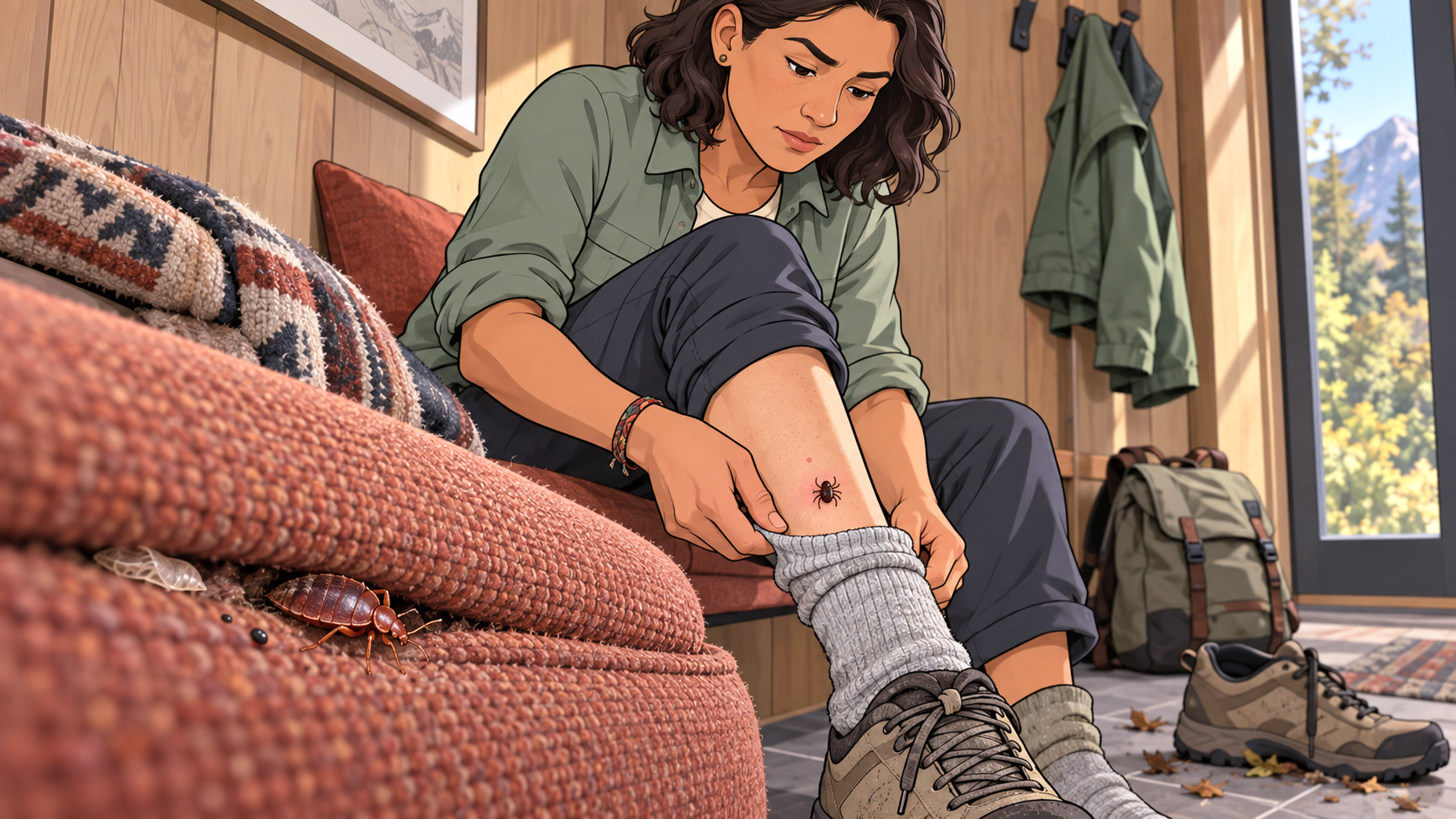
A tiny brown creature on a bedsheet can trigger two very different worries. One points toward a household infestation. The other raises questions about outdoor exposure and tickborne disease. Before looking at bite photos or worrying about where it came from, identify the creature itself. Ticks and bed bugs overlap in size and color, but they are built differently enough that a close look usually separates them.
Ticks and bed bugs are not closely related. Ticks are arachnids, while bed bugs are insects. Adult and nymphal ticks have eight legs, while bed bugs have six. Ticks may remain attached to the skin while feeding, but bed bugs feed temporarily and then return to hiding places near where people sleep.
That difference in biology changes almost everything that follows, including where you are likely to find them, what they look like after feeding, and what you should do next.
Count the Legs Before You Compare Anything Else
The most useful identification feature is surprisingly basic. A typical bed bug has six legs because it is an insect. Adult bed bugs also have a flattened, oval body and no functional wings. An unfed adult commonly measures about 5 to 7 millimeters long, which puts it in the same general size range as some ticks. adult bed bug appearance and size
Ticks belong to the arachnid group. Nymphs and adults have eight legs, while tick larvae have six. That larval exception is worth remembering because “six legs means bed bug” is not universally safe when dealing with a very young tick. Still, most ticks people notice attached to themselves or pets are nymphs or adults, and their eight-legged body plan separates them quickly from a bed bug. tick life stages and leg counts
Once you know you are looking at six-legged versus eight-legged anatomy, color becomes secondary. Brown alone is not helpful because both groups can appear brown or reddish after feeding. Our guide to what bed bugs look like gives a closer view of the bed bug side, while the separate page on actual bed bug size is useful when scale is causing the confusion.
A Tick Holds On. A Bed Bug Usually Does Not.
Finding the creature attached to skin changes the comparison considerably.
Ticks anchor themselves to a host and remain there while feeding. As they take a blood meal, some species can become much larger and more swollen than they were when unfed. Engorgement can also change the body shape and color enough that identification becomes harder. how feeding changes the appearance of ticks
Bed bugs feed differently. They bite, take a blood meal, and leave the host rather than staying fixed to the skin for an extended feeding period. They usually return to cracks, seams, furniture joints, mattress areas, or other protected spaces close to where people sleep. where bed bugs hide between blood meals
That creates one of the cleanest real-world checks in this entire comparison. A small arthropod firmly attached to the skin is much more consistent with a tick than a bed bug. A flat insect found moving across a mattress seam or headboard points the other direction.
Feeding Can Make the Two Look More Similar Than They Really Are
An unfed bed bug has a broad, flattened outline. After feeding, its abdomen becomes more elongated and reddish because of the blood meal. That change is visible enough that someone who has only seen one life stage can think they are looking at a different pest entirely.
Ticks also change dramatically after feeding, but in a different way. An engorged female tick may become rounded and swollen, sometimes losing much of the compact look people associate with an unfed tick. Because engorgement alters both size and color, using body color alone can be especially misleading.
This is one reason we would not identify either pest from “small and brown” or “reddish after feeding.” Leg count, attachment behavior, and body structure are far more useful. If the insect appears like a pale or smaller version of a bed bug, our guide to bed bug nymph identification can help with the juvenile stages.
Where You Found It May Tell You More Than Its Color
The setting matters because ticks and bed bugs arrive in homes through very different routes.
Ticks usually encounter people outdoors. They wait on vegetation or other surfaces and attach to passing hosts, including people and animals. After outdoor activity in wooded, brushy, or grassy areas, finding a tick on clothing, a pet, or attached to the skin fits that pattern well. where tick exposure commonly occurs
Bed bugs are primarily an indoor infestation problem associated with places where people sleep or rest. They commonly hide in mattress seams, bed frames, headboards, furniture, cracks, and nearby crevices. They can also hitchhike between locations in luggage, clothing, and belongings.
So a brown arthropod found after hiking and attached behind a knee belongs in a very different investigation from several bugs found repeatedly along a mattress seam. For the indoor side of that problem, our guide to checking a bedroom for bed bugs and the page on early signs of a bed bug infestation are more useful than staring at the insect’s color.
The Bites Are Much Less Helpful Than the Bugs
People often turn to bite appearance first because the skin reaction is what gets their attention. Unfortunately, that is one of the weakest ways to separate ticks from bed bugs.
Bed bug bites can produce itchy red marks, lines, clusters, or no visible reaction at all. The inflammatory reaction itself is not specific enough to diagnose a bed bug infestation. Confirmation is much stronger when an adult or nymph is actually collected from a sheltered area around the sleeping site. why bed bug bites alone cannot confirm an infestation
A tick bite can also leave a small localized mark after the tick detaches or is removed. The skin mark does not reliably identify the tick species or tell you whether a pathogen was transmitted. Because tickborne illnesses differ by tick species, location, attachment time, and pathogen, the attached tick itself and the circumstances of the bite matter much more than the shape of the mark.
That is why a rash comparison should come after pest identification, not before it. If you are dealing with unexplained nighttime marks, our guide to bed bug symptoms on the skin can help organize the possibilities without treating the rash as proof.
Finding an Attached Tick Changes the Medical Stakes
This is the part of the comparison where treating ticks and bed bugs as interchangeable becomes risky.
Bed bugs are not known to transmit disease to people. Their medical importance comes mainly from bite reactions, itching, loss of sleep, allergic reactions in some people, and secondary infection from scratching. health effects associated with bed bug bites
Ticks are different because some species can transmit pathogens that cause human illness. Blacklegged ticks, for example, can transmit the bacteria that cause Lyme disease. Other tick species can carry different pathogens, so the health question is not simply “was I bitten by a tick?” but also what species was involved, where the exposure happened, and how long the tick may have been attached.
For Lyme disease specifically, transmission risk rises with attachment time. In general, infected blacklegged ticks usually need to remain attached for more than 24 hours before transmitting the bacteria that cause Lyme disease, although different tickborne pathogens have different transmission timelines. how Lyme disease spreads through tick bites
That disease risk is one reason an attached tick deserves immediate attention rather than being treated as just another household pest.
Removing a Tick Is Not the Same as Dealing With a Bed Bug
Once you identify an attached tick, remove it promptly.
Use clean fine-tipped tweezers to grasp the tick as close to the skin as possible, then pull upward with steady, even pressure. Do not delay removal while waiting for a medical appointment. Prompt removal can reduce the risk associated with certain tickborne infections. proper tick removal with fine-tipped tweezers
Methods involving heat, petroleum jelly, nail polish remover, or attempts to force the tick to detach are poor alternatives to simple mechanical removal. Afterward, clean the bite area and watch for illness. A fever, rash, or other symptoms developing in the following days or weeks is a reason to contact a healthcare provider.
A loose bed bug does not require any of this. Capture the specimen for identification instead of crushing it beyond recognition. Then inspect the sleeping area for additional bugs, shed skins, spotting, and other signs. Our guide to what to do after finding a bed bug covers that situation separately.
A Bed Bug on the Bed Usually Means You Need to Inspect the Room
One bed bug and one tick carry very different implications for the house.
A tick found indoors may simply have been carried in on a person, clothing, or pet after outdoor exposure. That does not automatically mean the bedroom contains a reproducing tick population. Some tick species can infest buildings under certain circumstances, but a single indoor tick should first be interpreted in light of recent outdoor activity and pets.
A confirmed bed bug is more directly tied to the sleeping environment because bed bugs hide and reproduce indoors close to hosts. Finding one near the bed warrants a careful search for others rather than assuming it wandered in from the yard. Our article on what finding one bed bug can mean covers that question without assuming that one specimen automatically tells you the infestation size.
During that search, pay particular attention to mattress seams, bed-frame joints, headboards, nearby furniture, and cracks. Physical evidence matters more than bite counts or internet photos.
When the Creature Is Too Small to Identify Confidently
Tiny specimens can defeat an otherwise simple leg count.
Young ticks can be extremely small. Bed bug nymphs are also smaller and paler than adults. Poor lighting, a damaged specimen, or an engorged body can erase some of the visual differences that look obvious in close-up photographs.
Instead of guessing, preserve the specimen. A clear container, sealed bag, or piece of transparent tape can keep a bed bug available for identification. For ticks, saving the specimen can also help with species identification if a healthcare or public-health professional needs that information. However, testing a tick for pathogens should not be used by itself to decide whether a person has been infected.
The most useful question is not “which one does this photo remind me of?” It is whether the actual specimen has the anatomy and behavior of a tick or a bed bug.
Work From the Specimen Outward
When you find a mystery bug, start with the creature before investigating the bite.
Count the legs. Check whether it is attached to the skin. Look at the body shape, then think about the setting where you found it. Outdoor exposure plus an attached eight-legged arthropod points toward a tick. A six-legged flattened insect repeatedly turning up around a mattress or bed frame points toward a bed bug.
Once the identity is clearer, the next action becomes much easier. An attached tick needs prompt removal and health monitoring. A confirmed bed bug calls for a bedroom inspection and infestation-control plan. Treating those two situations as visually similar “little blood-feeding bugs” misses the most useful differences between them.
More Questions About Ticks and Bed Bugs
Can a tick crawl across a bed without being attached?
Yes. A tick can crawl on clothing, bedding, a person, or another surface before it attaches to a host. Finding one loose on a bed therefore does not make it a bed bug. Leg count and body structure remain more reliable identification features than the surface where it was found.
Can bed bugs stay attached to your skin overnight like ticks?
No. Bed bugs do not remain anchored to the skin in the way feeding ticks do. They take a blood meal and then retreat to nearby hiding places. A firmly attached arthropod should therefore make you consider a tick or another attached parasite rather than a bed bug.
Can an engorged tick look like a completely different bug?
Yes. Feeding can enlarge a tick significantly and change its shape and color, especially in adult females. That is why species identification can become more difficult after engorgement and why leg arrangement and other structural features deserve more weight than color alone.
Do ticks cause a bed bug-style household infestation?
Usually not in the same way. Most ticks encounter people and pets outdoors and feed as temporary parasites. Bed bugs, by contrast, establish indoor populations around sleeping and resting areas. Some tick species, particularly brown dog ticks, can reproduce indoors, so repeated tick findings in a home should still be identified properly rather than dismissed as random outdoor hitchhikers.
Should you see a doctor after every tick bite?
Not every tick bite automatically requires an office visit, but the tick should be removed promptly and the person should watch for symptoms. Seek medical advice if fever, rash, or other concerning symptoms develop, or if you have questions about the species, attachment time, or local tickborne-disease risk.