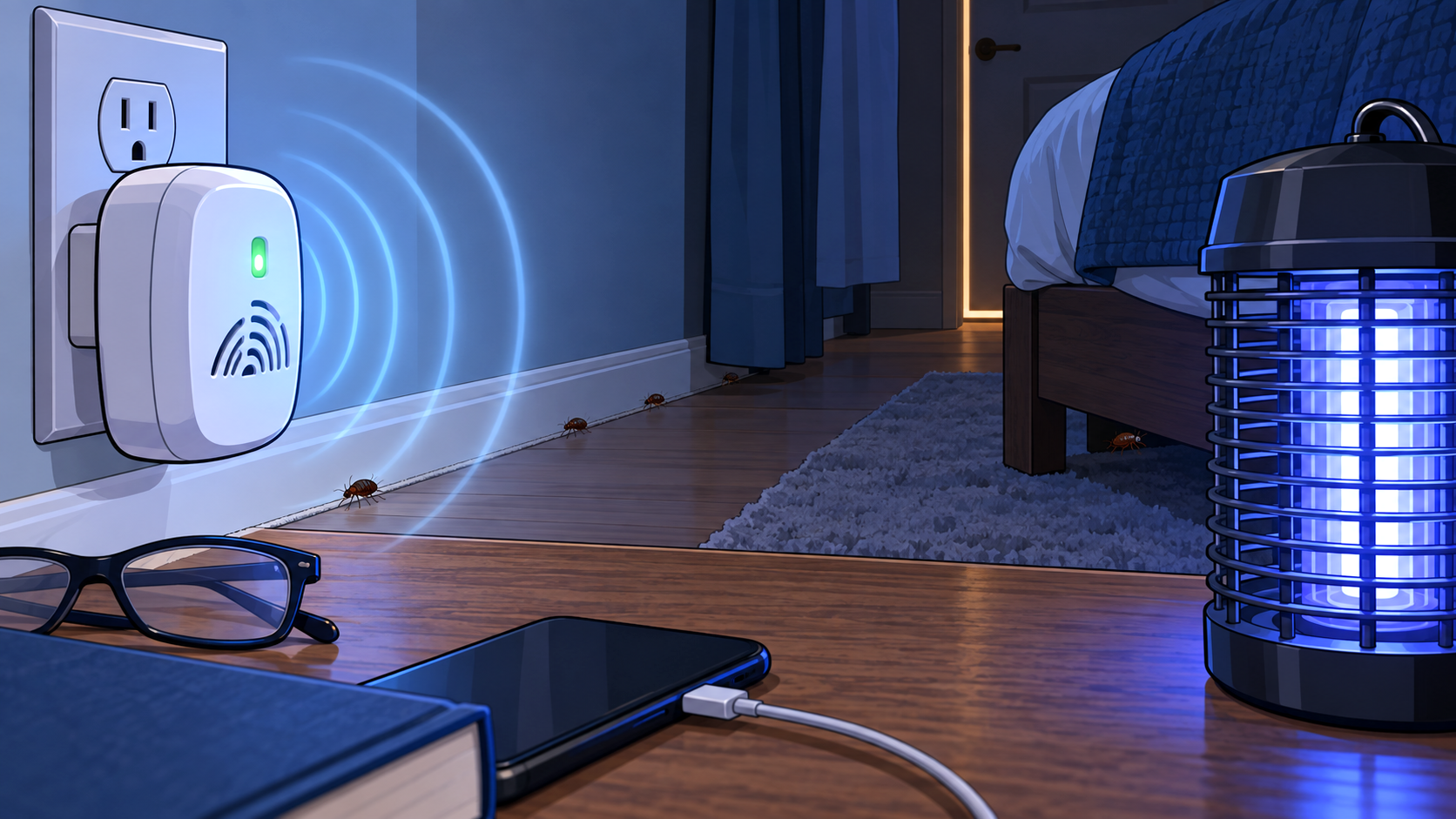
The appeal is obvious. Plug a small device into the wall, leave it humming silently in the corner, and let technology deal with the bed bugs while you sleep. No mattress inspection, no laundry, no traps under the bed, and no complicated treatment plan. For a pest as exhausting as bed bugs, that sounds almost perfect.
It also asks an important question that advertising often skips. What would the device actually have to make a bed bug do?
Ultrasonic pest repellents are not a reliable way to eliminate or repel bed bugs, and conventional ultraviolet bug zappers are poorly matched to bed bug behavior. Bed bugs crawl rather than fly and spend much of their time hidden near hosts. Effective control requires finding, monitoring, containing, and eliminating the infestation rather than relying on an electronic plug-in device.
A Bed Bug Zapper Solves the Wrong Kind of Insect Problem
The familiar electric bug zapper is built around a simple idea. Light attracts an insect toward an electrified grid, and the grid kills the insect when it reaches the device. That approach makes sense only when the target insect responds strongly enough to the lure and can physically reach the zapper.
Bed bugs are a poor fit from the start. Adult bed bugs are wingless, and they move by crawling rather than flying across a room toward a hanging light. Adult bed bugs are wingless insects Our separate guide to whether bed bugs fly or jump explains the movement side in more detail. A conventional bug zapper mounted across the bedroom therefore depends on behavior that bed bugs simply do not have.
Bug zappers also tend to rely on ultraviolet light as the attraction mechanism. Ultraviolet traps can be useful for certain flying insects because some flies and other insects actively orient toward light. Ultraviolet traps are used for light-attracted flying insects Bed bugs belong to a different behavioral problem. Their relationship with a sleeping host, nearby hiding places, heat, carbon dioxide, and other host-associated cues makes the glowing zapper across the room a poor substitute for the thing they are actually seeking.
So when a product is marketed as a “bed bug zapper,” the name deserves scrutiny. An electronic device does not become appropriate for bed bugs simply because the target pest has been added to the packaging.
Ultrasonic Repellents Make a Different Promise, but the Result Is No Better
Ultrasonic repellents usually do not claim to kill insects. Instead, they emit high-frequency sound that is supposed to make an area uncomfortable enough that pests leave or stay away.
That idea has been sold for decades for insects, rodents, bats, and other household pests. It has also attracted regulatory attention for decades. Federal enforcement actions have repeatedly challenged pest-control claims made for ultrasonic and electromagnetic devices when marketers lacked competent scientific evidence to support them. Earlier complaints specifically challenged claims that ultrasound could repel or control insects. Ultrasonic pest-control claims have faced repeated scrutiny over lack of substantiation
The issue is not that every plug-in device must produce absolutely no observable response from every insect under every circumstance. That is a much weaker standard than pest control. A useful bed bug repellent would have to keep bugs from reaching people consistently enough to prevent feeding and help resolve the infestation. An effective control device would need to reduce the population, not merely cause a temporary behavioral change somewhere near the outlet.
That evidence is not there for ultrasonic bed bug control. We would not buy one expecting it to clear an infested bedroom, protect a sleeping person, or replace established bed bug management. The same caution applies to broad electronic devices claiming that they control many unrelated pests through one ultrasonic or electromagnetic signal. Pest-control efficacy claims require reliable scientific support
The Outlet Is Not Where the Bed Bug Problem Is Happening
Another weakness becomes obvious once you picture the bedroom from a bed bug’s perspective.
Most of the infestation is not wandering openly across the center of the room waiting to encounter a gadget. Bed bugs hide in protected spaces around places where people spend long periods resting. Bed frames, mattresses, box springs, furniture joints, cracks, crevices, and nearby structural gaps can all provide shelter. Bed bugs hide in small protected spaces near feeding sites They can fit into extremely narrow cracks, which is one reason complete treatment can be difficult.
This matters because a plug-in repeller can create an illusion of whole-room coverage. The outlet may be several feet from bugs hidden inside a frame joint or beneath the edge of nearby furniture. A claim that an electronic signal “covers” hundreds or thousands of square feet tells you very little about whether a hidden bed bug colony will stop feeding, reproducing, or occupying those harborages.
The same problem appears when people expect a device to force bed bugs out of hiding. Even if bugs move, displacement is not eradication. A pest that retreats deeper into another crack or shifts to an adjacent area is still a pest problem. Our guide to why bed bugs are difficult to eliminate covers how their hiding behavior complicates treatment.
Bed Bugs Do Respond to Cues, Just Not in the Way These Gadgets Suggest
Electronic repeller advertising can sound more believable because bed bugs clearly do respond to their surroundings. That part is true. The leap from “bed bugs sense things” to “therefore this plug-in repels them” is where the reasoning falls apart.
Purpose-built bed bug monitoring systems can use cues such as heat, carbon dioxide, or scent to attract bugs toward a trap. Passive interceptors take another approach by catching bed bugs as they crawl between the floor and a bed or other piece of furniture. Active bed bug monitors can use heat, carbon dioxide, or scent lures Those devices are designed around documented bed bug movement rather than around the assumption that an irritating sound will empty the room.
There is an important limitation, though. A monitor is not automatically an exterminator. Catching some bed bugs or detecting their presence does not mean the entire infestation has been removed. Monitors are most useful when they answer a narrower question: are bugs present, where are they moving, and is activity continuing after treatment?
That makes bed bug monitors and bed bug detectors fundamentally different from ultrasonic repellents. One category is designed to gather evidence about bed bug activity. The other asks you to trust that unseen insects have been driven away.
A Trap Under the Bed Can Do More Useful Work Than a Plug-In Across the Room
Interceptors are almost comically simple compared with an electronic repeller. They sit under furniture legs and trap bed bugs attempting to crawl through them. Yet that simplicity is connected directly to how the insect moves.
Bed bug interceptors can help detect activity and can also make it more difficult for bugs on the floor to climb onto an isolated bed. Federal bed bug guidance specifically includes interceptors as part of monitoring and do-it-yourself management. Bed bug interceptors can be placed beneath furniture legs for monitoring
That does not mean a few cups under the bed solve every infestation. Bugs may already be living in the bed or frame, and furniture touching walls or bedding touching the floor can create alternate routes. Still, an interceptor produces information you can inspect with your own eyes. Our guide to bed bug leg traps explains how that approach differs from devices that promise invisible repellency.
Active traps built around carbon dioxide or other host-like cues also have a legitimate monitoring role, although their purpose and design vary. You can read more about carbon dioxide traps for bed bugs if detection is the goal. What we would not do is treat either type of monitor as evidence that the rest of the room no longer requires inspection or control.
“I Haven’t Seen Any Bed Bugs Since I Plugged It In” Is Not a Good Test
Bed bugs are unusually bad subjects for judging a repellent by casual observation. They already spend much of their time concealed, and people with infestations may go long periods without seeing a bug walking openly across the room.
Suppose someone installs an ultrasonic device on Monday and sees no bugs for the next week. That sounds like a success story until you ask how many bugs were visible during an average week before the device went in. If the answer was zero or one, the observation tells you almost nothing.
Treatment success needs something measurable. Inspection findings, interceptor catches, known harborages, and continued monitoring provide a better record of what the population is doing. Bed bug control guidance emphasizes continued surveillance precisely because failing to see a bug does not establish eradication. Continued monitoring is part of effective bed bug control
That is also why we are wary of customer reviews saying an ultrasonic product “worked overnight.” A disappearing pest is easy to imagine when the pest was difficult to observe in the first place.
The Bigger Cost Is Often the Time Lost While the Infestation Continues
An ultrasonic plug-in does not have to cost much to become expensive. The more important cost can be the delay it creates.
Bed bug infestations require a methodical approach. Correct identification comes first, followed by determining where bugs are present, preventing spread, using appropriate control methods, and checking whether those measures succeeded. Effective do-it-yourself bed bug control follows multiple coordinated steps Integrated pest management combines appropriate nonchemical and chemical techniques instead of expecting one object or product to carry the entire job.
A repeller sitting in an outlet can become a reason to postpone all of that. Someone may wait another week to see whether it starts working, then buy a second unit for the other side of the bedroom, then assume a few new bites mean the device needs more time. Nothing about that process tells them where the bugs are hiding or whether the population is shrinking.
We would rather put that effort into an actual bed bug inspection and a control plan. Our broader guide to getting rid of bed bugs covers the combination of methods used to address the infestation itself.
What We Would Spend Money on Instead
The answer depends on whether you are still trying to confirm bed bugs or already know you have them.
When the infestation is uncertain, spend first on detection rather than supposed repellency. Inspect the bed, identify suspicious insects, and use appropriate monitors or interceptors where useful. Moving from “I think something is biting me” to “I have confirmed bed bugs in this location” gives every later decision a much stronger foundation.
Once bed bugs are confirmed, the money belongs in a complete control plan. That may include laundering and drying appropriate items, vacuuming, encasements, interceptors, targeted heat or steam methods where appropriate, EPA-registered pesticides used exactly according to their labels, and professional treatment when the infestation exceeds what you can realistically manage. Bed bug control works best as a multi-method strategy
Pesticides deserve the same skepticism as electronic gadgets when the claims exceed the label. A product intended for bed bugs should actually list bed bugs on its label and be used only in the locations and manner the label permits. Bed bug pesticide products should be selected and used according to their registered labels
None of this is as convenient as plugging something into the wall. Unfortunately, convenience does not change bed bug biology.
Electronic Bed Bug Devices: Questions Worth Settling Before You Buy
Could an ultrasonic device stop bed bugs from biting me even if it does not kill them?
There is no reliable basis for using an ultrasonic pest repeller as personal protection from bed bug bites. A device would need to repel bugs consistently under real household conditions, not simply produce sound or cause a temporary response. Claims that ultrasonic pest devices repel or control insects have repeatedly faced regulatory challenges over inadequate scientific substantiation.
What if an ultrasonic repeller has thousands of positive reviews?
Reviews can tell you what purchasers thought happened, but bed bugs are difficult to evaluate by casual observation because they spend so much time hidden. A stronger test is whether objective monitoring shows that activity has stopped over time. When infestation status matters, capture evidence, inspection findings, and monitoring results are more useful than impressions that a room “seems better.”
Would putting a bug zapper directly beside the bed make it more effective?
Moving the zapper closer does not solve the behavioral mismatch. Bed bugs are wingless crawling insects, while conventional bug zappers depend on attracting insects toward a light source and an electrified grid. A trap specifically designed around bed bug movement or host-seeking behavior makes more sense than repositioning a device designed for light-attracted flying insects.
Can electronic devices be used together with real bed bug treatment?
They can physically remain in the room, but an unsupported ultrasonic repeller adds no established bed bug control step to an integrated management program. We would not count it as part of the treatment plan or use it to decide whether the infestation has ended. Monitoring devices designed for bed bugs are different because they can provide evidence about continuing activity.
When should you stop experimenting with gadgets and call a professional?
Persistent activity after careful do-it-yourself efforts, bugs appearing in several locations, difficulty finding harborages, or an infestation that you cannot contain are reasonable points to consider professional help. Our guide to when to call an exterminator for bed bugs covers that decision separately. Professional treatment should still involve inspection, monitoring, and a comprehensive strategy rather than promises built around one miracle device.