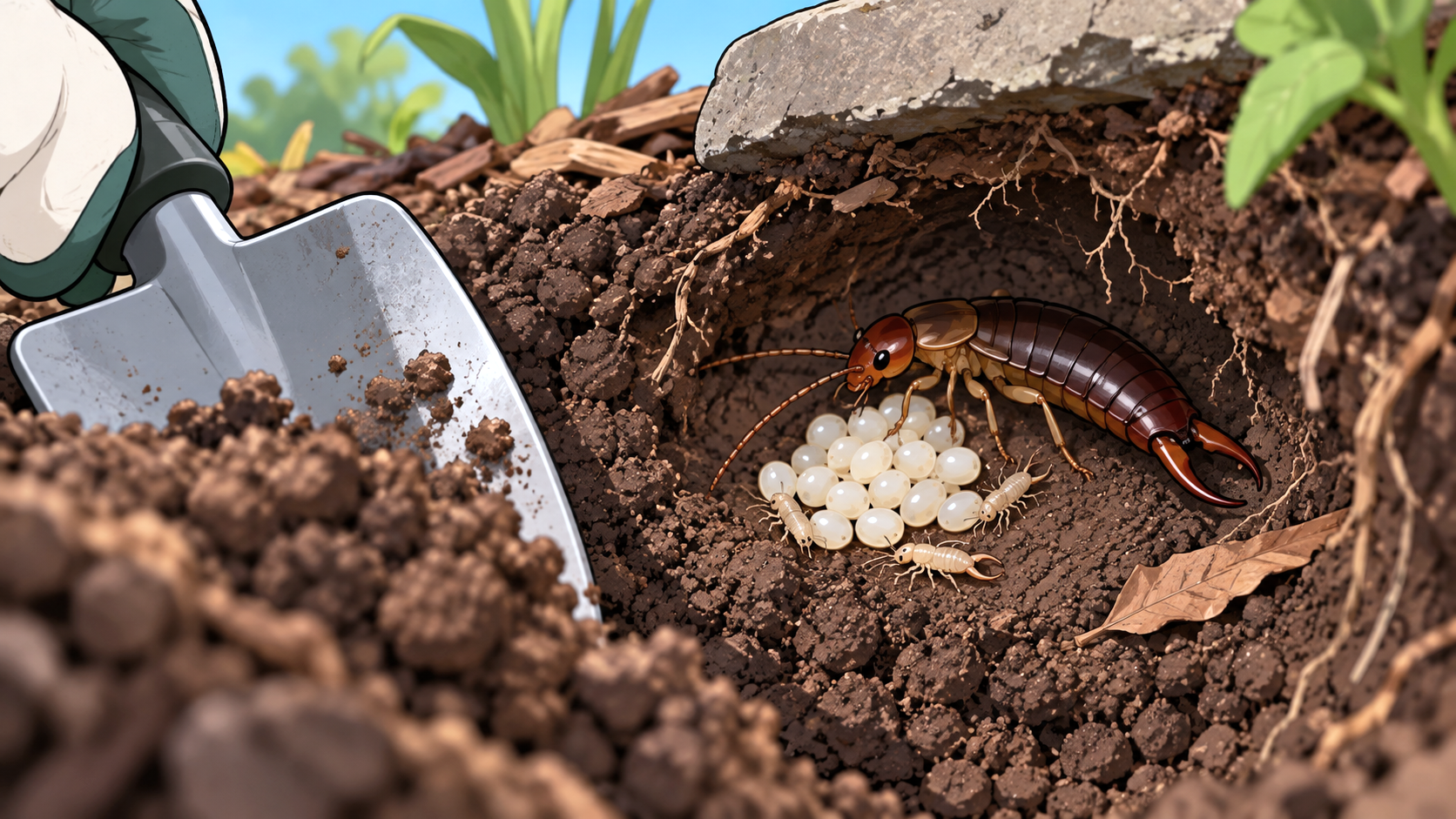
Earwig eggs are tiny, elliptical, and pearly white when freshly laid. European earwig eggs are about 1 millimeter long, roughly pinhead-sized, and females lay them together inside protected soil nests. As the embryos develop, the eggs increase in size and become darker before hatching, so an older clutch may not look as bright white as a newly laid one.
The eggs themselves are easy to overlook. What often makes them recognizable is the combination of their appearance, their clustered arrangement, and where you find them. A group of tiny pale eggs inside a small soil chamber, particularly with an adult female earwig nearby, is much more meaningful than finding a single unidentified white speck somewhere in your home.
What Earwig Eggs Look Like Up Close
Fresh eggs of the European earwig, Forficula auricularia, are pearly white, elliptical, and approximately 1 millimeter long. They have a smooth, rounded appearance rather than the elongated body shape you see once an earwig hatches. Because each egg is so small, photographs taken under magnification can give a misleading impression of their actual size unless something familiar appears beside them for scale.
Their appearance also changes during development. The eggs increase in size and darken before hatching, which means two healthy clutches can look somewhat different simply because they are at different stages. For identification, we would therefore avoid treating a precise shade of white as a requirement. Size, elliptical shape, clustering, nesting location, and the presence of a guarding female provide a much stronger combination of clues.
How Big Are Earwig Eggs?
At around 1 millimeter long, European earwig eggs are visible without a microscope but still extremely small. A single egg would be easy to miss against soil or debris, whereas an entire clutch is considerably easier to notice. Their tiny size also explains why a close-up image can make them look much larger than they would to your naked eye.
A useful comparison is the adult insect itself. European earwig adults are around 16 millimeters long in typical descriptions, making each newly laid egg only a small fraction of an adult’s body length. Once an egg hatches, the difference becomes easier to recognize because the offspring no longer resembles an egg at all. It emerges as a nymph with the basic earwig body form, a transition covered in our guide to the earwig life cycle from egg to adult.
What Color Are Earwig Eggs?
Newly laid European earwig eggs are characteristically pearly white. However, that description applies most closely to the beginning of development. As the embryo matures, the egg gradually becomes darker and increases in size before the young earwig emerges.
This developmental change matters when you’re comparing what you found with photographs online. An older clutch does not necessarily match the bright, almost pearl-like appearance of freshly laid eggs. We would use color as one clue rather than the deciding feature, especially because many unrelated insect eggs can also appear white or cream-colored. With earwigs, the nest and the adult tending it can tell you much more.
Earwig Eggs Are Laid Together in Clusters
European earwigs don’t normally distribute their eggs one at a time across exposed surfaces. A female lays a group of eggs inside a protected nest and keeps the clutch together. Depending on the population and brood, dozens of eggs may occur in a single nest, so discovering an exposed nest can reveal many similarly sized eggs at once.
This is an important identification clue because homeowners sometimes see one tiny pale object and assume it must be an earwig egg after finding an adult nearby. One unidentified speck does not give you much to work with. A compact collection of similarly shaped eggs in an appropriate nest is far more consistent with how European earwigs actually reproduce.
The number of eggs isn’t something we would use as a strict identification test either. Clutch size varies, and you may uncover only part of a nest. The useful clue is that the eggs normally occur as a group rather than being deliberately scattered around the surrounding area.
Where You Find Earwig Eggs Matters
Female European earwigs construct nests in the ground, where egg masses are deposited in protected soil cells. The nest provides a sheltered place for the eggs to develop and for the female to remain with them. Consequently, soil and protected ground-level hiding places make much more sense for an earwig clutch than an exposed wall, countertop, windowsill, or bed.
That distinction is particularly useful indoors. Earwigs can enter houses, but finding an adult inside does not mean it has established an egg-filled nest somewhere in the room. European earwigs normally reproduce in soil rather than completing their reproductive cycle throughout houses. If adults repeatedly appear indoors, the more relevant question is usually why earwigs are entering the house, not where they might be scattering eggs.
For us, location is one of the strongest checks against a false identification. Tiny white objects are common. Tiny elliptical eggs collected inside a protected soil nest fit earwig biology much better.
A Female Earwig May Be Guarding the Eggs
The adult beside a clutch can be an even better identification clue than the eggs themselves. Female European earwigs remain with their eggs and provide unusually extensive maternal care. After laying, the female gathers and guards the clutch rather than abandoning the eggs and returning to ordinary activity.
She also tends the eggs while they develop, helping keep the clutch together and protecting it from fungal growth. Her involvement continues after hatching, when the earliest nymphs remain associated with the nest. This maternal behavior is unusual enough that we’ve covered how earwigs care for their young separately.
If you expose a small soil chamber containing pale eggs and find a female earwig with them, inspect the adult. The familiar rear forceps make an adult earwig much easier to identify than a 1-millimeter egg viewed in isolation.
What Happens to Earwig Eggs Before They Hatch?
Development inside the egg is not visible in the same way that nymph growth is, but the outside of the egg does change. The egg becomes larger and darker as the embryo develops. Eventually, a first-instar nymph emerges and begins the next stage of the earwig life cycle.
How quickly that happens depends heavily on conditions. In documented European earwig populations, cooler first-brood eggs can develop much more slowly than eggs laid later under warmer conditions. This is why a single universal number for how long every earwig egg takes to hatch can be misleading.
After hatching, there is no worm-like larval stage. Earwigs undergo gradual metamorphosis, so the newborn is already recognizably earwig-shaped. It is smaller and less developed than an adult, and its appearance continues changing through successive molts. Our guide to what baby earwigs look like covers those differences without turning an egg-identification article into another life-cycle guide.
Are Those Tiny White Eggs Actually Earwig Eggs?
We would identify suspected earwig eggs from several clues together rather than one feature. A convincing match involves very small elliptical eggs, pearly-white coloration when newly laid, a clustered arrangement, and a protected soil nest. More developed eggs may be larger and darker, while a female earwig tending the clutch provides an especially useful additional clue.
By contrast, a few tiny white objects on a mattress, wall, shelf, countertop, or other exposed household surface should not automatically be labeled earwig eggs simply because you’ve recently seen an earwig. Many arthropods produce small pale eggs, and household debris can resemble eggs under magnification. The location and surrounding evidence need to make biological sense too.
If you are trying to identify a suspected clutch, photograph the eggs where you found them before disturbing the area. Include something for scale and, if an adult is present, photograph that insect as well. Those details are much more useful than relying on egg color alone.
Other Questions About Earwig Eggs
Can you see earwig eggs with the naked eye?
Yes. European earwig eggs are about 1 millimeter long, so they are visible without magnification. However, their small size makes individual eggs easy to overlook, particularly against soil. A clustered clutch is considerably easier to notice.
Do earwigs carry their eggs around?
Female European earwigs gather and tend their eggs within the nest rather than carrying a clutch around during normal foraging. The eggs remain associated with the protected nesting site while they develop.
Do earwig eggs hatch into larvae?
No. An earwig hatches as a nymph rather than a larva. The newborn already has the general body form of an earwig and becomes progressively more adult-like as it molts through its nymphal stages.
Can male earwigs guard the eggs?
Maternal care in European earwigs is performed by the female. The mother remains associated with the eggs and young nymphs, while males do not provide the same documented parental care.
3 thoughts on “What Do Earwig Eggs Look Like?”