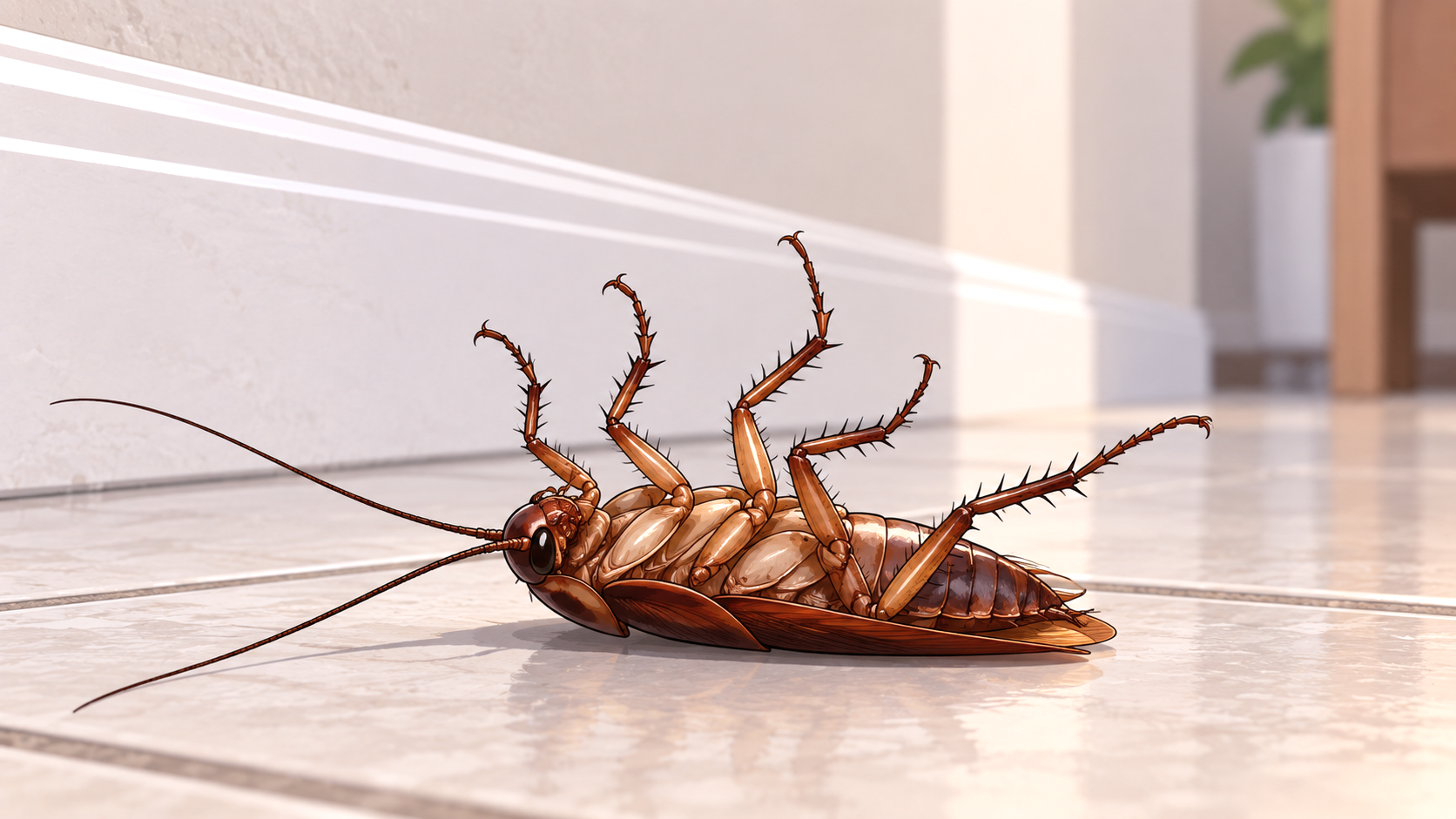
Cockroaches often end up on their backs when weakness, injury, neurological disruption, or death prevents them from righting themselves. A healthy cockroach that is overturned can usually roll or push itself upright using its legs, body, and, in some species, wings. The familiar upside-down dead cockroach is often one that lost this ability. The position itself does not reveal exactly what killed the insect. Pesticides can interfere with coordinated movement, but a severely weakened cockroach can become stranded the same way without insecticide exposure.
A Healthy Cockroach Is Usually Very Good at Getting Back Up
Being overturned is not normally a permanent position for a cockroach. Controlled experiments with American, discoid, and Madagascar hissing cockroaches found that the insects successfully righted themselves in 97% of trials when given 30 seconds. Nearly two-thirds succeeded on their first attempt, often within one second.
Getting upright requires more than waving six legs. The cockroach has to rotate its body far enough to move its center of mass past a mechanical tipping point. Different species accomplish that in different ways. American cockroaches in the same experiments predominantly generated rolling forces with their legs, while discoid cockroaches could combine leg movements with their wings. Madagascar hissing cockroaches, which are wingless, relied heavily on deformation and rolling of the body.
Righting can demand substantial force. Measurements from discoid cockroaches show that individual legs generate considerable ground reaction forces during righting and overturning movements. A cockroach lying upside down with legs moving is therefore not necessarily trapped. It may be actively trying to generate enough leverage to rotate itself.
A Smooth Floor Can Turn a Difficult Maneuver Into a Failed One
The surface beneath the cockroach changes its chances. Legs are much more useful when they can push against something. A smooth floor provides fewer opportunities for claws and other leg structures to obtain useful purchase, especially when the animal is already positioned awkwardly on its back.
Experiments deliberately testing cockroaches on a flat, rigid, low-friction surface found repeated failed righting attempts before some insects eventually succeeded. Successful attempts involved enough rolling or pitching motion to overcome the mechanical barrier keeping the body upside down.
An insect overturned beside a wall, cabinet edge, debris, or textured material may have more options. Contact with nearby objects can provide leverage unavailable in the middle of a slick floor. Cockroaches are otherwise remarkably capable on difficult surfaces, including the ability to move through extremely confined spaces. Their normal agility does not guarantee that every body position provides enough traction for recovery.
Weakness Can Remove the Force and Coordination Needed to Right the Body
A healthy cockroach has both the muscular force and coordinated motor activity required for righting. An insect approaching death may retain enough nervous and muscular activity to move its legs without producing an effective recovery movement.
Cockroach righting is a coordinated motor behavior rather than a simple automatic kick. Neural recordings have found that its leg activity resembles an organized locomotor pattern, and even headless cockroaches produce motor activity associated with attempted righting. Those decapitated insects move poorly and show substantial discoordination, demonstrating how movement can persist after normal control has been severely disrupted.
Age can reduce locomotor performance as well. Studies of discoid cockroaches found declining spontaneous movement and leg abnormalities in older adults, although the aged insects tested could still perform righting behavior. (pubmed.ncbi.nlm.nih.gov) Weakness therefore does not have one universal cause. Injury, physiological stress, neurological impairment, and advanced deterioration can all leave an insect less capable of converting leg movements into enough body rotation.
Once a cockroach becomes too impaired to complete the maneuver, its broad back can remain against the floor while the legs project upward. Continued twitching may persist even though those movements no longer produce useful leverage.
Insecticides Can Cause the Classic Upside-Down Cockroach
Some insecticides interfere directly with the nervous system, making loss of coordinated movement part of the poisoning process. Pyrethroids provide a well-studied example. They act on voltage-gated sodium channels involved in electrical signaling, and exposed cockroaches can progress through restlessness, hyperactivity, incoordination, prostration, and paralysis.
A poisoned cockroach may consequently lose normal control before all movement stops. If it falls or rolls onto its back during this period, uncoordinated leg activity may be insufficient to turn the body upright again. Laboratory exposure to deltamethrin has produced measurable knockdown in both American and German cockroaches, with mortality occurring later in some exposed insects.
Different active ingredients disrupt insects through different mechanisms, so the same visible posture cannot identify which pesticide was involved. Even among products that affect sodium channels, poisoning can produce different patterns of excitation, tremors, incoordination, and paralysis. Choosing among cockroach killers with different active ingredients therefore involves more than looking for a product expected to make insects flip over.
An upside-down cockroach is also not proof that a treatment has solved an infestation. Control depends on what happens to the population, not the posture of one affected insect. Cockroach bait and gel can expose hidden insects without producing a trail of visible bodies in the middle of a room.
Cockroaches Do Not Deliberately Turn Over to Die
There is no biological reason to interpret the position as a death pose chosen by the cockroach. The insect has no need to place itself on its back before dying. The pattern is better explained by mechanics: an animal that falls, rolls, convulses, or becomes overturned while impaired may no longer possess enough coordinated force to reverse the position.
This also explains why dead cockroaches are not universally found upside down. An insect can die while sheltered in a crack, standing normally, lying on its side, trapped beneath an object, or positioned in another orientation. Cockroaches spend much of their inactive time inside protected harborages, particularly because many household species have strongly nocturnal activity patterns. Many deaths therefore occur where people never see the body.
The conspicuous cockroach lying in an open room is only one visible outcome. Its position attracts attention precisely because the legs and pale underside make an overturned body easy to notice.
A Cockroach on Its Back May Still Be Alive
Leg or antenna movement is the clearest immediate indication that an overturned cockroach is not yet dead, but lack of obvious movement during a brief observation is not always enough to establish death. An impaired insect may be motionless for periods or respond only when disturbed.
A living cockroach can also recover from being overturned if its condition allows it to generate another successful attempt. Self-righting research shows that cockroaches may make multiple unsuccessful attempts before eventually rolling upright. An insect that appears stuck for several seconds is therefore not necessarily incapable of recovering.
If you need to remove one, avoid handling it with bare fingers. A disposable tissue, vacuum, or other hands-off collection method avoids unnecessary contact. Finding several dead or impaired insects after treatment may reflect pesticide exposure, while finding repeated live insects, nymphs, egg cases, or fresh droppings provides more useful evidence about whether a cockroach infestation remains active.
What an Upside-Down Cockroach Can and Cannot Tell You
Does an upside-down cockroach always mean pesticide was used?
No. Pesticide intoxication is one possible cause of lost coordination, but injury, weakness, unfavorable footing, or other physiological impairment can also prevent successful righting. The body position alone cannot identify the cause.
Can a cockroach right itself without using its wings?
Yes. Cockroaches can use leg-generated forces and body movements, and the strategy varies among species. Wings can assist some species during demanding righting attempts, but cockroach wing use differs considerably among species.
Why do the legs sometimes keep twitching after the cockroach flips over?
Insect nervous systems contain neural circuits outside the brain that can continue producing motor activity when normal higher-level control has been disrupted. Persistent leg movement does not mean the cockroach retains normal coordination, as demonstrated by the limited movements possible when a cockroach survives without its head.
Should you assume an upside-down cockroach is dead before disposing of it?
No. Treat an overturned cockroach as potentially alive unless its condition is clear. A cockroach that still has sufficient strength and coordination may eventually complete another righting attempt.
One thought on “Why Do Cockroaches Flip Onto Their Backs?”