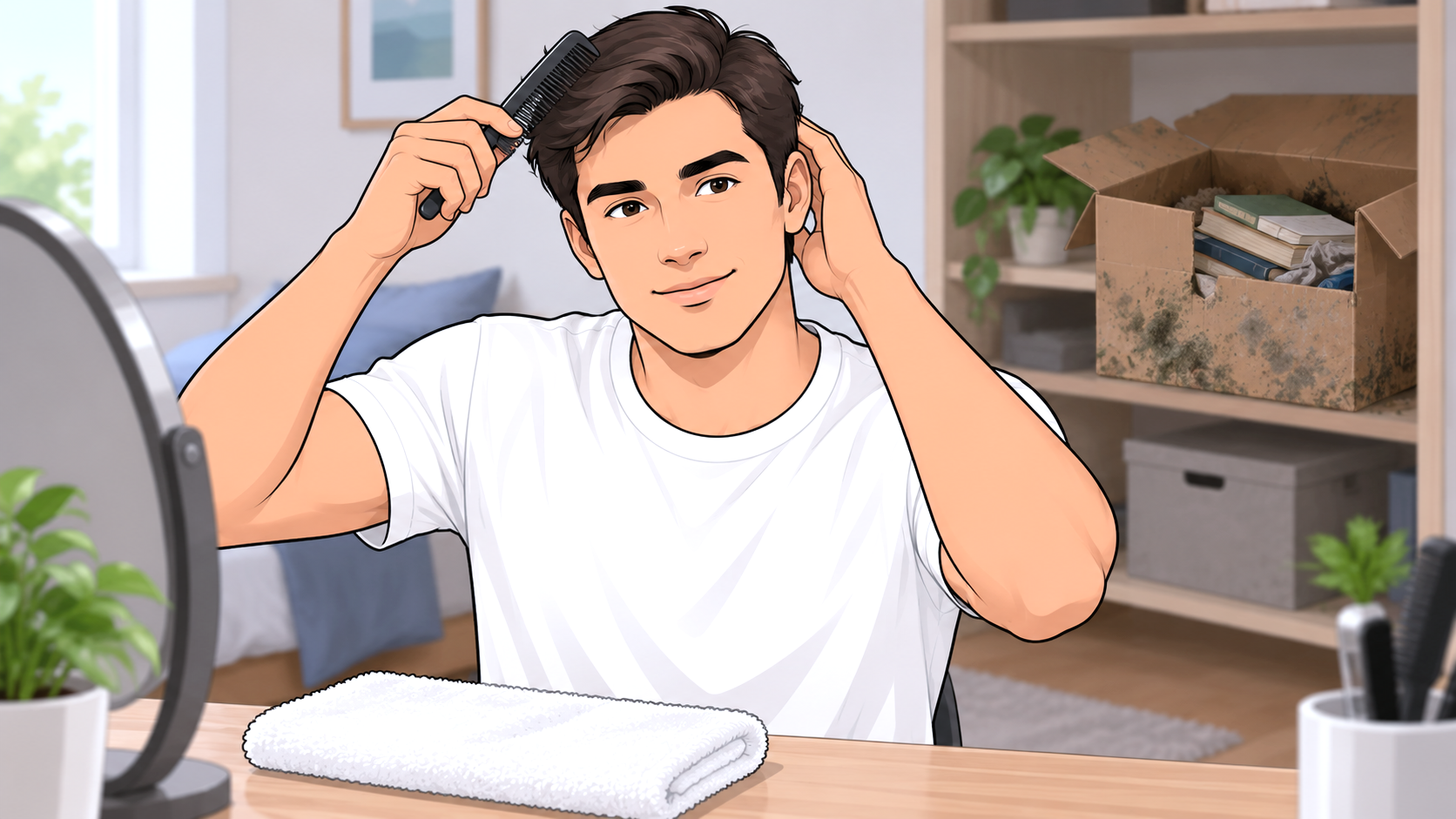
Finding a tiny insect in your hair can be alarming, particularly when it resembles a booklouse. The first thing to know is that booklice are not human parasites. They live in the environment, feed mainly on mold and fungi, and are not adapted to establish an infestation on your scalp. If you find a booklouse in your hair, remove it and wash or comb your hair normally. You do not need a pesticide treatment for booklice on your scalp. However, if you repeatedly find crawling insects in your hair or eggs firmly attached near the scalp, confirm that they are not head lice, which are human parasites and require different treatment.
Booklice Do Not Normally Live in Human Hair
Booklice can accidentally end up on a person, but human hair is not their normal habitat.
Common indoor booklice are small, wingless psocids that inhabit damp, warm, undisturbed areas where mold and fungi grow. They commonly occur around damp books, cardboard, stored products, cupboards, leaking pipes, and other moisture-affected materials.
They do not need a human host. They do not feed on blood, and they are described as harmless to people and pets.
That biology is fundamentally different from head lice. Head lice, Pediculus humanus capitis, are parasites that live on the human head and feed on blood. Their legs are adapted to cling to hair, and females attach their eggs directly to hair shafts.
So while an environmental booklouse can crawl onto your hair, finding one there does not mean your scalp has become its habitat.
Start by Removing the Insect
If you find what appears to be a booklouse in your hair, there is no need for an elaborate treatment.
Remove the insect with your fingers or a comb. Washing and combing your hair normally can remove any additional insects that happened to crawl onto it. There is no established reason to apply a booklice pesticide, household insecticide, essential oil, alcohol, bleach, or other pest-control chemical to your scalp.
That last point matters. Products intended for treating household surfaces or environmental pests should not be improvised into hair treatments.
Once the insect is removed, try to preserve it if identification remains uncertain. A small sealed container, clear tape, or a sharp macro photograph can make comparison much easier.
A genuine booklouse should match the typical appearance of booklice, including a tiny soft body, six legs, long slender antennae, and a relatively broad head.
Make Sure It Really Is a Booklouse
Misidentification is the bigger concern when someone reports “booklice in my hair.”
Booklice are generally only about 1 to 2 millimeters long. Their small size puts them within the same general visual range as several other tiny arthropods, particularly when the specimen is moving between hairs.
Do not identify the insect from size or pale color alone.
Booklice have conspicuously long, threadlike antennae relative to their bodies. Their heads are broad, and common indoor forms have soft, flattened bodies. They are not shaped specifically for clinging tightly to human hair.
A hand lens or close macro photograph can reveal far more than trying to inspect a moving speck in a bathroom mirror.
If you repeatedly find similar insects on your scalp, reliable identification becomes more important than assuming the first online photograph that looks close is correct.
Check Carefully for Head Lice
Head lice deserve particular attention because they really do live and reproduce in human hair.
Adult head lice are approximately 2 to 3 millimeters long, while their nymphs are smaller and can overlap more closely with booklice in apparent size. The CDC recommends diagnosing head lice by finding a live nymph or adult on the scalp or in the hair.
A fine-toothed lice comb can help with the inspection. Pay particular attention behind the ears and around the back of the neck.
Head lice have six legs equipped with claws adapted for holding onto hair. Booklice have a different body shape, including longer antennae and a broader-looking head.
The behavioral difference is even more important. Head lice are adapted to remain on a human host and repeatedly feed on blood. Booklice are environmental insects associated with moisture and fungi.
The broader comparison between booklice and human lice can help when the specimen is difficult to identify.
Look for Nits Attached to the Hair
Eggs provide another useful distinction.
Head lice attach their eggs, called nits, firmly to individual hair shafts. The CDC describes head-louse eggs as approximately 0.8 by 0.3 millimeters, with viable eggs usually located very close to the scalp. They are attached with a cement-like substance that makes them difficult to remove.
Booklice do not have this scalp-adapted reproductive strategy. Their eggs are deposited in their environmental habitat rather than being cemented to human hair.
If you find numerous egg-like objects firmly attached near the scalp, do not interpret them as evidence that booklice have started reproducing in your hair. Head lice need to be considered.
Dandruff, dirt, hair-product residue, and other particles can also be mistaken for nits, which is why the CDC considers finding a live crawling louse the best evidence of an active head-louse infestation.
The appearance and placement of booklice eggs are quite different from the specialized nits of head lice.
Booklice Will Not Feed on Your Scalp
Your scalp does not provide booklice with the feeding relationship they have evolved to use.
Indoor booklice commonly consume molds and fungi. They may also feed on grains, insect fragments, and certain starchy materials. Penn State describes them as feeding on mold growing on substrates such as paper, books, bindings, flour, and stored grains.
Human blood is not part of that diet.
Booklice therefore do not crawl into hair so they can bite the scalp. They are not using you as a host in the way head lice do.
This also means scalp itching should not automatically be blamed on a booklouse you happened to find. Booklice do not bite people, so persistent itching, sores, or other scalp symptoms deserve a separate explanation.
Do Not Treat Your Hair With Household Booklice Remedies
Finding an unfamiliar bug in your hair can encourage aggressive treatment before the insect has even been identified.
Avoid that approach.
Do not put household insecticide sprays, diatomaceous earth, rubbing alcohol, bleach, borax, essential-oil pest mixtures, or similar environmental treatments onto your scalp in an attempt to kill booklice. A booklouse that accidentally reaches your hair does not require environmental pesticide treatment on your body.
If the insects turn out to be head lice, use a treatment specifically intended for head lice and follow its directions. The CDC advises using head-lice medications exactly according to their instructions and notes that treatment failure can result from misdiagnosis as well as incorrect application.
Identifying the organism first prevents you from treating the wrong pest with the wrong product.
If Booklice Keep Getting Into Your Hair, Look Around the Room
Repeated genuine booklice sightings deserve attention, but the investigation should move outward from your scalp.
Ask where you spend time immediately before noticing them. A bed against a damp wall, moldy window frame, humid bathroom, wet cardboard storage, bookshelf, desk, or moisture-affected ceiling could support booklice nearby.
Utah State lists damp books, leaking or sweating pipes, wall voids, cardboard boxes, and other places capable of supporting mold as common booklice habitats.
A booklouse can then wander from that environment onto clothing or hair through ordinary contact.
For example, repeatedly finding booklice after sitting beside an infested bookshelf would give us a much better lead than assuming the insects have established themselves on the person’s head.
Check Your Pillow and Bed Area Without Assuming Bed Bugs
The bedroom is worth inspecting if insects are repeatedly discovered after sleeping.
Look along the headboard, wall behind the bed, windowsill, bedside furniture, books, cardboard storage, and any area showing condensation or dampness. If genuine booklice are present there, the source may be environmental.
The pillow itself does not turn booklice into human parasites. An insect crawling across bedding can accidentally reach a person’s hair during sleep.
At the same time, do not identify every tiny bedroom insect as a booklouse. Young bed bugs can be small, and head lice can occur in hair independently of whatever is happening around the room.
Correct identification is especially important when skin symptoms accompany the sightings because booklice are not harmful to humans in the way biting parasites are.
Moisture Is Usually the Real Booklice Problem
Once the insects are genuinely identified as booklice, humidity becomes a much more useful target than your hair.
Booklice thrive in damp conditions and feed heavily on microscopic fungi. Penn State recommends correcting the underlying water problem and lowering relative humidity below 50 percent when managing household populations.
The University of Minnesota similarly notes that psocids do not survive when humidity remains below approximately 45 to 50 percent and recommends moisture reduction as the most effective management method.
Check for condensation, plumbing leaks, damp drywall, wet cardboard, excessive bathroom humidity, poorly ventilated storage, and other moisture sources. A hygrometer can help identify rooms where relative humidity remains high.
If booklice are wandering onto people because hundreds are developing nearby, changing the environment removes the source rather than repeatedly removing individual insects from your hair.
Other Questions About Booklice in Hair
Can booklice lay eggs in your hair?
Booklice are not adapted to reproduce on the human scalp. Their eggs are deposited in suitable environmental habitats rather than cemented to hair shafts like head-louse nits. Firmly attached eggs near the scalp should prompt an inspection for head lice.
Can booklice bite your scalp?
No. Booklice do not bite people or feed on human blood. Finding one in your hair does not explain bite marks or sores on the scalp.
Can booklice stay in your hair after a shower?
A normal wash and thorough combing should physically remove accidental booklice. Repeated sightings afterward are a reason to confirm the identification and investigate the surrounding environment rather than repeatedly treating the hair.
Why do I keep finding tiny bugs in my hair?
Several explanations are possible, and booklice should not be assumed without identification. If live insects repeatedly occur directly on the scalp or eggs are firmly attached to hair shafts, check specifically for head lice. A healthcare professional can help when identification remains uncertain.
Can booklice spread from one person’s hair to another?
Booklice are not human parasites that maintain themselves by spreading from scalp to scalp. Head lice, by contrast, spread primarily through direct hair-to-hair contact.
Treat the Source, Not Your Scalp
If the insect really is a booklouse, finding it in your hair is usually an accidental encounter rather than a scalp infestation. Remove it, wash or comb your hair normally, and then look for where booklice are living in the surrounding environment.
Repeated insects attached to the scalp deserve more scrutiny because head lice and booklice require completely different responses. Head lice live on people, feed on blood, and attach eggs to hair. Booklice live in damp environments and feed mainly on fungi.
Once booklice are confirmed, concentrate on moisture. Fix leaks, dry damp materials, reduce excessive humidity, address condensation, and remove mold-supporting conditions. Those steps attack the source and form the basis of getting rid of booklice instead of treating your hair for an infestation that booklice are not adapted to establish.
2 thoughts on “What You Can Do About the Booklice in Your Hair”