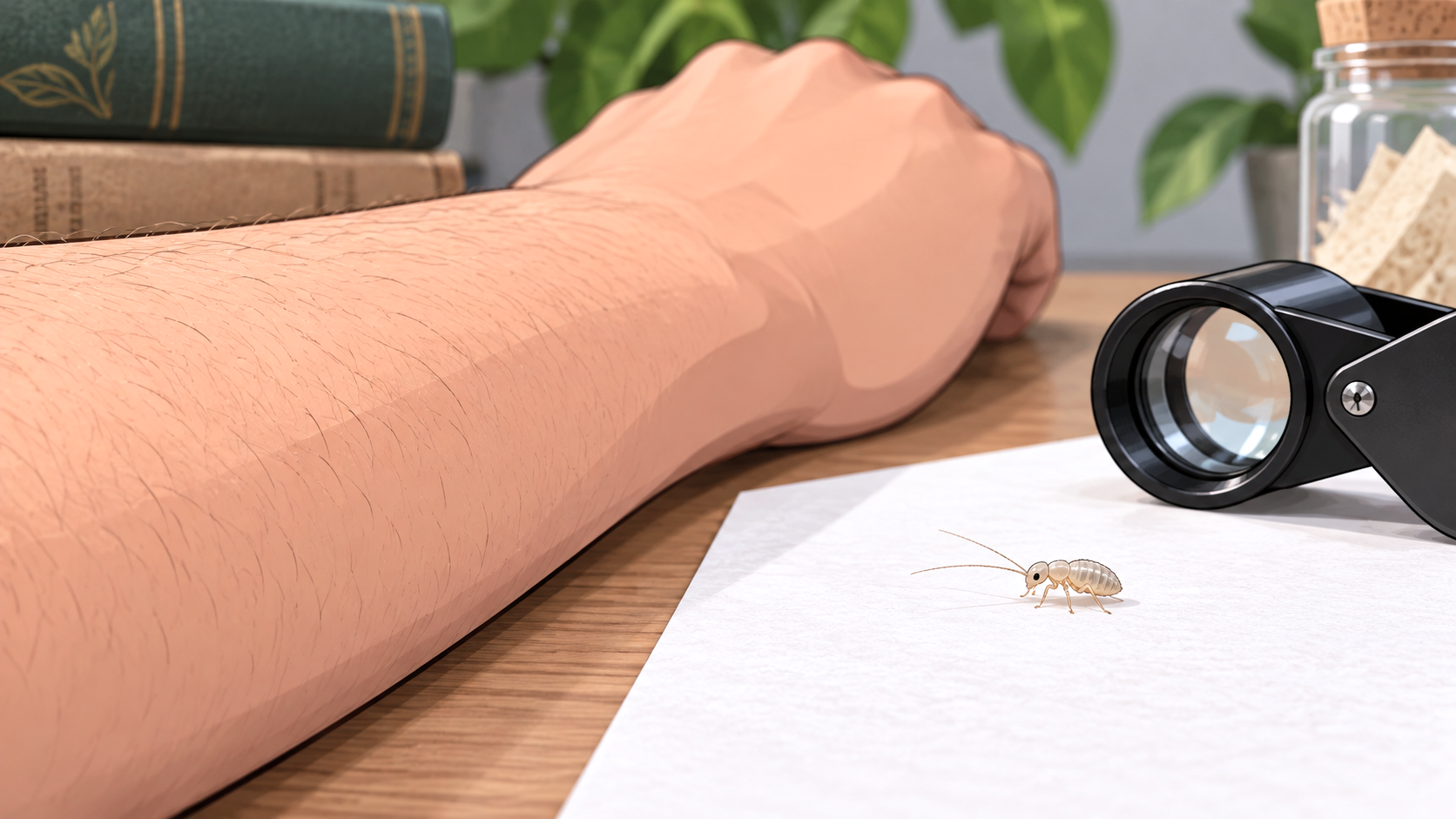
Finding booklice in a bedroom, bathroom, or even accidentally crawling on your skin can make biting an immediate concern. Their name does not help because “lice” suggests a parasite that lives on people and feeds on blood. Booklice have a completely different lifestyle and are not human parasites. No, booklice do not bite people or pets. They do not feed on blood and are not adapted to live on the human body. Household booklice mainly feed on microscopic mold, fungi, grains, and other suitable organic material. If you have unexplained bites or itchy marks, booklice are not the likely cause.
This is one of the most useful facts for identifying a suspected booklice problem. You can have large numbers of these insects in a damp part of a house without developing booklice bites.
Booklice Do Not Bite Humans
Booklice are considered harmless to people. They can become a substantial nuisance when populations grow, but biting is not part of their normal interaction with humans. They do not bite or otherwise harm human or animal health, despite sometimes being found in rooms where people sleep or spend considerable time.
The reason is simple. Humans are not a food source for booklice. Common indoor species primarily feed on microscopic fungi and mold, along with grains, insect fragments, and some other starchy or organic materials depending on the species. They have no reason to seek out a person for a blood meal.
This is fundamentally different from mosquitoes, fleas, bed bugs, and parasitic lice. Those organisms have feeding behaviors specifically associated with animals or humans. Booklice belong in a completely different ecological category.
If you see an insect that appears to be a booklouse and you are also developing skin marks, treat those as two separate observations until the insect has been identified correctly.
Booklice Have Mouthparts, but That Does Not Mean They Bite People
Booklice have chewing mouthparts, which can sound alarming without context. An insect having chewing mouthparts does not automatically mean those mouthparts are used to attack human skin.
Booklice use their mouthparts to feed on the materials that make up their normal diet. Indoors, that primarily means mold and fungi, although some species also consume grains, insect fragments, and suitable starchy materials.
Their feeding biology is therefore completely different from a bed bug piercing the skin to obtain blood. Booklice are not blood feeders and are not equipped with the specialized blood-feeding lifestyle of a human parasite.
The presence of chewing mouthparts should not be interpreted as evidence that a tiny insect can or normally will bite a person.
There Is No Normal “Booklice Bite” to Identify
Because booklice do not bite people, there is no characteristic booklice bite pattern to look for.
You should not expect a particular arrangement of red bumps, a certain size of welt, or a distinctive itching pattern from booklice. Photos online claiming to show typical “booklice bites” should therefore be treated cautiously unless another cause for the skin reaction has been established.
This becomes particularly important when someone notices insects and skin irritation at roughly the same time. It is natural to connect the two events, but proximity does not establish causation. A humid bedroom can contain booklice while an unrelated skin condition or another arthropod is responsible for the marks.
If the insects have been correctly identified as what booklice actually look like, biting can be removed from the list of problems those insects are causing.
Booklice Do Not Feed on Blood
Blood is not part of the normal booklice diet.
Household booklice are closely associated with fungi, mold, and damp organic material. Some stored-product species can also exploit grains and cereal-based foods. Their broader diet is covered in what booklice eat, but human blood is not one of those food sources.
This distinction separates them immediately from several pests that can occur indoors. Bed bugs require blood meals throughout their development. Fleas feed on blood. Human lice are permanent or near-permanent parasites associated with their hosts. Booklice can complete their entire life cycle without feeding on a person.
Even an established population containing adults, booklice nymphs, and eggs can live in a house without using the occupants as food.
Booklice Are Not the Same as Head Lice
The word “lice” creates more confusion here than almost anything else.
Booklice and parasitic lice are both within the broader order Psocodea, but their lifestyles are radically different. Human head lice live among scalp hair and survive by feeding on blood. Booklice live in the environment and feed mainly on fungi and other suitable materials.
Head lice are specifically adapted for life on a human host. They remain close to the scalp, crawl among hairs, and attach eggs to hair shafts. Booklice do not establish themselves on the scalp and do not attach their eggs to human hair.
This means finding a tiny insect near a book or damp wall should not trigger head-lice treatment simply because its common name contains “lice.” The differences between booklice and human lice become quite obvious once their appearance and behavior are compared.
Correct identification matters because the response to each pest is completely different.
Booklice Do Not Bite Pets Either
Cats, dogs, and other household pets are not normal hosts for booklice.
A booklouse can accidentally crawl across fur just as it can crawl across your hand, clothing, furniture, or almost any other nearby surface. That does not mean the insect is feeding on the animal or establishing an infestation in its coat.
Booklice are considered harmless to people and pets. Their preferred indoor habitats are damp, warm, relatively undisturbed places where mold and fungi are available.
If a pet is persistently scratching or has irritated skin, do not assume booklice are responsible simply because tiny insects have been found elsewhere in the house. Fleas, mites, allergies, infections, and other causes require separate consideration.
Treating a pet for booklice would therefore target the wrong problem.
Can Booklice Crawl on Your Skin?
Yes. A booklouse can crawl onto your skin, but crawling is not biting.
These insects are extremely small, commonly around 1 to 2 millimeters long, and they can wander from infested materials onto nearby objects. If you handle a damp cardboard box, book, stored product, or another material containing booklice, one could end up on your hand or arm.
The same thing can happen if you sit or sleep near an area containing a large population. An individual insect wandering onto your body is possible without your body becoming its habitat.
You may even feel a crawling sensation if you are particularly aware of the insect. That sensation still does not mean the booklouse has bitten you.
Removing the insect and investigating where it came from is more useful than treating the skin for a nonexistent booklice bite.
Can Booklice Live in Your Hair?
Booklice are not adapted to establish populations in human hair.
An individual can accidentally end up in your hair after contact with an infested environment, but it does not have the specialized biology of a head louse. Human hair does not provide the normal food and habitat required by booklice.
This becomes an important identification clue when insects repeatedly appear directly on the scalp. If live insects remain in the hair and eggs appear firmly attached near the scalp, investigate head lice rather than assuming environmental booklice have somehow adapted to living there.
Finding an occasional booklouse in your hair should instead lead you back to the surrounding room. A humid bookshelf, damp wall, bathroom, cardboard storage area, or another nearby source may explain how the insect reached you.
If Booklice Do Not Bite, What Is Causing the Marks?
If you have genuine bite-like marks, another explanation is needed.
Bed bugs are an obvious possibility in a bedroom, but skin marks alone cannot reliably diagnose them. Fleas, mosquitoes, and certain mites can also bite people. Depending on the appearance and circumstances, some non-pest skin conditions can resemble arthropod bites as well.
Avoid choosing a pest based solely on the appearance of a bump. Even bed bug bites can be difficult to distinguish from other skin reactions without additional evidence. Look for the insect itself and other characteristic signs in the environment.
This is particularly important when the only insects you have actually found are booklice. A confirmed booklouse does not become a biting pest simply because an unexplained skin mark appeared at the same time.
If the marks are persistent, worsening, painful, infected, widespread, or accompanied by other concerning symptoms, medical evaluation is more appropriate than trying to identify the cause from internet photographs alone.
Booklice Can Be Confused With Bed Bug Nymphs
Misidentification can make the biting question considerably more confusing.
A newly hatched bed bug is small enough to overlap in size with an adult booklouse. Young bed bugs can also appear pale or translucent, which makes a quick glance unreliable. However, their body shapes and feeding behaviors are different.
Booklice typically have a relatively broad head and long slender antennae. Bed bugs have a broader, more oval body with a proportionally narrower head. A recently fed bed bug nymph can also show blood through its body.
Adult bed bugs are considerably larger than booklice, making mature specimens easier to separate. The difficult comparison is mainly between a tiny booklouse and a very young bed bug.
If unexplained bites are occurring and you have found tiny pale insects near the bed, carefully comparing booklice with bed bug nymphs is much safer than assuming either identification from size alone.
Booklice Can Also Be Confused With Mites
Mites create another source of confusion because some are extremely small and difficult to identify without magnification.
Booklice are insects and have six legs. Adult mites are arachnids and normally have eight legs, although immature mite stages can complicate identification. Booklice also have conspicuous antennae, whereas mites do not have antennae.
The distinction becomes especially important because “mite” describes an enormous variety of organisms with very different feeding behaviors. Ordinary house dust mites do not bite people, while certain other mites associated with birds, rodents, or other hosts can bite humans under particular circumstances.
A tiny moving speck should therefore not be diagnosed solely as “booklice” or “mites” from its size. Magnification and a clear photograph can reveal features that are impossible to see with the naked eye.
Booklice Do Not Transmit Disease Through Bites
There is no booklice biting cycle through which disease is transmitted to people.
Booklice are not considered disease vectors and do not otherwise have the human-health relationship associated with blood-feeding pests. This makes them very different from insects such as mosquitoes or body lice, where feeding can have direct medical significance.
Their indoor importance is mainly as nuisance insects, stored-product contaminants, and indicators of damp conditions. A large population can be unpleasant to discover, but its presence does not turn the insects into blood-feeding vectors.
That does not mean every problem associated with a damp environment should be ignored. Moisture and mold can require attention independently of the booklice. The important point is that biting and disease transmission are not the reasons to control these insects.
What Should You Do If Booklice Are Crawling Around Your Bedroom?
Concentrate on the environment rather than your skin.
Check for condensation, plumbing leaks, damp walls, wet cardboard, books stored against a humid surface, houseplants, and other sources of localized moisture. Booklice thrive where humidity supports both the insects and the fungi they eat.
Persistent populations are generally controlled by drying the affected area. When relative humidity remains below approximately 45 to 50 percent, conditions become unfavorable for household psocids. Fixing leaks and drying concealed moisture are equally important because a dehumidifier cannot compensate for a continuously wet material.
If you are simultaneously experiencing unexplained skin marks, investigate that as a separate issue. Confirming booklice explains the tiny insects you found, but it does not explain bites.
For the insects themselves, the broader steps for getting rid of booklice focus on eliminating the damp habitat that allows the population to persist.
Questions About Booklice Bites
What do booklice bites look like?
There is no characteristic booklice bite because booklice do not bite people. Red bumps, welts, or itchy marks require another explanation rather than being identified as booklice bites.
Can booklice make you itch?
Booklice do not bite, so an itchy bump should not be attributed to a booklouse bite. If itching persists, consider other insects, environmental irritants, or skin conditions and seek medical advice when appropriate.
Can booklice bite you while you sleep?
No. Booklice are not blood feeders and do not seek sleeping people for meals. Finding them in a bedroom does not mean they are responsible for marks that appear overnight.
Can booklice bite cats or dogs?
Booklice do not bite pets. They can accidentally crawl onto an animal, but cats and dogs are not their normal hosts or food source.
What should I do if I have bites and booklice in the same room?
Treat the two observations separately. Confirm that the insects are actually booklice, then investigate another explanation for the skin marks. If the marks are persistent or medically concerning, seek appropriate medical evaluation rather than assuming the insects you happened to find caused them.
6 thoughts on “Do Booklice Bite?”