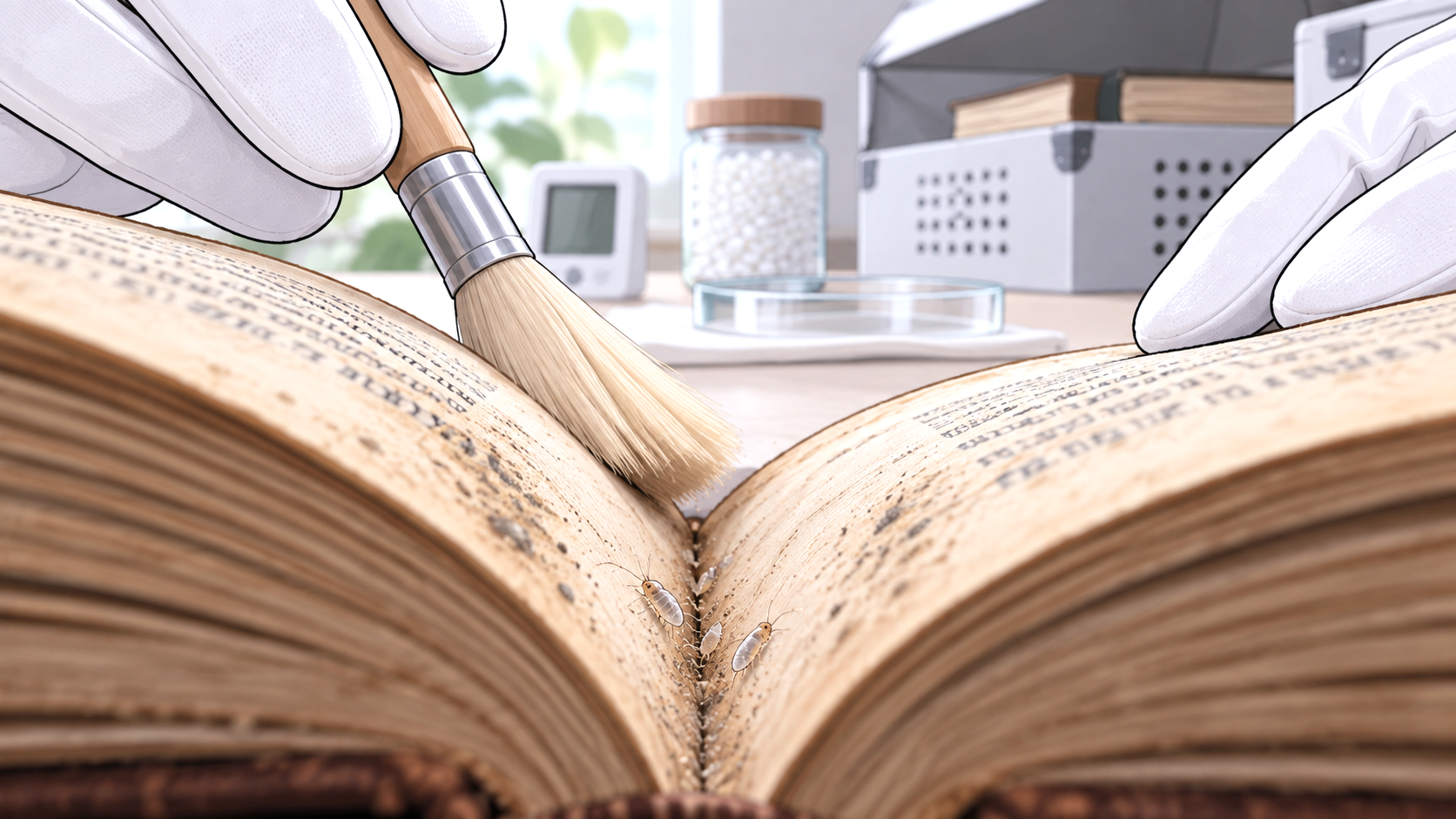
Finding tiny insects running across a page or disappearing into a book’s binding can make throwing the entire collection away seem tempting. Usually, that is unnecessary. Booklice are strongly associated with damp books because moisture supports the microscopic fungi they commonly eat, and drying the books and their surroundings removes the conditions that allow the insects to persist.
To get rid of booklice in books, move affected books to a dry area, isolate them from the rest of the collection, reduce relative humidity below about 50%, carefully remove visible insects, and dry the bookshelf and surrounding room. Avoid spraying books with pesticides or household liquids. Persistent moisture must be corrected or the booklice can return. The condition of the books matters too. A few booklice on otherwise dry modern books is very different from hundreds of insects in a damp, moldy collection.
Make Sure the Insects Are Actually Booklice
Before treating a collection, examine the insects closely. Booklice are extremely small, soft-bodied insects with relatively broad heads and long, slender antennae. Their tiny size can make identification difficult without magnification.
Their color can range from nearly translucent to gray, tan, brown, and darker shades. They usually crawl rather than making the conspicuous jumps associated with springtails. Several other tiny arthropods can occur around books, so checking what booklice look like before treating an entire collection can prevent unnecessary work.
The type of damage can also provide a clue. Booklice are not comparable to silverfish or book-boring beetle larvae that can produce obvious physical feeding damage. If pages contain substantial holes, missing areas, tunnels, or extensive surface scraping, do not automatically blame booklice.
Separate Affected Books From the Collection
When several booklice are concentrated on particular books, temporarily separating those volumes makes the problem easier to manage. It also gives you an opportunity to inspect the shelf and nearby books instead of repeatedly finding insects without knowing where they are concentrated.
Handle the books gently and avoid crushing booklice against pages. Squashed insects and their excretions can stain paper, even though booklice generally cause little direct feeding damage. The Canadian Conservation Institute notes that booklice feed on mold spores on paper and can soil paper through their bodies and excretions.
Isolation does not mean sealing damp books indefinitely in an ordinary plastic bag. Trapping moisture with a damp book can preserve the conditions that encourage mold. If the book is wet, visibly moldy, historically important, or otherwise valuable, preservation considerations become more important than ordinary household pest control.
Dry the Books and Lower the Humidity
Drying is the central treatment for booklice in books.
Indoor booklice thrive in damp environments and commonly feed on fungi and molds. In homes, reducing relative humidity below about 45% to 50% makes conditions unsuitable for continued booklouse survival. Keeping books and papers off damp floors also reduces their exposure to moisture.
Use a hygrometer to measure the room rather than relying on how dry it feels. If humidity is high, a dehumidifier can help maintain a consistently drier environment. Improving ventilation and air circulation can also help affected books release moisture, provided the surrounding air itself is reasonably dry.
Do not expect the insects to disappear within hours. Liposcelis booklice can survive dry conditions temporarily, but prolonged dryness eventually becomes lethal. Conservation guidance describes airing and drying affected objects as an effective way to control smaller numbers of psocids.
Carefully Remove Visible Booklice
Physical removal can reduce the number of insects while the books and room are drying.
For ordinary modern books in good condition, visible booklice can be gently removed without saturating the pages with a treatment. A soft brush can help dislodge insects from sturdy surfaces, while careful vacuuming around shelves, cracks, and surrounding storage areas removes booklice that have wandered away from the books.
Vacuuming is generally more effective than sweeping or mopping for physically removing pests. Be much more cautious when vacuuming a fragile book itself. Brittle pages, loose bindings, detached fragments, decorative elements, and damaged covers can be harmed by suction.
The goal is not to chase every individual booklouse through hundreds of pages. Physical removal reduces the current population, while sustained drying prevents the environment from continuing to support it.
Clean and Dry the Bookshelf Too
Treating the books while leaving them on a damp shelf can send you in circles.
Remove the books and inspect the entire shelving unit. Pay attention to the rear corners, joints, wall behind the shelf, baseboards, and any cardboard storage nearby. Vacuum cracks and remove accumulated debris. If the shelving or wall is damp, determine why before putting the collection back.
Bookshelves against cool exterior or basement walls can develop localized humidity that is not obvious elsewhere in the room. Condensation, plumbing leaks, water intrusion, or poor airflow behind tightly packed furniture can create a favorable microenvironment even when the center of the room seems comfortable.
If booklice are appearing throughout the collection and on walls, cardboard, windowsills, or nearby materials, check the broader signs of a booklice infestation rather than assuming the problem is confined to individual books.
Do Booklice Actually Eat Books?
Booklice can be associated with books without consuming ordinary paper in the way people often imagine.
Indoor booklice primarily feed on molds and fungi, although psocids can also consume starches and other suitable organic materials. Bookbinding adhesives and related materials can provide food for some species, which helps explain their long association with books. The University of Minnesota notes that booklice can consume molds, fungi and starchy materials including bookbinding glue.
Other authorities emphasize that their direct physical damage is generally limited. Booklice commonly graze surfaces rather than eating holes through objects, and small numbers are rarely considered a serious threat to a collection.
That distinction matters when deciding what to save. Finding booklice does not automatically mean a book has been structurally ruined. Booklice damage to books is usually much less dramatic than the damage caused by pests that actively consume paper or tunnel through books.
Check the Books for Mold
Booklice and mold frequently occur together because they benefit from similar damp conditions and because fungi provide food for the insects.
Look for visible fungal growth, unusual spotting, dampness, or a persistent musty odor. Do not aggressively brush active mold from a valuable book indoors, since disturbing mold can release spores. Extensive mold also changes the problem from simple pest removal to preservation and potential health protection.
The Canadian Conservation Institute recommends dealing with mold or insects on books promptly. Its guidance for valuable collections recommends isolating dry moldy or infested books and seeking help from a paper conservator, while wet books require specialized handling because mold can develop rapidly.
For an ordinary household collection, correcting the dampness is still essential. Booklice can feed on mold, which is one reason reducing moisture addresses both the insects and the conditions supporting their food supply. Whether booklice eat mold explains that relationship more specifically.
Should You Spray Booklice in Books?
Spraying books with household insecticide is usually unnecessary and can introduce a new problem.
Booklice infestations respond primarily to moisture control. Household guidance states that pesticides are normally unnecessary because correcting the water or humidity problem is more effective. A spray may kill exposed insects while leaving hidden individuals, eggs, fungal food, and dampness untouched.
Books also contain materials that may react poorly to liquids and solvents. Paper, inks, coatings, adhesives, leather, cloth, and decorative finishes can stain, warp, fade, soften, or otherwise deteriorate after inappropriate treatment.
Do not spray pesticide between pages or soak the binding in an attempt to reach hidden booklice. If an unusually serious infestation affects a valuable collection, professional pest management should be coordinated with someone familiar with conservation rather than treating the books like an ordinary household surface.
Should You Use Vinegar or Rubbing Alcohol on Books?
Vinegar and rubbing alcohol are poor choices for treating books, regardless of whether they can affect an exposed booklouse.
The important question is not whether a liquid can kill one insect on contact. It is whether the method can eliminate the infestation without damaging the object. Wetting paper and bindings with household liquids can cause staining, distortion, ink changes, adhesive problems, and other irreversible damage.
The same caution applies to bleach, essential oils, and improvised sprays. A book that only needed drying should not end up permanently damaged because the treatment was more aggressive than the pest.
Even when considering natural ways to get rid of booklice, moisture control and physical removal remain preferable around books. “Natural” does not make a liquid safe for paper.
Can You Freeze Books to Kill Booklice?
Freezing is a legitimate pest-management technique for some collection materials, but it needs more precision than simply placing a book in a household freezer overnight.
Successful low-temperature treatment depends on the pest, temperature, exposure time, and whether the entire object reaches the required temperature. The Canadian Conservation Institute includes low-temperature treatment among established collection pest-control methods, but not every object is suitable for freezing.
Books can contain leather, adhesives, photographs, coated materials, media, or other components that respond differently to temperature and moisture changes. Condensation during handling can also undermine the goal of keeping a collection dry.
For ordinary booklice on otherwise sound books, sustained drying is usually simpler. If freezing is being considered for a valuable item or serious contained infestation, the exact procedure matters. Whether freezing kills booklice provides more context on the method.
What About Rare, Antique, or Valuable Books?
Do less experimentation, not more.
An inexpensive paperback can tolerate handling that would be inappropriate for a centuries-old binding, manuscript, photograph album, or collectible first edition. Valuable books may contain sensitive inks, pigments, leather, parchment, adhesives, coatings, or previous repairs that make improvised pest treatments risky.
If a valuable book is dry but infested, isolate it carefully and consult a qualified paper or book conservator before applying chemicals or subjecting it to extreme temperatures. If it is wet or actively moldy, professional advice becomes even more important.
Proper storage also protects the object after treatment. High humidity encourages mold and insect activity, while extremely low humidity can make some book and binding materials brittle. The goal for a collection is a stable, appropriately controlled environment, not simply the lowest humidity you can produce.
Why Do Booklice Keep Coming Back to the Books?
Repeated booklice usually mean the habitat has not changed enough.
The books may still contain excess moisture, the shelf may sit against a damp wall, or room humidity may continue rising for part of each day. Cardboard boxes nearby can also hold moisture, and a hidden leak can support fungal growth in an area that appears dry from the outside.
Another possibility is that the insects are developing somewhere else and merely wandering onto the books. Booklice can occur in numerous humid locations, so check other damp areas of the home rather than repeatedly treating the same shelf. How booklice get into a house in the first place can help identify other potential sources.
Use a hygrometer and watch the pattern over time. If booklice steadily decline after the books and room are dried, the control strategy is working. If large numbers continue appearing, search for another moisture source rather than repeatedly treating the pages.
How to Prevent Booklice From Returning to Books
Store books somewhere consistently dry and well ventilated. Avoid damp basements, garages, and other locations with large fluctuations in temperature and humidity when better storage is available. Keep books off potentially damp floors and leave enough circulation around shelving to prevent persistent humid pockets.
Inspect stored cardboard and nearby paper materials periodically, particularly after leaks, flooding, or unusually humid weather. A collection that has become wet should be dried promptly because moisture threatens books through mold and material deterioration even without booklice.
Prevention is ultimately about the environment. Booklice may occasionally arrive with books, boxes, packaging, or other belongings, but a dry collection gives them little opportunity to establish a large population. Steps for preventing booklice from getting into books can further reduce the chance of another problem.
Questions About Getting Booklice Out of Books
Do I need to throw away books with booklice?
Usually not. Small numbers of booklice rarely cause serious direct damage, and drying the books and their environment can eliminate the conditions supporting them. Discarding may make sense for inexpensive material that is severely moldy or water damaged, but valuable books should be evaluated rather than automatically thrown away.
Can booklice eggs be hidden inside books?
Booklice lay very small eggs, which can be difficult to find among books and surrounding materials. Trying to locate every egg individually is impractical, which is another reason environmental control is more useful than relying on manual removal alone. You can see the identifying characteristics in what booklice eggs look like.
Will putting books outside get rid of booklice?
Only if doing so safely contributes to drying. Outdoor humidity, rain, direct sunlight, temperature changes, dirt, and other pests can expose books to additional damage. A controlled dry indoor environment is usually more predictable than leaving a collection outdoors.
Can I put infested books in plastic bags?
Temporary isolation can help contain insects, but sealing a damp book in a bag without an appropriate treatment plan can trap moisture. Dry, valuable, or mold-affected books may also require conservation-specific handling. Isolation should support the treatment rather than preserve the humid conditions booklice need.
How long will booklice survive after the books are dried?
They may not die immediately. Some Liposcelis can survive unfavorable dry conditions temporarily, so continue maintaining low humidity and removing visible insects. A steady decline over time is more meaningful than expecting every booklouse to disappear as soon as the room becomes dry.
One thought on “How to Get Rid of Booklice in Books”