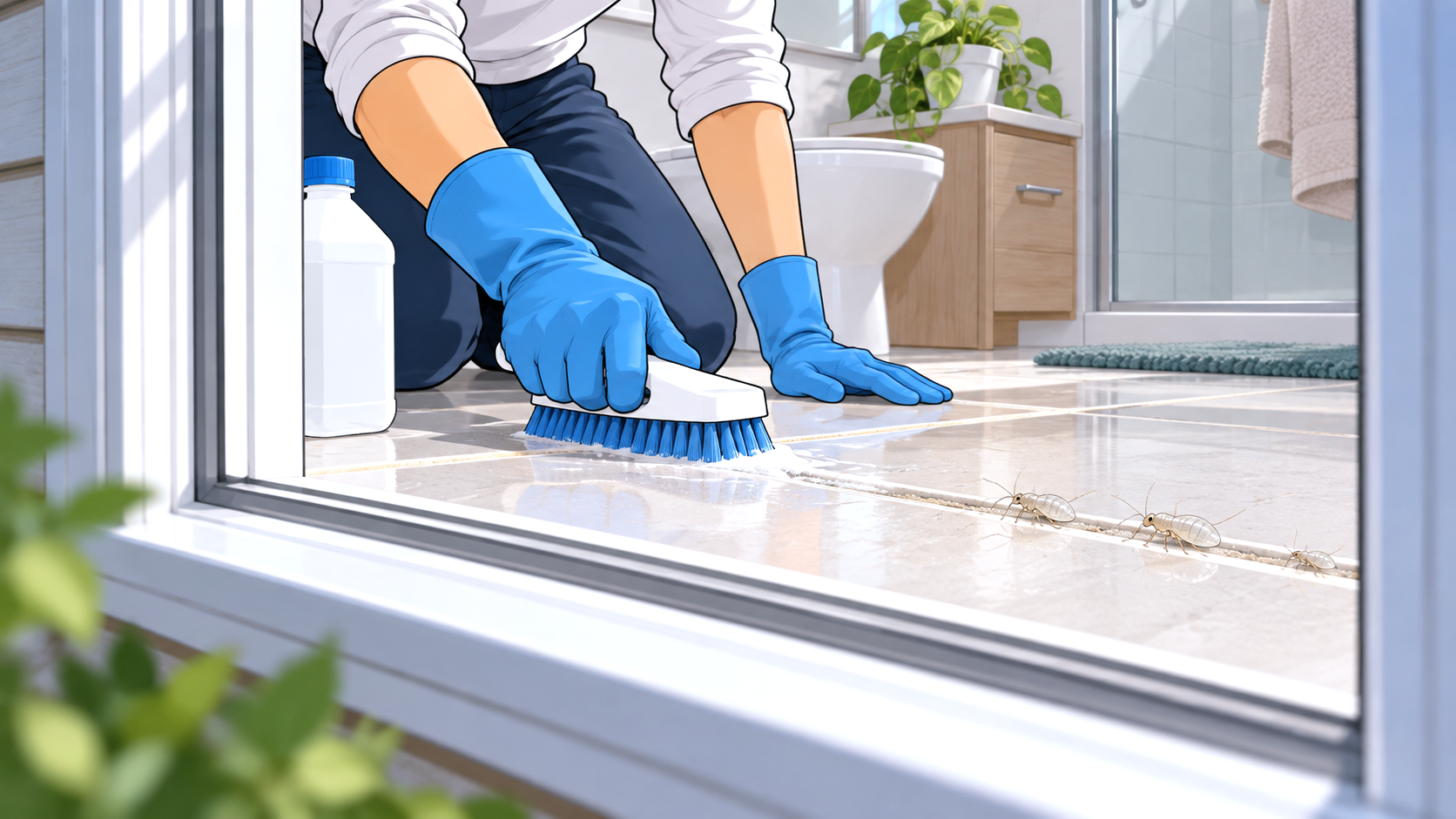
Seeing booklice crawling across a bathroom wall or damp windowsill makes bleach seem like an obvious solution. It is already sitting under the sink, it is used for cleaning, and booklice often occur in the same damp places where mold develops. The problem is that killing whatever happens to be on the surface is not the same as eliminating the conditions keeping booklice alive.
Bleach may kill booklice that are directly exposed to a sufficiently strong solution, but there is not good evidence supporting household bleach as a reliable treatment for a booklice infestation. Booklice usually persist because of moisture and fungal growth. Reducing humidity, correcting leaks, drying damp materials, vacuuming visible insects, and cleaning affected areas provide much more dependable control.
Bleach Is Not an Established Booklice Treatment
Household bleach contains sodium hypochlorite and is designed primarily for cleaning, whitening, and disinfection. That does not automatically make it an effective insecticide for every household pest.
More importantly, authoritative booklice control recommendations do not rely on bleach. They focus on reducing moisture because indoor booklice thrive in warm, humid environments and commonly feed on microscopic fungi. Keeping relative humidity around 45 to 50 percent or lower creates conditions in which they cannot survive well.
The same pattern appears in other booklice recommendations. Reducing humidity below 50 percent, correcting leaks, removing mold-supporting materials, cleaning infested areas, and improving ventilation are the measures repeatedly used for control. Chemical treatment is generally considered unnecessary.
So even if bleach kills an individual booklouse that gets soaked with it, that is not a good reason to make bleach the treatment itself.
Why Bleach Can Seem to Work
Imagine finding ten booklice on a damp bathroom wall. You wipe the wall with bleach, and afterward none are moving. It is easy to conclude that the problem has been solved.
What you have actually done is remove or kill the insects that happened to be exposed on that surface. Booklice can also occupy cracks, wall voids, cardboard, cupboards, books, trim, stored foods, and other protected locations. Their tiny size makes many of those hiding places easy to overlook.
The underlying moisture also remains unless you correct it. A bathroom wall that repeatedly develops condensation, for example, can continue providing favorable conditions after the bleach has dried.
That explains a common pattern with household pest remedies. The treatment appears successful for a day or two because the visible insects disappear, then more show up. In that situation, the returning booklice are a better clue than the initial kill.
Bleach Does Not Solve the Moisture Problem
Moisture is much more important to a booklice infestation than the cleaning product you choose.
Booklice commonly develop in humid buildings, damp stored materials, around plumbing, and in other places where moisture allows microscopic fungi to grow. They are especially associated with high relative humidity, and prolonged dry conditions are unfavorable to their survival.
This is why lowering humidity is so effective. Clemson recommends reducing indoor relative humidity below 50 percent, while Penn State similarly advises keeping relative humidity under 50 percent. The University of Minnesota notes that booklice cannot survive when relative humidity remains below roughly 45 to 50 percent.
A bleach solution cannot accomplish that. In fact, repeatedly wetting an area while ignoring a leak, condensation, or excessive humidity misses the part of the environment that actually supports the population.
What About Bleach Killing the Mold They Eat?
This is where bleach can have a legitimate cleaning role without becoming a booklice treatment.
Booklice feed heavily on molds and other microscopic fungi. Therefore, removing fungal growth and correcting the moisture that allowed it to develop can remove an important food source. The CDC says visible mold on suitable hard surfaces can be cleaned with household products, soap and water, or an appropriately diluted bleach solution.
However, mold cleanup still depends on solving the water problem. Cleaning visible growth while allowing the surface to remain damp gives mold an opportunity to return. The same principle applies to mold attracting booklice. Removing fungal growth helps, but lasting booklice control comes from making the location too dry to support the same cycle again.
Bleach can therefore be relevant when you are cleaning a bleach-safe moldy surface. That is different from spraying bleach around the house as a booklice insecticide.
Should You Spray Bleach Directly on Booklice?
We would not use bleach as a general-purpose booklice spray.
Booklice are so small that physically removing exposed insects is easy. A vacuum can collect adults, nymphs, debris, and other material without covering the surrounding area in a strong oxidizing chemical. The Canadian Conservation Institute recommends physical removal and vacuuming as useful pest-management measures for collections and objects.
Once the visible insects are removed, attention can move to the reason they were there. Check humidity, condensation, leaks, damp cardboard, stored foods, mold, and poorly ventilated storage.
That approach accomplishes more than repeatedly spraying the insects you happen to see.
Will Bleach Kill Booklice Eggs?
We would not rely on bleach to eliminate booklice eggs.
Booklice eggs are tiny and can be deposited in protected locations. A surface application cannot be assumed to reach every egg hidden in cracks, among materials, or elsewhere in an infested area.
There is also no established household bleach concentration and contact time that we can recommend as a validated treatment for booklouse eggs. Without that evidence, promising that wiping or spraying an area with bleach will kill all eggs would be guesswork.
This is one reason environmental control matters so much. You do not need to locate and chemically treat every microscopic egg if the surrounding environment becomes unsuitable for the insects to continue developing and reproducing.
Does Bleach Repel Booklice?
There is no good basis for treating household bleach as a booklice repellent.
A freshly cleaned surface may temporarily have fewer booklice because insects were physically wiped away and fungal material was removed. That should not be confused with a residual repellent effect.
Once the surface dries and the odor disappears, nothing about ordinary bleach cleaning fixes high room humidity, a leaking pipe, damp drywall, condensation, or wet stored materials.
If booklice repeatedly return to the same spot, investigate that spot instead of increasing the amount of bleach.
Using Bleach on Bathroom Booklice
Bathrooms are one of the places where the distinction between cleaning and pest control becomes especially important.
Suppose booklice are appearing beside a shower, around a window, or near the baseboard. Cleaning a bleach-safe hard surface may be appropriate if there is also visible mold. However, you should still look for persistent condensation, inadequate ventilation, deteriorating caulk, plumbing leaks, or damp material around the affected area.
Run the exhaust fan during and after showers, dry persistently wet surfaces, correct leaks, and use a dehumidifier when necessary. Those measures make the bathroom less suitable for booklice instead of simply removing the insects already visible.
The same moisture-first approach is more effective when booklice keep appearing on walls and windowsills elsewhere in the house.
Using Bleach on Kitchen Booklice
The kitchen requires a different approach because booklice may be associated with stored foods as well as general humidity.
Check flour, cereals, grains, powdered foods, cardboard packages, cupboard corners, and other dry goods if insects are concentrated around a pantry. Remove clearly infested or spoiled products, vacuum cracks and shelves, clean the cupboard, and store replacement foods in tightly closed containers.
Do not spray bleach onto food to try to save it, and do not assume wiping a cupboard with bleach treats insects inside packages. If the source is an infested food product, removing that source matters more than which cleaner you use on the shelf afterward.
Where no stored-food source is present, investigate moisture. A leaking sink connection, condensation around plumbing, or damp cabinet material can create the conditions behind repeated booklice in a kitchen.
Can You Use Bleach on Books?
Bleach is a poor choice for treating booklice in books.
Liquid bleach can discolor paper, affect inks and dyes, damage bindings, and introduce moisture into an object that you are trying to keep dry. Booklice in books are better handled through isolation, careful physical removal, drying, humidity control, and an appropriate non-liquid treatment when necessary.
This is particularly important because booklice do not normally consume plain paper as their primary food. Damp books can support microscopic fungi, while some booklice can also feed on suitable starchy materials associated with bindings.
The goal is therefore not to saturate the book with something toxic enough to kill an insect. It is to remove the insects while preserving the object and correcting the conditions that attracted them.
For suitable materials, controlled freezing can kill booklice without applying a liquid chemical to the pages.
What Should You Do Instead of Using Bleach?
Start by confirming that the insects really are booklice. They are usually around 1 to 2 millimeters long, with relatively broad heads, long threadlike antennae, soft bodies, and colors ranging from nearly clear to shades of gray, tan, and brown. Springtails and mites are commonly mistaken for them, so treatment based on the wrong identification can waste a lot of effort.
Next, find the moisture. Measure indoor relative humidity, inspect plumbing and windows, look for condensation, check damp cardboard and stored materials, and examine areas where repeated sightings occur. A dehumidifier can be particularly useful when the problem is high room humidity rather than a specific leak.
Vacuum visible insects and clean the affected surfaces. Remove moldy or badly contaminated disposable materials where appropriate. Keep books, cardboard, food, and other vulnerable materials dry and well ventilated.
That combination forms the basis of getting rid of booklice. It also explains why spraying progressively stronger household chemicals rarely improves the result.
Is Bleach Better Than Vinegar for Booklice?
Neither should be the foundation of a booklice treatment plan.
The relevant question is not which household cleaner is more lethal when poured directly onto a tiny insect. The useful question is whether either product can reliably reach the population, eliminate its life stages, and prevent the environment from supporting another generation.
Humidity control, drying, cleaning, source removal, and vacuuming have much stronger support for that job.
The same standard should be applied when evaluating vinegar for booklice, rubbing alcohol, baking soda, borax, essential oils, and similar DIY remedies. A substance producing an immediate effect on an exposed insect does not establish that it controls an infestation.
When Bleach Actually Has a Useful Role
Bleach makes the most sense when you have a separate reason to use it for cleaning or mold remediation on a compatible surface.
For example, if booklice are concentrated around a hard, moldy bathroom surface, cleaning that surface appropriately can remove material the insects feed on. The CDC permits diluted household bleach for certain mold-cleaning situations and advises fixing the moisture source as part of mold control.
The bleach is serving as a cleaning product in that situation. Your booklice strategy is still moisture reduction, source correction, cleaning, and physical removal.
That distinction keeps you from treating every wall, window, bookcase, or cupboard with bleach when a dehumidifier may do far more to control booklice throughout the room.
Bleach Safety Matters More Than Killing a Few Booklice
Never mix bleach with ammonia or other household cleaners. The CDC warns that mixing bleach with other cleaners can release dangerous vapors. Follow the product label, ventilate the area well, and use appropriate skin and eye protection when the label requires it.
Bleach can also damage or discolor many materials. Do not apply it indiscriminately to books, fabrics, carpets, wood finishes, electronics, painted surfaces, or other possessions simply because you found booklice there.
For mold cleanup, the appropriate method depends on the surface and extent of contamination. The CDC recommends addressing the moisture problem as well as removing the mold, rather than relying on repeated chemical application.
Booklice themselves generally do not justify exposing an entire room or collection of belongings to bleach.
Questions About Bleach and Booklice
Does bleach kill booklice instantly?
Direct exposure to bleach may kill an exposed booklouse, but there is no validated household bleach treatment we can recommend for reliably eliminating a booklice infestation. Removing visible insects and correcting moisture is a more useful control strategy.
Can I wipe my walls with bleach to get rid of booklice?
You can clean a bleach-compatible surface with bleach when there is an appropriate cleaning reason to do so, such as certain mold-cleanup situations. Do not expect the wipe-down alone to eliminate booklice living elsewhere. Repeated sightings usually justify checking humidity, condensation, leaks, and damp materials.
Can I pour bleach down a drain to kill booklice?
Booklice appearing around a sink or bathroom are not evidence that they are breeding inside the drain. Do not pour bleach into plumbing as a booklice treatment. Investigate moisture around the fixture and identify the insects first.
Will bleach keep booklice from coming back?
No reliable evidence shows that household bleach provides lasting booklice repellency. Booklice can return when favorable humidity, fungal food, or damp materials remain. Long-term prevention depends primarily on keeping susceptible areas dry.
Do I need bleach if I have booklice and mold together?
Not necessarily. Mold cleanup methods depend on the affected material and situation. What matters for both problems is correcting the moisture source, removing the mold appropriately, and drying the area. Bleach is an option for certain compatible hard surfaces, not a universal requirement.