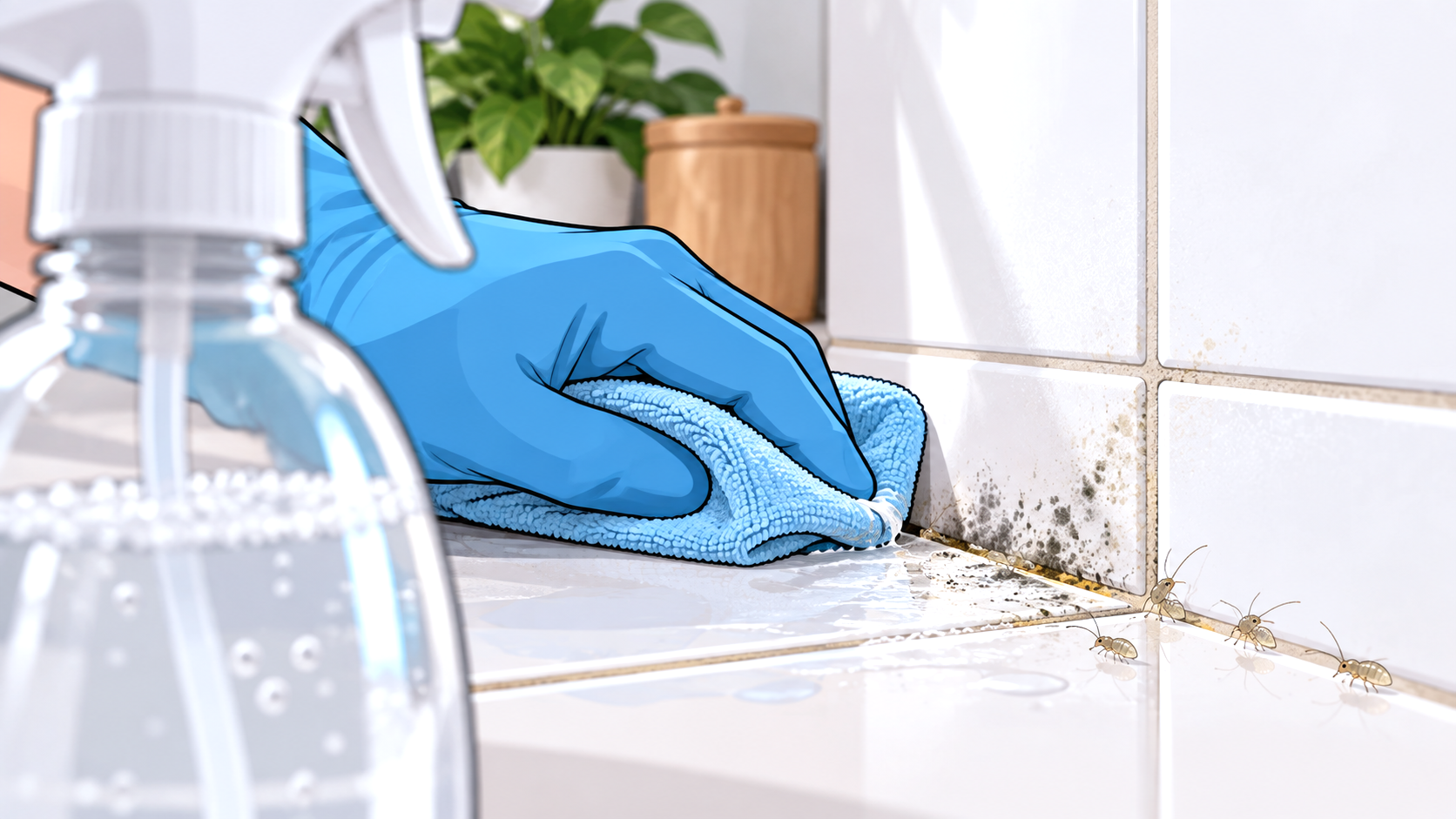
Vinegar is one of the first DIY remedies people reach for when tiny insects appear around a damp windowsill, bathroom wall, cupboard, or bookshelf. With booklice, that can create a misleading result. Wiping a surface with vinegar may remove insects that are already visible, but it does not address the conditions allowing the population to persist. Household vinegar is not a reliable treatment for booklice infestations. It may kill some booklice that receive sufficient direct contact, but it has no useful residual effect and cannot be relied on to reach concealed insects or eggs. Booklice are controlled more effectively by reducing humidity, correcting moisture problems, cleaning affected areas, and removing visible insects.
Why Vinegar Is a Poor Booklice Treatment
Ordinary white vinegar is a dilute solution of acetic acid. Acetic acid can damage living cells at sufficient concentrations, which helps explain why vinegar is repeatedly suggested as a homemade insect killer.
The problem is not whether an acidic liquid can affect a tiny insect when directly exposed. The problem is whether spraying that liquid around a house can eliminate a booklice population.
Booklice can occupy extremely small protected spaces. Common indoor forms are only about 1 to 2 millimeters long, so they can disappear into cabinet joints, cracks around trim, cardboard folds, wall spaces, book bindings, and similar locations. A surface spray cannot be expected to reach all of them.
Acetic acid also breaks down rapidly and leaves no lasting residue. Once household vinegar has dried, it does not provide a dependable residual treatment for booklice crossing the surface later.
Does Vinegar Kill Booklice on Contact?
Directly soaking a booklouse with vinegar may kill it, but contact killing has limited value when the insect is already exposed and easy to remove.
A vacuum, tissue, or damp cleaning cloth can remove the same visible insect without turning vinegar into an improvised pest treatment. Physical removal also makes it easier to monitor whether new booklice continue appearing afterward.
That matters because the insects crawling across a wall or shelf may represent only a small part of the population. Booklice are strongly associated with damp conditions, and the most effective control is correcting the underlying moisture.
If new insects appear after a vinegar treatment, spraying them again simply repeats the least important part of the job.
Vinegar Does Not Have a Proven Booklice Treatment Concentration
Household white vinegar is commonly around 5% acetic acid, while much stronger acetic-acid products are sold for other purposes. Those stronger products should not be treated as concentrated versions of a household booklice remedy.
Higher acetic-acid concentrations create greater risks to the skin and eyes. Concentrated products can be corrosive, and high-strength acetic acid can cause serious eye and skin injuries.
There is no established household vinegar concentration, application rate, or exposure period that should be used as a booklice treatment protocol. Increasing the concentration in an attempt to make vinegar more insecticidal therefore adds chemical exposure without providing a validated booklice-control method.
Does Vinegar Kill Booklice Eggs?
Do not depend on vinegar to eliminate booklice eggs.
Booklice eggs are extremely small and can be deposited in concealed locations. Even if an exposed egg were affected by direct contact with acetic acid, spraying a shelf, wall, or cabinet cannot guarantee contact with eggs hidden elsewhere.
This is one reason trying to kill every life stage individually is unnecessary for most indoor booklice problems. Their survival and reproduction are strongly tied to environmental moisture.
Sustained drying affects the population regardless of whether every egg has been located. Under sufficiently dry conditions, booklice cannot continue developing and reproducing normally.
Vinegar Does Not Remove the Main Cause of Booklice
Booklice thrive in humid environments and commonly feed on molds and other microscopic fungi. Their presence can therefore act as a useful warning that something nearby is staying too damp.
The most reliable way to eliminate booklice is dehumidification. Dry conditions affect the insects directly while also restricting the fungal growth that supplies much of their food.
Keeping relative humidity below approximately 50% is a practical target for indoor booklice control. At that point, conditions become increasingly unfavorable for the insects and the mold associated with their habitat.
Vinegar cannot lower room humidity, repair a leaking pipe, stop window condensation, dry a wall cavity, or improve bathroom ventilation. Those problems remain after the sprayed surface dries.
That makes booklice humidity control considerably more important than deciding which household liquid to spray.
What About Vinegar for the Mold Booklice Eat?
Cleaning fungal growth can remove food that supports booklice, but vinegar should not be confused with a complete solution to a moisture problem.
Booklice commonly feed on mold spores growing on damp materials. Books, paper, cardboard, stored products, and building surfaces can become suitable when moisture remains high.
Removing visible fungal contamination where appropriate can help, but the affected area must also be dried. Otherwise, the same moisture that supported the original growth remains available afterward.
The useful sequence is to stop the moisture, dry the material, clean or remove contaminated material as appropriate, and physically remove booklice. Whether vinegar belongs in the cleaning step depends on the material and the actual cleaning job, not on its reputation as a pest remedy.
Should You Spray Vinegar on Walls and Windowsills?
There is usually no reason to spray vinegar simply because booklice are crawling on a wall.
Vacuum or wipe away the insects and inspect the area. Windows deserve particular attention because condensation can repeatedly wet the frame, sill, trim, or nearby wall. Plumbing leaks and damp exterior walls can create similar localized problems.
A surface that repeatedly attracts booklice after cleaning is giving you useful information. Instead of increasing the amount of vinegar, determine why that location remains favorable.
When booklice keep appearing on walls or windowsills, persistent condensation or another source of moisture is a better target than the insects wandering across the paint.
Should You Spray Vinegar on Books?
Vinegar should not be sprayed onto books as a booklice treatment.
Paper, inks, adhesives, bindings, coatings, leather, and other book materials can respond differently to moisture and acids. Saturating pages also introduces liquid into an object that should generally be kept dry when booklice are present.
Booklice associated with paper collections are closely linked with humid storage and microscopic fungal growth. Dampness promotes both mold and booklice, making environmental control particularly important around books.
Move affected books to a dry environment when possible, isolate them from unaffected material, carefully remove visible insects, and lower the humidity around the collection. Suitable ordinary books can also be treated through controlled freezing for booklice when a physical treatment is needed.
Vinegar adds moisture without solving the reason the insects were able to persist.
What About Vinegar in the Kitchen?
Booklice in a kitchen should trigger an inspection before any liquid is sprayed.
Check flour, grains, cereals, dry pet food, cardboard packages, cupboard corners, and other stored products when insects are concentrated around a pantry. Booklice can contaminate stored foods, and affected products should be removed rather than sprayed with vinegar.
Dry food that is unaffected should be kept in tightly closing containers. Cupboards can then be vacuumed and cleaned while plumbing, condensation, and other possible moisture sources are checked.
This source-first approach is especially important for booklice in kitchens because a contaminated food package and a damp sink cabinet require completely different corrections.
Never apply vinegar to food as an attempt to kill booklice or salvage an infested product.
What About Vinegar in the Bathroom?
Bathrooms provide another situation where spraying the visible insects can distract from the real problem.
Steam, condensation, plumbing leaks, wet caulk, damp cabinets, and inadequate ventilation can all create favorable areas for booklice. If the room remains humid every day, wiping a few insects with vinegar changes very little.
Run effective exhaust ventilation during and after showers. Dry surfaces that repeatedly collect condensation and inspect plumbing when insects concentrate around a sink, toilet, tub, or vanity.
A bathroom booklice problem that keeps returning deserves a moisture inspection rather than progressively stronger vinegar applications.
Is Cleaning Vinegar Better Than White Vinegar?
A stronger vinegar product is not automatically a better pest treatment.
Products sold as cleaning vinegar can contain more acetic acid than ordinary food vinegar. Increasing the acid concentration also increases the potential for eye, skin, respiratory, and material damage.
Concentrated acetic-acid products can be substantially more hazardous than ordinary kitchen vinegar. Some pesticide products containing high concentrations of acetic acid carry strong hazard warnings because of their corrosive effects on eyes and skin.
There is no need to accept those additional risks for booklice when environmental control works without requiring an improvised acid spray.
Never Mix Vinegar and Bleach
Vinegar and bleach should never be mixed.
Acidifying sodium hypochlorite bleach can release dangerous chlorine gas. Household disinfectants and cleaners should not be combined unless their labels specifically instruct you to do so, and bleach should never be mixed with other cleaners or disinfectants.
This matters particularly when someone has already tried several DIY booklice remedies. Spraying vinegar after bleach, combining the products in a bottle, or applying them together does not create a stronger insect treatment. It creates a chemical hazard.
If bleach has already been used on an area, do not follow it with vinegar.
What Works Better Than Vinegar?
Start by removing exposed booklice. Vacuuming works well because it physically collects insects rather than depending on a chemical contact effect. Physical removal is an established pest-management method, and vacuuming is more effective than sweeping or mopping for removing many pests.
Then determine why the insects are there. Measure relative humidity, inspect for leaks and condensation, check damp cardboard and paper, and examine stored foods where appropriate.
Lower the humidity and keep affected materials dry. Booklice control is best achieved below about 50% relative humidity, where conditions become unfavorable for both the insects and much of the fungal growth associated with them.
A dehumidifier can help control booklice when the problem is excessive room humidity. A localized plumbing leak, on the other hand, needs repair rather than additional drying equipment.
The best response depends on the source, but none requires repeatedly coating household surfaces with vinegar.
When Vinegar Appears to Work
A vinegar treatment can look successful because spraying or wiping removes the insects that were visible at that moment.
If the room is already becoming drier at the same time, the population may decline afterward. Vinegar can easily receive credit for a change actually caused by lower humidity, removal of damp materials, seasonal drying, or cleaning.
Watch what happens at the original hotspot. If booklice return, look for the source rather than increasing the vinegar concentration.
If insects continue appearing despite sustained dry conditions, confirm that they really are booklice. Springtails, mites, and other tiny arthropods can resemble them from a distance, while booklice have a characteristic broad head and long antennae.
Correct identification and moisture control provide much more useful information than whether an exposed insect dies after being sprayed.
Safety note: Do not mix vinegar with bleach or other household chemicals. Strong acetic-acid products can injure the eyes and skin, and household vinegar should not be treated as a registered booklice pesticide. Follow product labels and use cleaning products only for their intended purposes.
Other Questions About Vinegar and Booklice
Will the smell of vinegar repel booklice?
Vinegar should not be relied on as a booklice repellent. Acetic acid evaporates and leaves little residual material, so the temporary odor does not provide dependable ongoing protection.
Can apple cider vinegar trap booklice?
Apple cider vinegar traps are commonly associated with fruit flies, not booklice. Booklice do not require a vinegar trap because exposed insects can be vacuumed while the damp conditions supporting the population are corrected.
Can I add vinegar to a dehumidifier?
No. Operate the dehumidifier according to its manufacturer instructions and put only the specified material into its tank or drainage system. Adding vinegar as a pest-control ingredient does not improve the drying process.
Can vinegar damage surfaces while treating booklice?
Yes. Acid-sensitive stone, some metals, finishes, coatings, adhesives, and other materials can be damaged by vinegar. The material being cleaned should determine which cleaning product is appropriate, not the presence of booklice alone.
3 thoughts on “Does Vinegar Kill Booklice?”