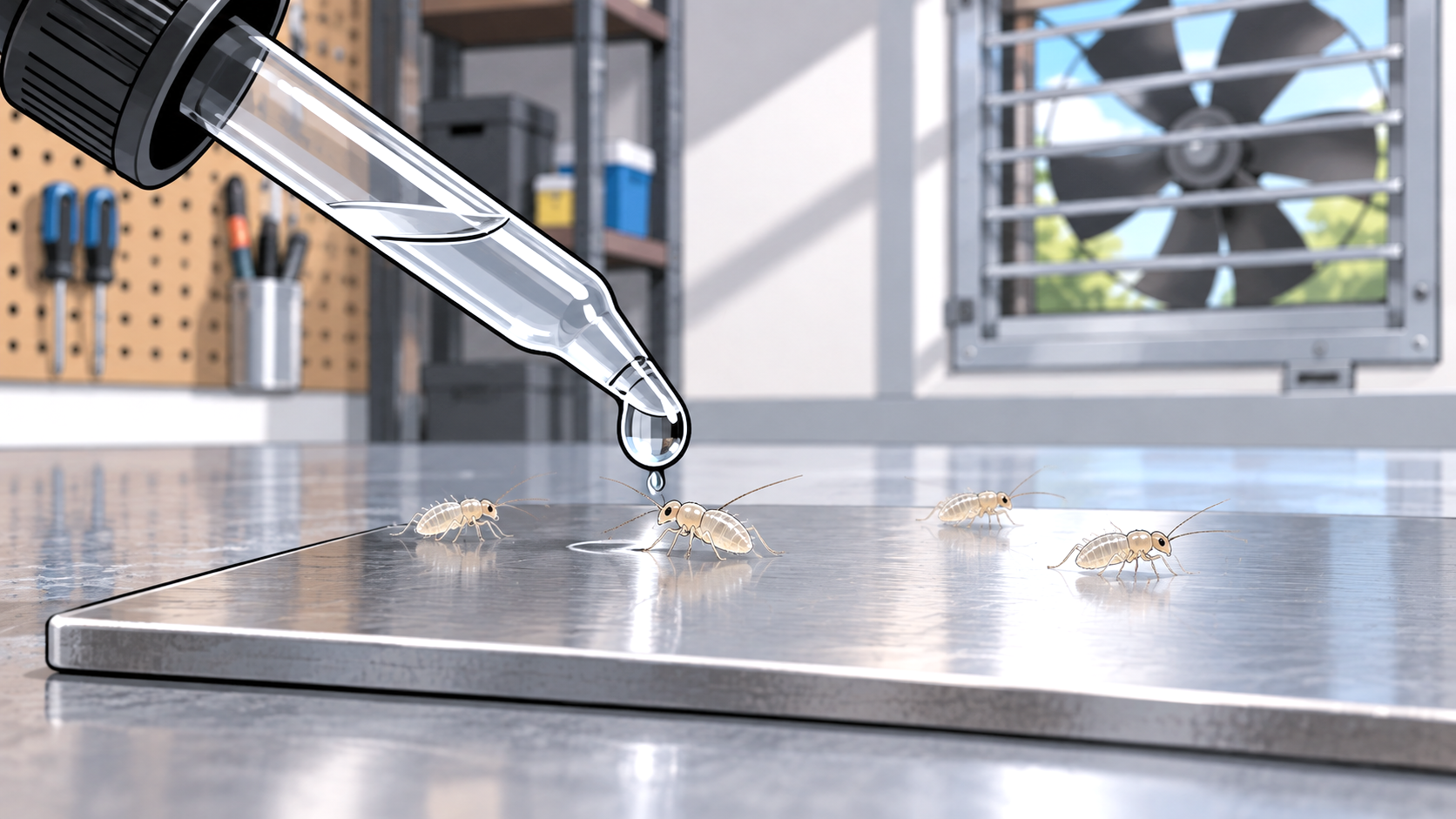
Rubbing alcohol often gets suggested for booklice because it evaporates quickly and can affect tiny insects on direct contact. That makes it tempting when booklice are crawling across a windowsill, bathroom wall, shelf, or cabinet. As an infestation treatment, however, rubbing alcohol has serious limitations and introduces an unnecessary fire hazard.
Rubbing alcohol can kill exposed booklice on direct contact, but it is not a reliable treatment for a booklice infestation. It evaporates quickly, provides no lasting control, and may not reach concealed insects or eggs. More importantly, isopropyl alcohol is highly flammable. Remove visible booklice physically and correct the humidity or moisture supporting them instead.
Why Rubbing Alcohol Can Kill an Exposed Booklouse
Rubbing alcohol usually contains isopropyl alcohol mixed with water. Isopropyl alcohol has biological activity and is used in disinfectants and other products, but its familiar household uses should not be confused with a validated treatment for booklice.
A booklouse directly saturated with rubbing alcohol can die from that exposure. The limitation becomes obvious once the insects are somewhere the liquid cannot reach.
Booklice are extremely small. Many common indoor species are only about 1 to 2 millimeters long, allowing them to occupy cabinet joints, gaps around trim, cardboard folds, book bindings, wall cracks, and other protected spaces. Spraying the insects visible on an exposed surface leaves those hiding places untreated.
Rubbing alcohol also evaporates rapidly. Once it has evaporated, it provides no useful residual barrier against booklice moving back across the surface.
Killing Booklice on Contact Is Not the Same as Getting Rid of Them
This is the main problem with using rubbing alcohol for booklice.
Suppose several insects are crawling across a bathroom windowsill. Spraying them may kill the individuals you hit, so the treatment appears to work immediately. More booklice can appear later because the population was never limited to those exposed insects.
Indoor booklice thrive where moisture remains high enough to support them and the microscopic fungi they commonly eat. They can occur around leaking pipes, damp cardboard, poorly ventilated cupboards, humid walls, stored foods, books, and other protected materials.
Successful booklice control therefore has to address the habitat. Killing ten exposed insects while leaving a damp cabinet or condensation problem unchanged does not accomplish that.
Does 70% Rubbing Alcohol Kill Booklice?
A 70% isopropyl alcohol solution can kill booklice that receive sufficient direct exposure, but there is no reason to turn that observation into a household treatment recommendation.
The percentage on the bottle does not tell you how effectively a spray will eliminate an infestation. A useful treatment would also need to reach concealed insects and eggs without creating unacceptable risks to people or property.
Research on Liposcelis bostrychophila also shows that tolerance to ethanol can change after acclimation to dry conditions. That finding reinforces a broader problem with treating alcohol concentration as a universal kill threshold for booklice.
There is no established household application rate or contact time for 70% rubbing alcohol that should be used as a booklice treatment protocol. For an insect that is already visible, a vacuum or physical wipe is simpler and avoids spreading a flammable liquid around the room.
Will Rubbing Alcohol Kill Booklice Eggs?
Do not depend on rubbing alcohol to eliminate booklice eggs.
Booklice eggs are tiny and can be laid in protected locations. Even if alcohol affected an egg that was completely exposed to it, spraying a shelf or wall would not establish that every concealed egg received the same exposure.
That makes egg control another weakness of contact-only remedies. The insects you can see are not necessarily the entire population.
Drying the environment works differently. Instead of trying to locate every individual egg, nymph, and adult, you make the habitat progressively less capable of supporting the population. Booklice are particularly vulnerable to prolonged low humidity, which is why moisture control appears repeatedly in established management recommendations.
The Fire Risk Makes Rubbing Alcohol a Poor Pest Spray
The strongest reason not to spray rubbing alcohol around a home is its flammability.
Isopropyl alcohol produces flammable vapor and can ignite around flames, sparks, cigarettes, and other ignition sources. Household pest-control guidance specifically warns against using rubbing alcohol as an improvised insect treatment because it evaporates quickly, is flammable, and has been associated with house fires.
That warning is published for bed bug control, but the chemical hazard does not change because the target insect is a booklouse. Spraying isopropyl alcohol across walls, furniture, shelves, mattresses, electrical equipment, or an entire room creates the same underlying flammability concern.
Rubbing alcohol also burns in ways that can make flames difficult to see. Serious burn injuries associated with isopropyl alcohol have led to specific flammability warnings for consumers.
A tiny nuisance insect does not justify turning a room into a larger fire risk.
Do Not Spray Rubbing Alcohol Around Electrical Equipment
Booklice sometimes appear around computers, televisions, game consoles, outlets, power strips, and other electronics, particularly when the surrounding environment is humid.
Do not respond by spraying rubbing alcohol into vents, sockets, switches, or powered equipment. Although isopropyl alcohol has legitimate electronics-cleaning applications under controlled circumstances, pouring or spraying household rubbing alcohol into an assembled electrical device is not a booklice treatment.
Disconnecting an appliance does not automatically make indiscriminate liquid application appropriate either. Household rubbing alcohol contains water, and electronics vary considerably in their materials and construction.
Booklice themselves do not normally damage electronics by feeding on their components. Repeated insects around electronics should instead prompt an inspection of the surrounding humidity, condensation, storage conditions, and nearby materials.
Rubbing Alcohol Can Damage Household Materials
Fire is not the only consideration.
Isopropyl alcohol can affect some finishes, coatings, plastics, adhesives, inks, paints, and other materials. A treatment that kills a tiny insect but clouds a plastic surface, removes a finish, or damages a valuable object is a poor trade.
Books deserve particular caution. Spraying liquid into pages or bindings adds moisture and can affect inks, coatings, adhesives, and other components. Booklice associated with books are better addressed by drying the collection, lowering room humidity, physically removing insects, and using an appropriate controlled treatment when necessary.
For suitable ordinary books, controlled freezing can kill booklice without repeatedly wetting pages with an improvised spray.
Using Rubbing Alcohol on Bathroom Booklice
Bathrooms are one of the easiest places to mistake an immediate kill for successful control.
Booklice may gather around condensation, shower areas, windows, plumbing, cabinets, or other persistently damp locations. Spraying the insects does nothing about water collecting on a windowsill or a slow leak beneath the vanity.
Vacuum or wipe away exposed insects, then determine why that particular location stays damp. Run effective exhaust ventilation during and after bathing, dry persistent condensation, inspect plumbing, and improve airflow where needed.
Keeping the room dry is the central part of removing booklice from a bathroom. Once the favorable environment disappears, chasing individual insects with rubbing alcohol becomes unnecessary.
Using Rubbing Alcohol on Kitchen Booklice
A kitchen infestation requires an additional check for stored foods.
Booklice can occur in flour, cereal, grains, dry pet food, packaging, and other stored products. Spraying rubbing alcohol around a pantry cannot rescue contaminated food and should not be applied to food.
Inspect susceptible packages when booklice are concentrated inside cabinets. Discard infested or spoiled products as appropriate, vacuum shelf joints and cracks, and keep replacement foods in tightly closing containers. The cabinet should also be checked for plumbing leaks, dampness, and poor airflow.
When booklice occur in the kitchen, removing an infested food source can matter far more than anything sprayed onto the shelf afterward.
Rubbing Alcohol Does Not Remove the Conditions Booklice Need
Booklice are strongly associated with moisture.
Indoor populations commonly develop where relative humidity remains high and microscopic fungi provide food. Household management recommendations consequently center on lowering humidity and correcting moisture, rather than applying contact sprays.
Keeping relative humidity below approximately 45% to 50% makes the environment much less favorable. Persistent dryness also limits the fungal growth that supports many indoor populations.
That gives humidity control an advantage rubbing alcohol can never provide. Alcohol treats only whatever receives sufficient direct exposure. Drying affects the habitat continuously.
If a room remains humid enough for booklice to thrive, more can survive elsewhere or appear again after the sprayed surface has dried.
What Works Better Than Rubbing Alcohol?
Start with the source rather than the insects scattered around it.
Measure relative humidity with a hygrometer. Check plumbing, windows, bathrooms, kitchens, basements, cabinets, cardboard storage, and exterior walls for dampness. Repair leaks and improve ventilation where moisture repeatedly accumulates.
Vacuum visible booklice instead of spraying them. Physical removal works immediately on the insects you can reach and does not leave a pesticide or flammable solvent behind. Damp or badly contaminated disposable materials may need to be removed, while valuable objects require a treatment appropriate for their construction.
Keeping relative humidity below about 50% is a core part of established booklice management. When excessive room humidity is the main problem, a dehumidifier can make the environment unsuitable for booklice far more effectively than repeatedly treating individual surfaces.
What if You Already Sprayed Rubbing Alcohol?
Stop using it as a room-wide pest treatment and keep the treated area away from flames, sparks, cigarettes, and other ignition sources while vapors are present. Ventilate according to the product’s safety instructions.
Do not immediately follow the alcohol with another household chemical. Mixing or layering cleaners and improvised pest remedies creates unnecessary exposure risks and may damage the treated material.
Once the area is safe and dry, return to the infestation itself. Find where booklice are concentrated and inspect that location for excessive humidity, leaks, condensation, mold-supporting moisture, infested stored food, or damp belongings.
A recurring population after alcohol treatment does not call for more alcohol. It calls for finding the source.
Rubbing Alcohol vs. Moisture Control
Rubbing alcohol has one appealing feature: the result can look immediate. A sprayed insect stops moving, while lowering humidity may take days to affect the population.
For booklice, the slower-looking approach is the more useful one.
These insects have a strong biological dependence on humid conditions. Sustained low humidity can kill booklice while also reducing the fungal food associated with damp environments. That means drying is a direct part of booklice control, not merely a preventive measure after another treatment has worked.
Rubbing alcohol cannot repair a leak, dry a wall cavity, lower room humidity, remove an infested food package, or prevent fungal growth. Once those differences are considered, it offers little advantage as a household booklice treatment.
When Booklice Keep Appearing
Repeated sightings after cleaning usually mean there is another source to find.
Check whether the insects consistently appear in one location. Booklice emerging around a sink suggest a different investigation from insects concentrated in flour, behind damp wallpaper, among stored books, or along a window that develops condensation every morning.
Also reconfirm the identification if the insects persist despite sustained dry conditions. Springtails, mites, and other tiny arthropods can be confused with what booklice look like, and treating the wrong pest can make an otherwise sensible control plan appear ineffective.
Once booklice are correctly identified, persistent moisture remains the factor worth pursuing. A hidden leak or damp structural material may require repair rather than another insect-killing product.
Safety note: Isopropyl rubbing alcohol is highly flammable. Do not use it as a room-wide pest spray or around flames, sparks, cigarettes, energized electrical equipment, or other ignition sources. Follow the product label for its intended household uses.
Other Questions About Rubbing Alcohol and Booklice
Does hand sanitizer kill booklice?
Hand sanitizer is not a booklice treatment. Formulations contain different concentrations of alcohol and other ingredients, and they are designed for use on hands rather than pest control. There is no practical advantage to smearing sanitizer onto household surfaces when visible insects can simply be removed.
Can I use rubbing alcohol inside a vacuum after collecting booklice?
There is no need. Empty or dispose of the vacuum contents appropriately after collecting the insects. Adding a flammable liquid to a vacuum or its collected debris creates an unnecessary hazard.
Will the smell of rubbing alcohol repel booklice?
Rubbing alcohol should not be used as a booklice repellent. Its rapid evaporation means any odor is temporary, while the moisture conditions supporting the insects remain unchanged.
Can I use rubbing alcohol on a single valuable object with booklice?
Avoid experimenting on valuable objects. Alcohol can affect finishes, inks, adhesives, coatings, plastics, and other materials. Isolation, environmental control, or advice from an appropriate conservator is preferable when damage to the object would be costly or irreversible.