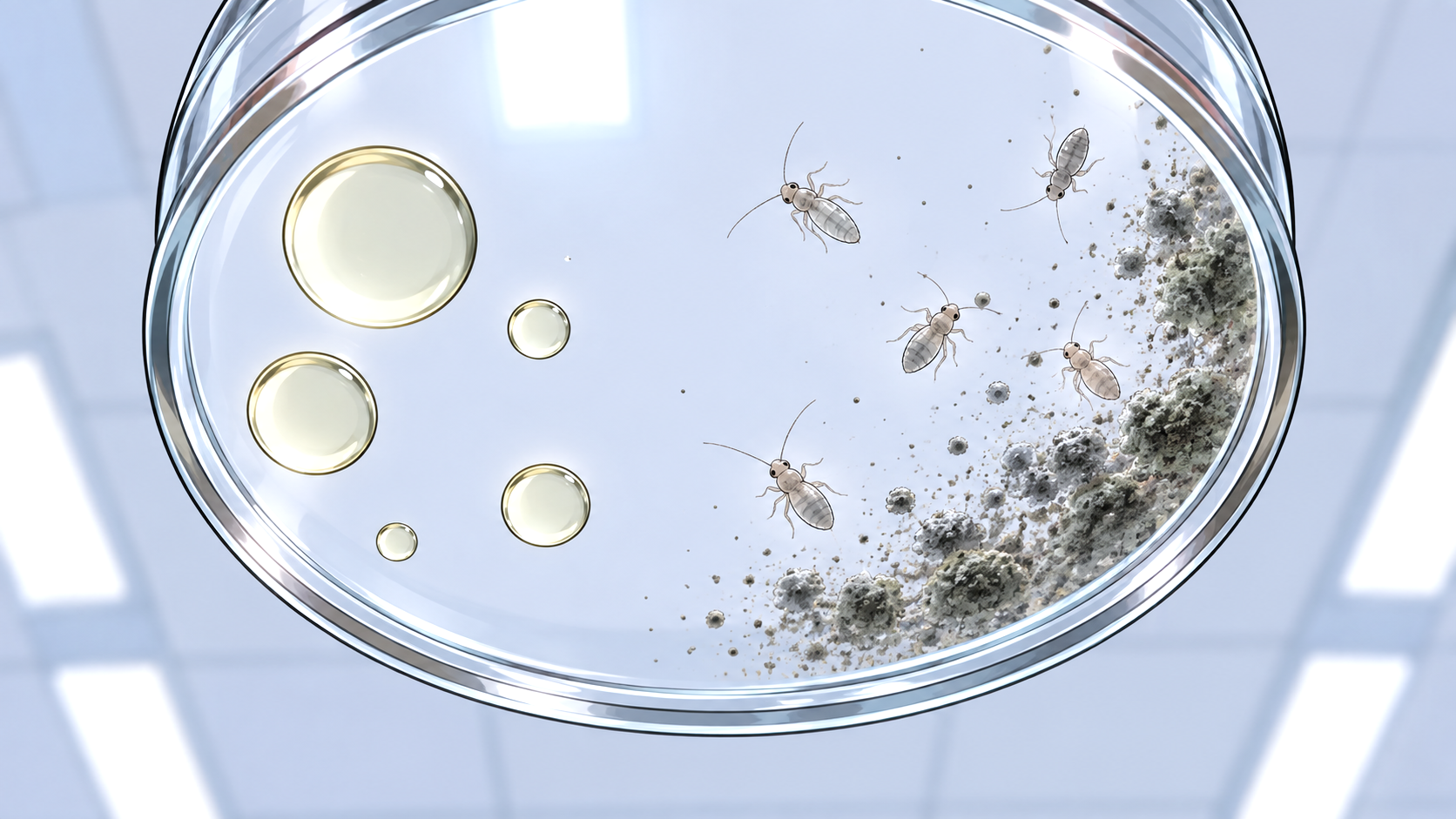
Essential oils are often recommended as a natural answer to tiny household pests, but booklice require a more precise answer. Some plant oils genuinely have insecticidal activity against booklice. Others mainly repel them, and the results depend heavily on the plant, chemical composition, concentration, exposure method, and booklouse species. Some essential oils can kill booklice under controlled experimental conditions. Laboratory studies have demonstrated contact or fumigant toxicity against Liposcelis species. That does not establish peppermint, lavender, tea tree, eucalyptus, or another household essential oil as a reliable DIY infestation treatment. In homes, moisture control remains the more dependable approach.
Essential Oils Really Have Been Tested Against Booklice
There is direct research on essential oils and Liposcelis bostrychophila, one of the booklice species associated with stored products and indoor environments.
For example, an essential oil extracted from Kaempferia galanga rhizomes produced both contact and fumigant toxicity against L. bostrychophila. Researchers also isolated several active components, including 1,8-cineole, ethyl cinnamate, and trans-cinnamaldehyde. The strength of contact, fumigant, and repellent effects differed among the compounds.
Other plant oils have produced similar experimental results. Essential oils from Artemisia rupestris showed contact and fumigant toxicity against the same booklouse species, while individual constituents such as α-terpineol and linalool differed considerably in activity.
More recent research continues to find insecticidal potential in plant-derived oils. Essential oils from different parts of Magnolia laevifolia produced both contact toxicity and repellency against booklice.
The evidence therefore supports a narrow conclusion. Certain essential oils can affect certain booklice under specific experimental conditions.
Laboratory Results Are Not a DIY Essential-Oil Recipe
A laboratory result tells us that a tested substance has biological activity. It does not automatically tell a homeowner how to use a bottle of essential oil safely and effectively.
Researchers work with identified plant species, chemically characterized oils, measured concentrations, controlled exposure periods, and known insect species. Commercial essential oils can differ in chemical composition because of plant variety, growing conditions, extraction method, storage, and formulation.
The experimental dose matters as well. A laboratory surface treated with a measured quantity of oil is not equivalent to adding several drops to a spray bottle and misting a bathroom.
This distinction is especially important because booklice are not one species. Many common indoor forms belong to Liposcelis, but booklice encompass more than a single species. Evidence involving L. bostrychophila should not be presented as proof that every oil works identically against every indoor booklouse.
Which Essential Oils Have Killed Booklice in Studies?
Researchers have tested a surprisingly broad range of plant oils against Liposcelis species.
Essential oil from Clinopodium chinense demonstrated both fumigant and contact toxicity against L. bostrychophila. Piperitone, bornyl acetate, and caryophyllene were among the isolated constituents investigated for activity. The oil and individual compounds produced different levels of toxicity.
Essential oil from Illicium henryi root bark also showed contact and fumigant toxicity, with myristicin and other constituents contributing to its activity.
Research on Rhynchanthus beesianus found fumigant and contact activity against Liposcelis entomophila. Individual compounds from the oil again differed in their effects.
These are meaningful findings for the development of plant-derived insecticides. They are much less useful as a shopping list for homeowners because the studies tested defined extracts and doses rather than ordinary household applications.
What About Peppermint Oil?
Peppermint oil should not be promoted as a proven household treatment for booklice simply because peppermint is widely used in DIY pest-control recipes.
Menthol, a major constituent associated with mint oils, has demonstrated repellent activity against L. bostrychophila in experimental research. That is evidence of biological activity, but repellency is different from killing an infestation.
A repellent may cause an insect to move away from a treated area without killing it. For booklice living around damp materials, pushing insects from one exposed location to another does not solve the environmental problem supporting them.
Without a validated household peppermint-oil treatment for booklice, there is no reliable number of drops, dilution ratio, or spraying frequency we can recommend.
What About Eucalyptus Oil?
The answer is similar.
The compound 1,8-cineole, also called eucalyptol, occurs prominently in eucalyptus oil and in numerous other essential oils. It has been isolated and tested in several booklice studies.
Its performance has not been identical across experiments or exposure methods. In research involving Kaempferia galanga, for example, 1,8-cineole showed fumigant activity but relatively weak acute contact toxicity compared with several other isolated constituents.
That variation illustrates why identifying one active chemical does not prove that a bottle of eucalyptus oil is an effective home booklice treatment.
The concentration, complete oil composition, exposure route, and target species all matter.
What About Lavender Oil?
Lavender oil is another common recommendation for household insects, but it should not be added to a list of proven booklice killers without direct evidence supporting the particular treatment being proposed.
Linalool, a compound found in lavender and many other plants, has been tested against L. bostrychophila. In one study, linalool displayed both contact and fumigant activity, although its performance differed from the other compounds tested.
A single active constituent is not the same thing as a finished lavender-oil treatment. The concentration of linalool in an essential oil can vary, and the remaining chemical mixture matters.
For a homeowner, that leaves no validated lavender-oil application rate for eliminating a booklice infestation.
Killing and Repelling Booklice Are Different
Essential-oil discussions often mix these two effects together.
A contact insecticide has to affect an insect sufficiently after physical exposure. A fumigant acts through vapors at an effective airborne concentration. A repellent influences whether an insect approaches or remains in a treated location.
One substance can perform differently in each category.
Research screening several medicinal-plant essential oils found that some oils and individual compounds repelled L. bostrychophila. That does not mean every repelled insect died.
For a household infestation, repellency alone may be particularly unhelpful. Booklice are only about 1 to 2 millimeters long and can occupy tiny cracks and protected spaces. Moving them away from one treated surface may simply make them harder to find.
Essential Oils Do Not Solve the Moisture Problem
This is where laboratory insecticidal activity becomes less important to most homeowners.
Booklice are strongly associated with damp, humid environments. They commonly consume molds and microscopic fungi, so the same moisture that helps the insects survive can also provide food.
Keeping relative humidity below approximately 50% prevents favorable mold growth and booklouse development. Correcting leaks, condensation, and other water problems is consequently more effective than routine pesticide treatment.
Essential oils cannot dry damp drywall, stop a pipe from leaking, lower room humidity, or remove condensation from a window.
A booklice humidity problem therefore remains after the scent of an essential-oil spray disappears.
Essential Oils Are Not Automatically Safe Because They Are Natural
Plant-derived does not mean risk-free.
Essential oils contain concentrated biologically active chemicals. Depending on the oil, concentration, exposure route, and person exposed, they can irritate skin, eyes, or respiratory tissues. Some oils can also damage household materials.
Pest-control claims introduce another distinction. In the United States, certain ingredients can be used in qualifying minimum-risk pesticide products, but those products still have to meet specific federal conditions, including ingredient and labeling requirements. States can impose additional registration requirements.
A bottle sold for aromatherapy should therefore not automatically be treated as a pesticide simply because the same plant compound appears in a pest-control study.
Be Particularly Careful Around Pets
Essential-oil exposure deserves extra consideration in homes with animals.
Cats, dogs, birds, and other pets do not necessarily process concentrated plant compounds in the same way humans do. Exposure can occur through direct skin contact, ingestion, spills, contaminated fur, or inhalation of concentrated vapors.
That makes indiscriminate spraying and homemade essential-oil fumigation poor choices around animals.
If a pesticide product containing essential oils is used, follow its current label, including restrictions involving people, pets, treated surfaces, ventilation, and reentry. Do not assume a homemade concentration is safe because the ingredients came from plants.
For booklice, this additional exposure is usually unnecessary because the infestation can normally be managed without filling the room with aromatic compounds.
Should You Spray Essential Oils on Books?
Books are another place where an appealing remedy can create a second problem.
Do not saturate pages or bindings with essential oils. Oils can stain paper and interact with inks, adhesives, coatings, leather, and other materials. The odor can also remain long after treatment.
Booklice around a collection frequently indicate humid storage. They commonly feed on microscopic fungi rather than simply eating paper, so drying the collection addresses a much more important part of the infestation.
Lower the surrounding humidity and carefully remove visible insects. Isolate affected material when appropriate.
For suitable ordinary books requiring physical treatment, controlled freezing can kill booklice without deliberately coating the pages in essential oil.
Valuable or irreplaceable material should receive conservation advice before any treatment is attempted.
Should You Diffuse Essential Oils to Kill Booklice?
A household essential-oil diffuser is not a booklice fumigation device.
Laboratory studies reporting fumigant toxicity use controlled concentrations of specific oils or isolated compounds in measured volumes of air. A diffuser designed to scent a room does not reproduce those experimental conditions.
Trying to increase the amount of oil until the room reaches an imagined insecticidal concentration would also increase exposure for everyone and everything breathing the same air.
There is no validated diffuser setting, number of drops, treatment period, or room concentration that should be recommended for household booklice control.
If room-wide environmental control is needed, lowering the humidity is the relevant intervention. A dehumidifier can make conditions unsuitable for booklice without attempting homemade fumigation.
What About Essential Oils in the Kitchen?
Booklice concentrated around a pantry deserve an inspection of the food and storage conditions.
Check flour, cereals, grains, dry pet food, cardboard packages, and other stored products. Infested food should be discarded rather than sprayed with essential oils.
Clean and vacuum cupboard joints, store unaffected dry foods in tightly closing containers, and inspect beneath sinks or around plumbing for moisture.
These steps matter because booklice in kitchens can be associated with either stored products or damp structural areas.
Spraying a strongly scented oil around the cabinet can obscure the problem without identifying which source is responsible.
What About Essential Oils in the Bathroom?
A bathroom is another place where environmental control should come first.
Repeated booklice around a window, vanity, shower, sink, or baseboard point toward condensation, persistent humidity, poor ventilation, or a plumbing problem.
Vacuum or wipe away exposed insects. Run effective exhaust ventilation during and after bathing, dry surfaces that repeatedly collect condensation, and investigate leaks.
Once bathroom booklice lose the damp environment supporting them, an insecticidal fragrance becomes unnecessary.
What Works Better Than Essential Oils?
For most household infestations, start with a hygrometer rather than an essential-oil bottle.
Measure the humidity in the affected area. Inspect recurring hotspots for leaks, condensation, damp cardboard, wet building materials, stored foods, and fungal growth. Remove visible insects with a vacuum and discard contaminated disposable materials when appropriate.
Then keep the area dry. Relative humidity below about 50% makes conditions unfavorable for booklice and the fungal growth associated with them.
This approach also reaches beyond the insects you happen to see. A spray can affect only booklice receiving a sufficient exposure, while environmental drying changes conditions throughout the room.
That is why the broader process of getting rid of booklice begins with moisture correction rather than choosing a particular essential oil.
When an Essential-Oil Product Might Make Sense
Research into plant-derived insecticides is legitimate, and essential oils may eventually contribute to useful booklice-control products. Some already appear as active ingredients in commercial pesticide formulations for various pests.
A finished product is different from a bottle of raw essential oil. If a pesticide product containing essential oils is considered for booklice, check the current label to determine its permitted pests, locations, application method, precautions, and other directions. Use it only as the label allows.
For a typical household booklice problem, pesticides are normally unnecessary once the water or humidity problem has been corrected. That leaves us with a useful distinction. Some essential oils can kill booklice. That does not make homemade essential-oil sprays a dependable way to get rid of booklice in a home.
More Questions About Essential Oils and Booklice
Does tea tree oil kill booklice?
Tea tree oil should not be treated as a proven household booklice treatment without evidence establishing an effective formulation and application method. Research showing that other essential oils kill Liposcelis species cannot automatically be transferred to tea tree oil.
Can essential oils kill booklice eggs?
Do not rely on essential oils to eliminate booklice eggs. Eggs can be concealed in tiny protected spaces, and evidence of toxicity against exposed adults does not establish that a homemade spray will reach or kill every egg.
Can I mix several essential oils to make them stronger?
There is no validated DIY mixture for booklice. Combining oils changes the chemical mixture and exposure without establishing that the result is more effective or safer. A registered or otherwise legally marketed pesticide formulation should be used according to its label rather than recreated at home.
Will essential oils prevent booklice from coming back?
They should not be relied on for long-term prevention. Preventing excess humidity, repairing leaks, reducing condensation, keeping stored foods dry, and avoiding damp paper or cardboard address the conditions that allow booklice to persist.
One thought on “Do Essential Oils Kill Booklice?”