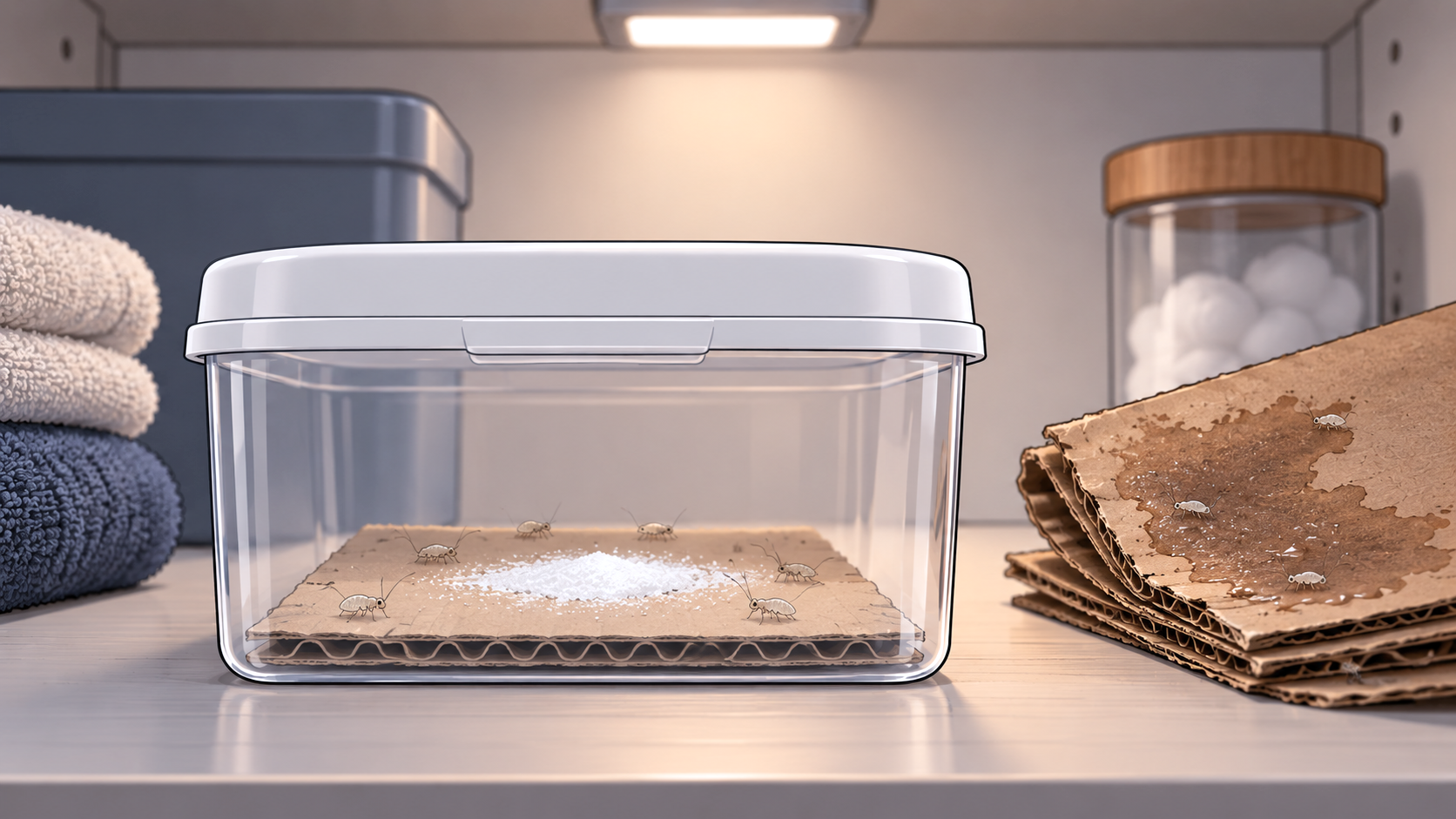
Borax sounds like a plausible booklice remedy because borate compounds really do have insecticidal uses. That fact often gets stretched into a much broader claim that sprinkling household laundry borax wherever booklice appear will eliminate them. The chemistry is real, but the DIY conclusion does not follow from it.
Borax can have insecticidal effects, but household borax is not a dependable treatment for a booklice infestation. Borax is a sodium borate salt, and borates are used in registered insecticides. However, booklice control is much more reliably achieved by reducing humidity, fixing moisture problems, removing contaminated materials, cleaning affected areas, and physically removing visible insects.
Borax and Boric Acid Are Not the Same Thing
The names are often used interchangeably online, but borax and boric acid are different chemical compounds.
Borax is commonly sodium tetraborate decahydrate, while boric acid is a separate boron-containing compound. Both belong to a broader group of boron compounds, and boric acid and sodium borate salts have pesticidal uses. Depending on the formulation, registered products containing these compounds can be sold as dusts, granules, liquids, pellets, baits, and other forms.
That does not make a box of household borax equivalent to a pesticide formulated and labeled for insect control. The formulation, concentration, intended use, application instructions, and registered target sites can differ.
For booklice, there is no reason to blur those categories. A household cleaning product should be used according to its label rather than converted into a homemade insecticide.
How Borates Affect Insects
Boric acid and related borates can affect insects in more than one way. Boric acid can act as a stomach poison after ingestion, while borate dusts can also affect an insect’s exterior.
That explains why boron compounds appear in legitimate pest-control products. It does not establish that every borate product works equally well against every insect.
The target pest matters. So does how the insect encounters the material. A cockroach consuming a boric-acid bait presents a very different treatment situation from tiny booklice scattered through damp wall cracks or among stored materials.
Booklice are only about 1 to 2 millimeters long and can occupy extremely small protected spaces. A powder scattered across an exposed surface cannot be assumed to reach the population living elsewhere.
Will Sprinkling Borax Kill Booklice?
Some booklice contacting or ingesting borax may die, but sprinkling household borax around an infested room is not a sound control plan.
The visible insects are usually only part of the problem. Booklice can occur behind trim, inside cupboards, around plumbing, among cardboard, in books, within stored foods, and wherever persistent moisture provides suitable conditions.
A layer of borax on a windowsill does not reach insects elsewhere. It also does not repair the condensation that made the windowsill favorable in the first place.
There is another practical limitation. Borate dusts become less effective when they get wet. Booklice frequently occur precisely where dampness is present, making indiscriminate powder application an especially awkward answer to the underlying problem.
Does Borax Kill Booklice Eggs?
Do not depend on household borax to eliminate booklice eggs.
Booklice eggs are tiny and often concealed, so a powder applied to exposed surfaces cannot be assumed to contact every egg. There is also no household borax application rate or exposure period that should be treated as a validated booklice egg-control protocol.
This matters because eliminating exposed adults while leaving viable eggs and protected nymphs behind can give the impression that a treatment worked before insects begin appearing again.
A dry environment attacks the problem differently. Booklice require relatively humid conditions, so sustained moisture control affects the habitat in which eggs hatch and developing insects must survive. It does not depend on finding every individual egg first.
Borax Does Not Fix High Humidity
Booklice control is unusual compared with many household pest problems because changing the environment can be remarkably effective.
Indoor booklice prefer damp conditions and commonly feed on molds and other microscopic fungi. Reducing moisture is the most effective control measure, while persistent low humidity also restricts the fungal growth that supports them.
Keeping relative humidity below approximately 50% is a useful household target. Under dry conditions, booklice lose the environment they need to thrive.
Borax cannot lower the humidity in a bathroom, stop a pipe from leaking, dry damp drywall, improve ventilation, or prevent condensation on a window. Those problems remain after the powder is applied.
That makes humidity control much more important than trying to create a barrier of borax around every place where an insect appears.
Borax Is Not a Substitute for Cleaning
A dusty layer of borax can actually make it harder to see what is happening in an infested area.
Vacuuming is a cleaner way to remove exposed booklice, shed material, debris, and some of the material accumulating in cracks. Once the surface is clear, repeated sightings become easier to track.
Cleaning also gives you an opportunity to inspect the area closely. Damp cardboard, mold-supporting residue, leaking plumbing, condensation, and infested stored food can all explain why booklice are concentrated in a particular location.
The goal is not merely to kill insects wandering across an exposed surface. It is to identify what allows them to remain there.
Should You Put Borax on Books?
Do not sprinkle household borax through books or between their pages to control booklice.
Loose powder can lodge between pages, enter bindings, abrade surfaces, and contaminate an object that may be difficult to clean afterward. Adding a chemical powder to a book also does nothing about the humidity that allowed booklice to persist around the collection.
Booklice associated with books are often linked to damp storage and fungal growth. Some can also feed on suitable starchy materials associated with bindings, although plain paper is not their primary food.
Drying the collection and its storage environment should come first. Visible insects can be removed carefully, while appropriate movable books can receive a controlled physical treatment when one is necessary.
For ordinary books that can safely tolerate it, freezing can kill booklice without leaving borax powder throughout the pages.
Should You Use Borax in Kitchen Cabinets?
Loose borax is a particularly poor choice around food-storage areas.
Booklice in a kitchen may be associated with flour, grains, cereal, dry pet food, cardboard packaging, or other stored products. They can also occur because a cabinet is damp from a plumbing leak or condensation.
If insects are concentrated around food, inspect the packages themselves. Remove infested or spoiled products as appropriate, vacuum cupboard cracks, clean the shelves, and store replacement foods in tightly closed containers.
Do not sprinkle household borax onto food or use it to salvage infested food. Keeping a loose pesticide-like powder around areas where food is prepared or stored also creates unnecessary opportunities for accidental exposure.
Finding the source is far more useful when booklice appear in a kitchen than dusting the entire cabinet.
What About Borax in the Bathroom?
A bathroom infestation usually points toward moisture rather than a shortage of insect-killing chemicals.
Booklice may appear near shower areas, windows, sinks, toilets, cabinets, and baseboards where humidity or condensation stays elevated. Powdering those areas with borax does not stop steam from condensing or water from leaking behind a fixture.
Start with ventilation and drying. Run an effective exhaust fan during and after bathing, dry persistent condensation, inspect plumbing connections, and look for damp material around recurring hotspots.
Visible booklice can simply be vacuumed or wiped away during cleaning. When booklice keep appearing in a bathroom, locating the damp area behind the sightings is more useful than repeatedly adding borax.
Can Borax Kill the Mold Booklice Eat?
Borates can inhibit fungal growth, but this still does not turn borax into a solution for a damp building.
Booklice commonly feed on mold and other fungi, which is one reason they become abundant in humid environments. Removing fungal growth can reduce available food, but existing mold also signals that the moisture problem needs attention.
A leaking pipe will keep leaking after borax is applied. Condensation will continue forming if humidity and surface temperatures remain unchanged. Damp building materials can continue supporting fungal growth where a surface treatment never reaches.
Correct the water source first. Cleaning or removing affected materials can then address the contamination that remains.
Is Boric Acid Better Than Household Borax?
A pesticide product containing boric acid or another borate is fundamentally different from improvising with household borax.
Registered boric-acid and borate products are formulated for specific uses and come with directions defining where and how they may be applied. Their uses vary considerably among individual products, so the presence of a borate active ingredient does not create one universal application method.
Booklice rarely require chemical control in the first place. They are easily killed by insecticides, but their protected hiding places can make surface treatments inefficient. More importantly, chemical control is usually unnecessary when humidity is corrected.
If a pesticide is genuinely needed, use a product whose current label permits the intended site and pest-control use. A household laundry product should not be substituted for a labeled pesticide.
Borax Is Not Harmless Because It Is a Household Product
The fact that borax is sold for household use does not mean unrestricted exposure is harmless.
Borax dust can irritate the nose, throat, and respiratory tract when inhaled. It can also irritate skin, and borax can cause serious eye irritation. Accidental ingestion is another reason loose powder should not be scattered where children or pets can reach it.
Pesticide-grade borate products carry their own labels and safety instructions. Those directions matter because exposure depends on the formulation, application method, concentration, and location.
The safer response to exposed booklice is usually simpler anyway. Vacuum them. Then find the damp conditions supporting the population.
What Works Better Than Borax for Booklice?
Begin with relative humidity.
Use a hygrometer to see whether the affected room remains humid. If it does, improve ventilation or use a dehumidifier. Check windows for condensation and inspect plumbing, cabinets, walls, basements, and other recurring hotspots for moisture.
Next, remove the insects you can see. Vacuum cracks, shelves, windowsills, and other appropriate surfaces. Remove damp cardboard and investigate stored food when either appears connected to the infestation.
Then keep the environment dry. Booklice are negatively affected by sustained low humidity, and reducing relative humidity below 50% can control them. A dehumidifier can help with booklice when excessive room humidity is the problem.
Those measures address both the insects and the conditions allowing them to multiply.
Why Booklice Can Return After a Borax Treatment
When booklice disappear after borax is scattered and return later, the treatment has usually addressed only the insects that encountered it.
Look at where the new insects appear. A cluster beside a sweating pipe points toward moisture around the plumbing. Repeated insects on a window can correspond with condensation. Booklice concentrated around stored food deserve a pantry inspection, while insects among books call for a closer look at storage humidity.
Correct identification matters as well. Springtails and several kinds of mites can be confused with booklice at first glance. A powder treatment will not compensate for treating the wrong arthropod.
Once the insects are confirmed as booklice, moisture remains the strongest lead. Removing that advantage from their environment is more dependable than repeatedly spreading another layer of powder.
Safety note: Borax and boric acid are different compounds, and household borax should not be treated as interchangeable with a registered pesticide. Avoid inhaling borax dust or getting it in the eyes, keep it away from children and pets, and use pesticide products only according to their current labels.
Other Questions About Borax and Booklice
Can I mix borax with sugar to kill booklice?
Sugar-and-borax bait recipes are associated with other insects and are not an established booklice control method. Booklice commonly feed on microscopic fungi and other suitable organic material, so there is no reason to introduce a sugary homemade bait into a damp area.
Will borax stop booklice from crossing a windowsill?
Do not depend on borax as a lasting booklice barrier. A windowsill with recurring booklice deserves an inspection for condensation, damp trim, or nearby fungal growth instead. Removing that moisture makes the location less suitable regardless of where the insects enter.
Can I put borax in a dehumidifier to kill booklice faster?
No. A dehumidifier should be operated according to its manufacturer instructions. Adding borax or other household chemicals to the machine does not improve booklice control and could damage the appliance.
Can I vacuum borax after putting it down for booklice?
If household borax has already been scattered, clean it according to the product’s instructions while avoiding unnecessary dust generation. There is no pest-control benefit to leaving loose borax throughout living spaces once you have moved to moisture control and physical removal.