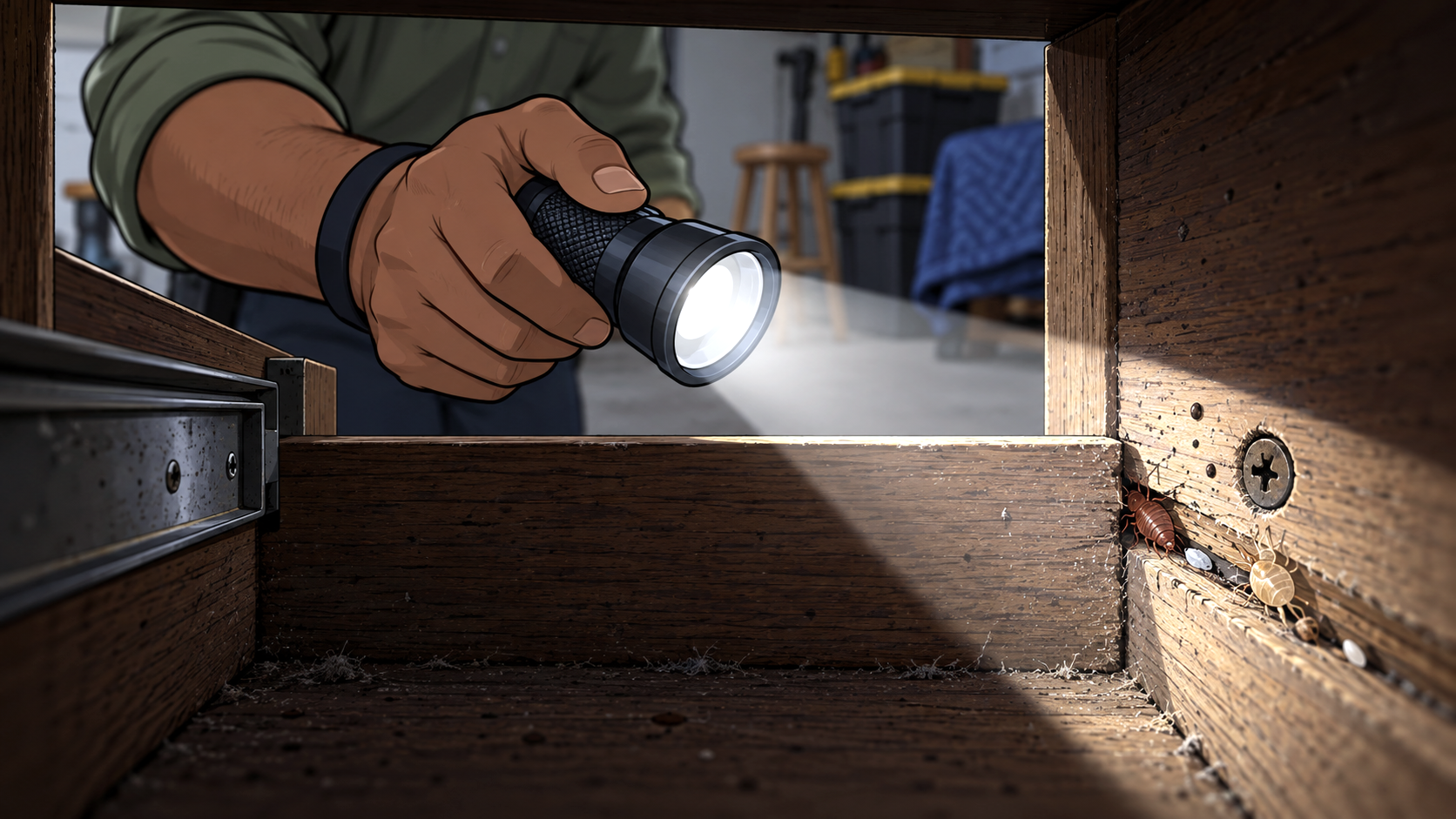
Yes, a flashlight can help you find bed bugs, especially in seams, folds, cracks, and other dark hiding places. For the smallest bugs and eggs, hold the beam almost parallel to the surface. This low angle can make them cast small shadows, making subtle evidence easier to notice during a close inspection.
Why a Flashlight Helps You Find Bed Bugs
A flashlight does more than brighten a dark bedroom. Bed bugs spend much of their time in protected spaces that ordinary room lighting doesn’t illuminate well. They can hide along mattress piping and seams, around tags, inside bed-frame cracks, behind headboards, in drawer joints, and even in screw heads.
That makes a concentrated light useful because you can direct it into each hiding place as you inspect it. You’re looking for live bed bugs as well as eggs, shed skins, and dark fecal spotting. Some of that evidence is tiny. Bed bug eggs are about 1 millimeter long, while young nymphs are smaller and paler than adults.
This is also why casually shining a light across the top of a mattress isn’t much of an inspection. The flashlight only helps when you put the beam where the bugs and their evidence are likely to be.
The Flashlight Angle Makes a Difference
Here’s the technique we’d use when inspecting a seam or another textured surface. Instead of pointing the flashlight straight down, bring it closer to the surface and aim the beam across it.
Keeping the flashlight roughly parallel to the surface can make eggs and small bed bugs cast shadows. Those shadows can make tiny objects easier to pick out from the fabric or surface around them.
Move slowly rather than sweeping the beam back and forth as though you’re searching a dark room. Follow the mattress piping, folds, buttons, and tufts. Then inspect the box spring, bed frame, and headboard. Bed bugs are small and flat enough to occupy very tight spaces, so a methodical inspection matters more than waving around the brightest flashlight you own.
Our guide to inspecting a mattress for bed bugs covers those mattress-specific hiding places in more detail.
What You’re Actually Looking for With the Flashlight
Don’t make the mistake of searching only for a moving adult bed bug. A useful inspection looks for several forms of evidence.
Dark reddish or brownish fecal spots or smears can appear on mattresses, sheets, pillowcases, and nearby areas. Shed skins can collect where bed bugs have been hiding. Eggs are tiny and pale, while unfed young nymphs can be nearly invisible because of their size and coloring.
The flashlight helps differently with each one. Use it to illuminate cracks and dark spaces, and use the low-angle technique when you’re trying to distinguish tiny bugs or eggs from the surface underneath them. For dark marks, good illumination helps you see the spot clearly, but don’t expect a fecal stain to cast the same useful shadow as a raised egg or insect.
If you find suspicious dark marks, compare them with what bed bug fecal spots look like rather than assuming every dark speck around a bed came from bed bugs.
A Phone Flashlight Can Work
You don’t need a specialized bed bug flashlight. A phone flashlight can still illuminate seams and other hiding places, and the basic inspection technique doesn’t change.
The limitation is handling. A separate flashlight is easier to position independently while your other hand lifts a mattress edge, moves bedding, or examines furniture. A phone can become awkward when you’re trying to illuminate a narrow crevice and inspect it closely at the same time.
We’d choose the light that’s easiest to control rather than obsessing over specifications. Authoritative inspection guidance recommends a flashlight, and some guidance specifically calls for a strong flashlight paired with a magnifying glass. It doesn’t establish a particular lumen rating you need to find bed bugs.
That means there isn’t much value in shopping for a flashlight based on an arbitrary brightness number. You need enough usable light to see into the area you’re inspecting and enough control to position the beam where you need it.
A Magnifying Glass and Flashlight Do Different Jobs
A magnifying glass doesn’t replace the flashlight. The two tools solve different problems.
The flashlight illuminates the hiding place and helps you spot suspicious evidence. Magnification helps you examine something tiny once you’ve found it. That’s particularly useful with eggs, small nymphs, or an insect you’re trying to distinguish from another household bug. Inspection guidance commonly pairs a flashlight with a magnifying glass for that reason.
Even so, finding a tiny brown insect doesn’t automatically make it a bed bug. Carpet beetles, spider beetles, bat bugs, and several other insects can cause confusion. If the insect itself is questionable, compare it against bugs that look like bed bugs before deciding what you’re dealing with.
Where to Point the Flashlight First
Start where people regularly sleep or rest. Bed bugs are commonly found around mattresses, box springs, bed frames, couches, and recliners, particularly in protected seams and crevices near those resting areas.
On the bed, inspect the mattress seams, piping, folds, tufts, and tags before moving to the box spring. Then check joints, cracks, recessed hardware, and screw holes in the frame and headboard. A thorough inspection may require examining upper and lower seams and surfaces rather than only the visible side of the bed.
From there, work outward instead of randomly jumping around the room. Nearby furniture, upholstered chairs, couches, baseboards, picture frames, and other cracks can also provide hiding places. Our complete guide to checking for bed bugs covers the broader inspection rather than turning this flashlight guide into a room-by-room checklist.
The Flashlight Mistake We’d Avoid
The biggest mistake is treating the flashlight as a detector. It isn’t one.
A flashlight doesn’t make hidden bed bugs emerge, and shining one around a room doesn’t tell you whether an infestation is present. It simply makes a careful visual inspection easier. In fact, visual inspections involve searching specifically for bugs, eggs, shed skins, and fecal evidence, particularly around places where people rest.
So don’t judge the inspection by whether something immediately crawls through the beam. Work through likely hiding places slowly and examine what you actually find.
Likewise, don’t stop because the first mattress seam looks clean. Bed bugs can occupy very small hiding places away from the obvious upper mattress surface. If you’re finding suspicious evidence but no live insects, having signs without seeing bed bugs deserves a more complete inspection.
Other Questions About Finding Bed Bugs With a Flashlight
Can I inspect for bed bugs during the daytime?
Yes. You don’t need to wait until night to inspect. A flashlight is useful during the day because you’re directing light into seams, cracks, folds, and other protected spaces rather than trying to catch bed bugs wandering around a dark room.
Should I use a flashlight when checking hotel rooms?
Yes. A flashlight can be useful when inspecting a hotel room, particularly around the mattress and headboard. Check the luggage rack as well before putting your belongings on it.
Can a flashlight tell a bed bug egg from lint?
Light can make a tiny object easier to notice, but it doesn’t identify it for you. Magnification can help once you’ve found something suspicious. Bed bug eggs are tiny and pearl-white, so identification should rely on what the object actually looks like rather than the fact that it appeared under the beam. Our guide to bed bug egg size provides a better comparison.
Will turning on the room lights make bed bugs come out of hiding?
No. Bed bugs generally prefer darkness, but keeping a room brightly lit doesn’t prevent them from coming out to feed. A flashlight is an inspection tool, not a way to lure them out.
Use the Flashlight as Part of the Inspection
Grab the flashlight before you start, but don’t simply brighten the room. Begin at the bed, aim the beam into the places ordinary lighting doesn’t reach, and slow down around seams and crevices. When you’re looking for eggs or small bed bugs on a surface, bring the beam low enough for tiny raised objects to cast a visible shadow.
Most importantly, follow a pattern. A careful inspection of likely hiding places is far more useful than scanning the entire bedroom quickly with a powerful light. If you find a suspicious insect or other evidence, identify what you’ve found before moving from inspection to treatment.
5 thoughts on “Can a Flashlight Help You Find Bed Bugs?”