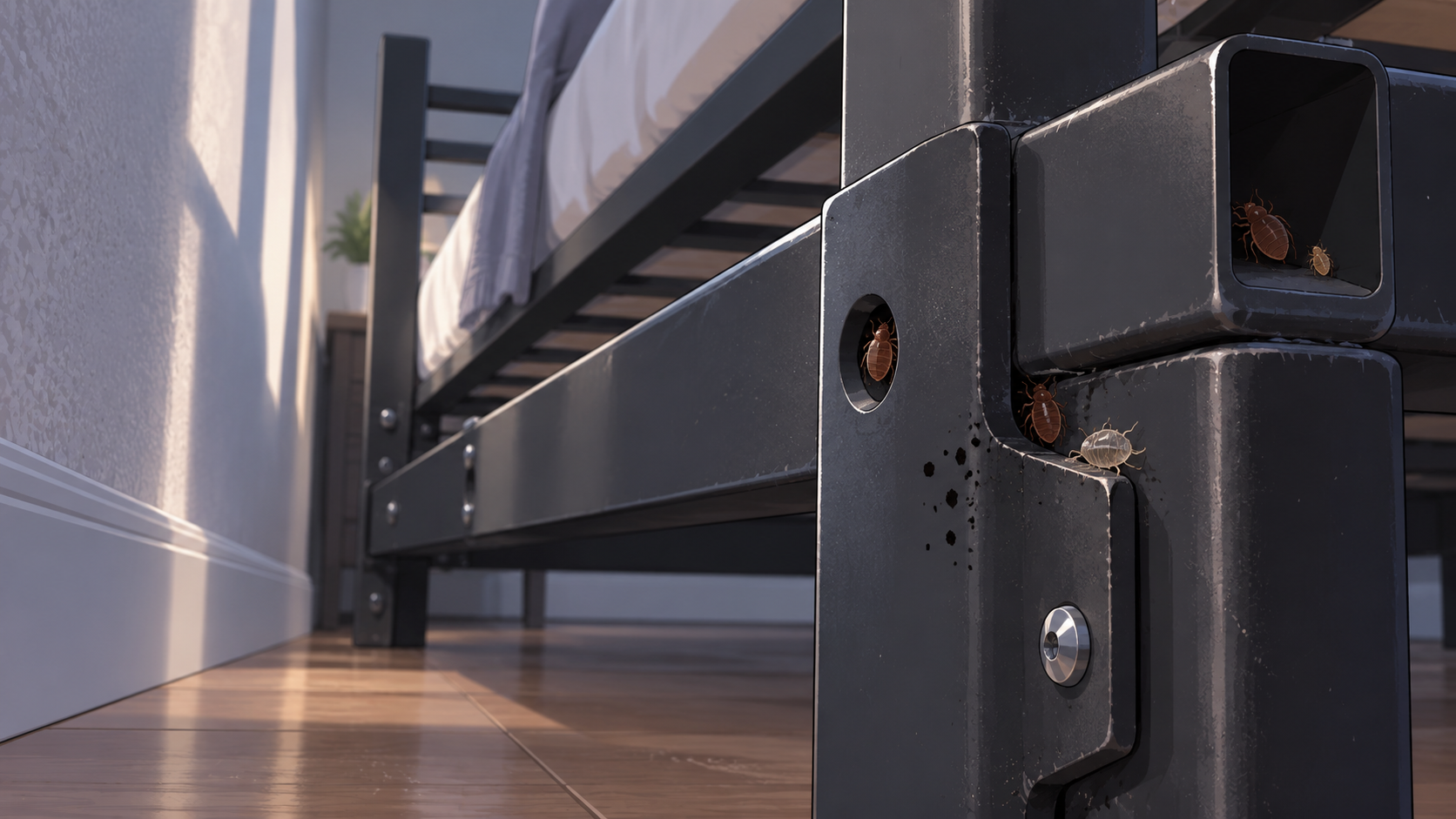
Buying a metal bed frame can seem like a clever way to give bed bugs nowhere to hide. The rails are hard, the surfaces are exposed, and there are no wooden cracks to worry about. Yet a bed bug does not need wood. It needs a protected opening close enough to a sleeping person to make that shelter useful. Bed bugs can live in a metal bed frame or headboard. They can hide in joints, screw holes, brackets, gaps, hollow openings, and other narrow spaces in metal furniture. Smooth exposed metal gives them little shelter, but the construction of a metal bed can still provide plenty of concealed places for bed bugs to hide. Bed bugs can hide in cracks in bed frames and headboards
So the useful question is not whether bed bugs like metal. Look at how the bed was built. A simple frame made from a few exposed pieces presents a very different hiding environment from a decorative metal headboard filled with joints, brackets, holes, and hollow tubing.
Metal Does Not Make a Bed Frame Bed-Bug-Proof
Bed bugs are built for tight spaces. Their flattened bodies allow them to squeeze into very narrow cracks, including openings about the width of a credit card. Around a sleeping area, those hiding places commonly include the mattress, box spring, bed frame, and headboard. Their flat bodies let them shelter in tiny furniture cracks and joints
Nothing about that behavior requires a wooden surface. In fact, bed bug guidance covering household belongings specifically includes frames and headboards constructed from wood, composite materials, plastic, and metal. The important features are the gaps and protected spaces within the furniture. Metal bed frames and headboards can provide bed bug hiding spots
That changes how we would judge a metal bed. A long, uninterrupted rail is not the part that deserves most of your attention. The places where that rail connects to something else are far more interesting. Bed bugs have even been documented hiding in the head of a screw, which shows how little shelter they actually need. Bed bugs can hide in something as small as a screw head
The Frame Can Look Completely Clean From Above
Imagine stripping the bedding and looking down at a black metal platform frame. Every visible rail is clean. You see no insects moving across the surface, so the frame seems clear.
Now turn the same frame over.
The underside may contain recessed screw heads, brackets, overlapping plates, bolt holes, corners, and joints that were invisible from above. If the frame can be dismantled, additional hiding spaces may appear between components once they separate. Bed bug inspection guidance specifically recommends taking a bed frame apart when possible because insects can remain concealed inside its joints. Dismantling a bed frame can expose concealed bed bug harborages
This is one reason having bed bugs without seeing them is entirely possible. A visual scan of the exposed metal tells you surprisingly little about what is happening inside the frame’s connection points. Even adult bed bugs are visible to the naked eye, but visibility does not help when the insect is tucked behind hardware you have not inspected.
Hollow Metal Tubing Changes the Inspection
Tubular metal frames create another possibility. The outside of a tube may offer almost nowhere to hide, while an accessible opening at the end or around a fastener leads to a protected interior space. Not every hollow component is accessible to bed bugs, so there is no reason to assume insects are secretly living inside every metal tube. What matters is whether an opening actually gives them access.
Start with the openings you can see. Check exposed tube ends, unused holes, connection points, mounting hardware, and any gap leading into a hollow section. A bright flashlight is useful here because a dark opening can hide detail even when the rest of the frame is well lit. Our guide to finding bed bugs with a flashlight explains how lighting can help during a close inspection.
You are not looking only for a live adult. Bed bug evidence can include eggs, shed nymphal skins, and dark fecal spotting around hiding areas. Physical signs include live bugs, eggs, shed skins, and dark fecal spots A suspicious mark by itself is not enough to identify an infestation, though. Our guide to the early signs of bed bugs explains how multiple pieces of evidence fit together.
A Metal Headboard May Offer More Hiding Places Than the Frame
A plain platform frame and an elaborate headboard should not be treated as the same object during an inspection. Headboards often have mounting hardware, decorative connections, overlapping components, wall brackets, and other sheltered areas. Their position directly beside a sleeping person also puts them in a part of the room where bed bugs commonly hide.
Headboards are important enough that inspection guidance specifically tells people to check behind them and examine cracks around both the headboard and bed frame. Bed bug inspections should include cracks in the frame and headboard If the headboard attaches to a wall, the mounting points and the narrow space behind it deserve attention as well.
A heavily decorated metal headboard can therefore be harder to inspect than its smooth finish suggests. Run the flashlight around joints and attachment points rather than simply looking across the front. When practical, inspect the back and underside too. The same systematic approach used in a full bed bug mattress inspection works better than checking whichever surfaces happen to be easiest to see.
Metal Versus Wood Is the Wrong Comparison
Wood furniture certainly offers cracks, joints, screw holes, and other places where bed bugs can hide. Our guide to bed bugs in wood furniture covers those locations separately. But replacing wood with metal does not remove the underlying bed bug problem if the new furniture still contains suitable crevices.
We would rather have a simple, easy-to-inspect bed frame than choose a complicated one purely because its label says metal. Fewer joints and concealed components mean fewer places that have to be examined. That is an inspection advantage, not evidence that the material repels bed bugs.
This also helps explain why bed bugs turn up in such varied objects. They can use baseboards, furniture, and even protected spaces around electrical outlets. The common feature is access to shelter, not a favorite building material. Bed bugs tend to remain close to places where people sleep and rest, although larger infestations can spread into additional areas. Bed bugs commonly stay near sleeping and resting areas
Finding One Harborage Does Not Clear the Rest of the Bed
Suppose you dismantle the headboard and find several bed bugs clustered behind a mounting bracket. You have found a hiding place, but you have not established that every bed bug in the room was living there.
Bed bugs can occupy more than one protected location around a sleeping area. Inspection should therefore extend through the mattress, box spring, frame, headboard, and nearby furniture instead of ending at the first confirmed group. A bed bug inspection should work systematically through the bed and surrounding room This is particularly important because bed bugs do not build a single nest that conveniently contains the entire infestation.
Look for evidence as you move through the bed. Dark spotting on the frame can help direct the search because fecal marks commonly occur around bed bug hiding areas. Fecal spots can appear on mattress and bed-frame surfaces If you are unsure whether the evidence is enough, our guide to how to tell if you have bed bugs covers the larger identification process.
You Usually Do Not Need to Throw Away the Metal Bed
Finding bed bugs in a frame does not automatically turn the entire piece of furniture into trash. A metal frame can be dismantled when its design allows, which makes concealed spaces more accessible for inspection and appropriate control measures. Vacuuming can remove some exposed insects, although it should not be treated as a complete bed bug solution. Vacuuming can remove some bed bugs but does not eliminate an infestation by itself
Avoid improvising with pesticides on the frame. A product has to be labeled for bed bugs and for the location and application method you intend to use. Bed bug control is also rarely solved by treating one piece of furniture while ignoring the rest of the affected sleeping area. Successful bed bug control requires finding and addressing the full infestation
Once bed bugs are confirmed, inspect outward from the bed and determine how far the infestation extends. Our broader guide to getting rid of bed bugs covers the full control process. A frame that can be inspected and treated appropriately may remain usable, so throwing it away should not be the automatic first response.
Other Questions About Bed Bugs in Metal Bed Frames
Can bed bugs crawl up metal bed legs?
A metal leg should not be treated as a dependable bed bug barrier. Interceptor traps are designed to sit beneath furniture legs and capture bed bugs moving between the bed and surrounding room. That gives you a way to monitor movement rather than relying on the smoothness of the metal itself.
Can bed bugs lay eggs on a metal bed frame?
Bed bug eggs can be deposited in protected areas around bed frames and headboards. Because the eggs are small, inspecting narrow joints and holes with good lighting is more useful than searching only the broad exposed rails. Our guide to where bed bugs lay eggs covers egg-laying locations in greater detail.
Does a rusty metal frame attract bed bugs?
Rust is not what draws bed bugs to a bed. Their hiding behavior centers on access to protected harborages near a host. However, corrosion and deteriorated surfaces can make a frame harder to inspect if they create additional irregularities or obscure small marks.
Are simple metal platform beds better for spotting bed bugs?
A simple frame with fewer joints can be easier to inspect because there are fewer concealed connection points to check. That can make monitoring more manageable, but it does not make the frame immune to bed bugs. Any remaining screw hole, joint, bracket, or accessible gap still deserves attention during an infestation.
Can bed bugs stay in a metal frame after the mattress is removed?
Removing a mattress does not establish that the frame is clear. Bed bugs can shelter in bed-frame joints and survive away from an immediate blood meal for substantial periods under suitable conditions. If an infested bed is being dismantled, inspect and address the frame rather than assuming removing the mattress removed the insects with it.
One thought on “Can Bed Bugs Live in a Metal Bed Frame or Headboard?”