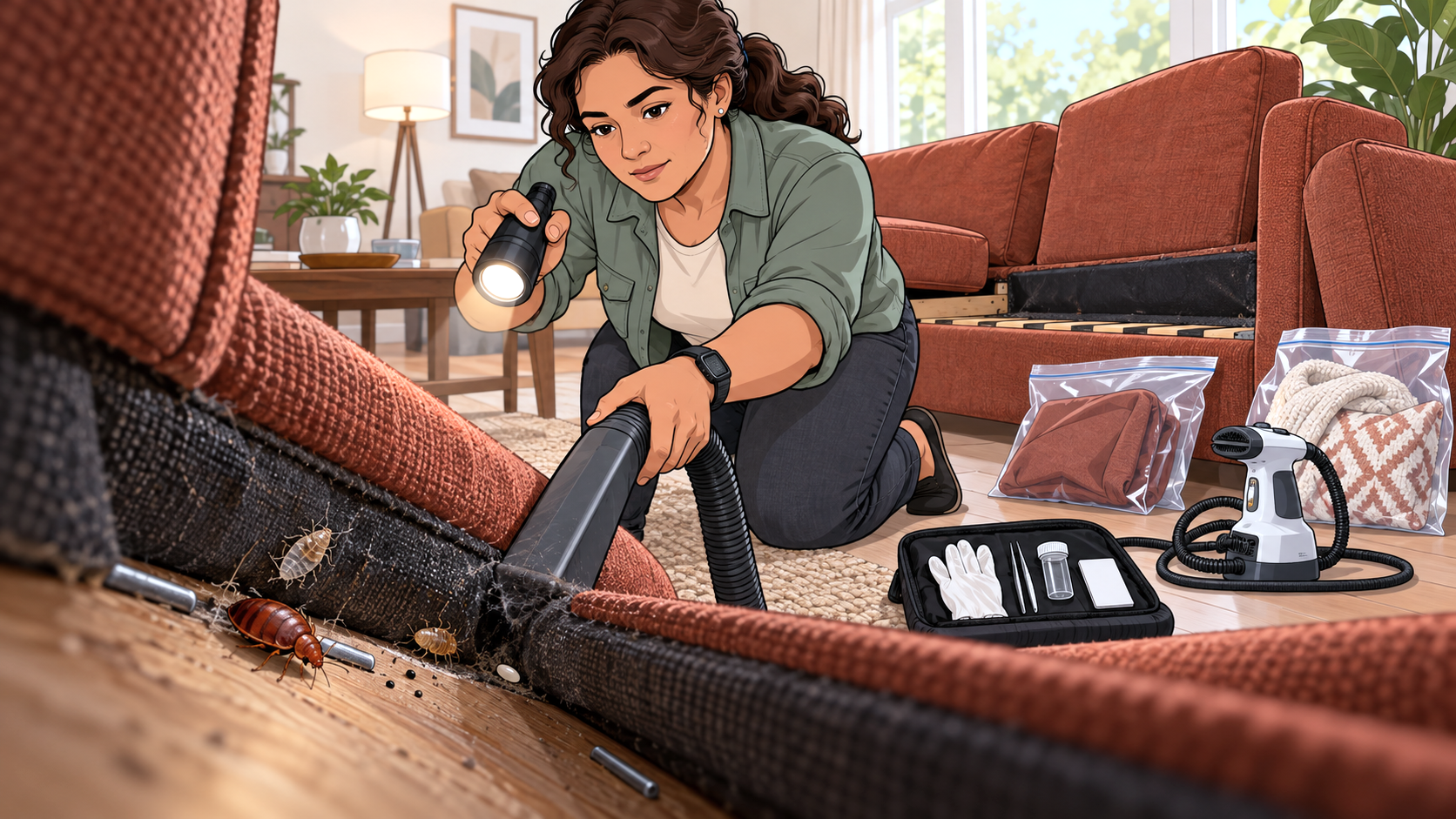
A couch creates an awkward bed bug problem because most of the places that need attention are not the surfaces you normally see. Pull off the cushions and there are seams, piping, folds, zippers, gaps around the frame, and an entire underside. Treating only the upholstery you sit on can therefore leave much of the infestation untouched.
To get rid of bed bugs in a couch, inspect the couch completely, vacuum accessible bugs and eggs, treat removable dryer-safe items with heat, and use steam correctly on suitable upholstery and crevices. The couch should also be treated as part of the room-wide infestation, because eliminating bugs from the sofa alone will not work if harborages remain elsewhere.
Start by Finding Out How Deep Into the Couch They Have Gone
Before reaching for a treatment, strip the couch down as far as its normal construction allows. Remove cushions and inspect them individually. A bright flashlight makes narrow seams and dark recesses easier to inspect, particularly where the upholstery changes direction or disappears into the frame.
Pay close attention to piping, seams, folds, zipper areas, cushion edges, and the spaces where cushions normally sit. Bed bugs can hide in couch seams and between cushions, so a clean-looking seat surface tells you very little about what is happening deeper inside the furniture.
Next, look underneath. The bottom of a couch is easy to ignore because nobody sits there, but bed bugs choose hiding places based on shelter and access to a host rather than whether a surface is visible to you. Inspect the legs, joints, frame edges, staple lines, fabric folds, and accessible areas beneath the couch.
What you are trying to establish is not simply whether one live bug is present. Look for live insects, eggs, shed skins, and fecal spotting. If identification is uncertain, our guide to how to tell if you have bed bugs covers the evidence that should be considered together.
Work From the Removable Parts Toward the Frame
Once the couch is stripped down, the removable pieces are the easiest place to begin reducing the infestation. Cushion covers or other removable fabrics that the manufacturer says can safely go in a clothes dryer can be treated separately. Heat from a dryer can kill bed bugs and eggs when appropriate items receive 30 minutes on high heat.
Do not assume every couch cover can tolerate that treatment. Upholstery fabrics, backing materials, decorative components, and foam can react differently to heat. The furniture manufacturer’s care instructions still matter, so a dryer method that works for a removable washable cover should not automatically be extended to the entire cushion.
Once something has been successfully treated, keep it separated from untreated items while you continue working. Otherwise, you can remove bed bugs from one cushion and then place it back against an infested frame. That is one reason couch treatment works better as a sequence than as one frantic cleaning session.
This same principle applies throughout a bed bug infestation. Clean items should not repeatedly cross back into untreated areas. Our broader guide to how to get rid of bed bugs covers how those individual treatment steps fit into whole-home control.
Vacuuming a Couch Is About Reaching Harborages, Not Cleaning Upholstery
A vacuum is useful here because it physically removes bed bugs from accessible areas. However, the way you vacuum a couch matters more than making several passes over the broad seat cushions.
Use the crevice attachment to work along seams, folds, piping, frame joints, cushion recesses, and other narrow spaces you identified during inspection. Thorough vacuuming of upholstered furniture and surrounding cracks can reduce the number of bed bugs present.
The limitation is access. A vacuum cannot remove a bed bug hidden somewhere the nozzle cannot reach, and eggs can be difficult to dislodge. We therefore see vacuuming as a population-reduction step rather than proof that the couch is clear. Our dedicated guide to vacuuming bed bugs explains that limitation in more detail.
What happens to the vacuum afterward is also part of the job. Seal the vacuum bag or collected contents securely and put them in an outside trash container. Leaving captured bed bugs sitting inside a vacuum in the same living area defeats part of the reason for removing them in the first place.
Steam Makes More Sense on a Couch Than Many Household Remedies
A couch is one of the places where steam can be particularly useful because steam can penetrate fabrics and reach some cracks that are difficult to treat mechanically. Steam cleaners can be used on fabrics, furniture, cracks, and other bed bug hiding areas, provided the material can safely tolerate steam.
Technique matters. The steam must reach lethal temperatures without blasting bed bugs away from the treatment area. Guidance for do-it-yourself control specifies steam of at least 130°F and warns against forceful airflow that could scatter the insects. A diffuser helps reduce that problem.
Move systematically through suitable seams, folds, cushion edges, and accessible frame areas rather than waving the steamer rapidly across the couch. The objective is to deliver sufficient heat where bed bugs are hiding. At the same time, avoid saturating the upholstery or damaging materials that are sensitive to heat or moisture. Our guide to whether steamers kill bed bugs covers the method itself in greater depth.
We prefer this targeted approach over improvised household remedies on a couch. Upholstered furniture spends hours in direct contact with skin and clothing, so spraying it indiscriminately with alcohol, cleaners, essential oils, or an unlabeled pesticide creates unnecessary exposure without guaranteeing that the product reaches the hidden bugs.
The Couch Is Not Finished Until You Inspect What Sits Around It
This is the step that changes the entire treatment strategy. Finding bed bugs in a couch does not prove that the infestation is confined to the couch.
Bed bugs can travel from established harborages to reach a person and can occupy many protected cracks around a heavily infested room. Therefore, inspect the floor around the sofa, nearby baseboards, side tables, adjacent chairs, wall cracks, and other furniture close to where people spend time. A couch that someone regularly naps or sleeps on can become an especially useful feeding location for them.
This also explains why moving the couch to another room is a bad first response. Bed bugs are effective hitchhikers, and moving infested furniture or belongings between areas can help expand an infestation. Keep the problem contained while you determine its extent.
Where the evidence extends beyond the sofa, stop thinking of the problem as “bed bugs in my couch.” You have a room or home infestation that includes the couch. That distinction prevents a common failure in DIY treatment, repeatedly killing the insects you can reach in one piece of furniture while untouched harborages continue supplying more.
Turn the Couch Into a Place You Can Monitor
After the first treatment, you need a way to tell whether bed bugs are still reaching the couch. A sofa with separate legs gives you a useful opportunity.
Bed bug interceptor traps can be placed beneath furniture legs. They are designed to capture bed bugs attempting to climb between the furniture and floor, and they can be used under couch and chair legs as well as beds. Pulling the couch slightly away from the wall also removes an alternative route that would let bugs bypass the interceptors.
Monitoring changes what happens next. A couch that looks clean immediately after vacuuming or steaming has only passed a visual check at that moment. Continued captures or fresh evidence tell you that bugs survived, another harborage remains nearby, or the infestation extends farther than the couch.
Inspect again after treatment rather than assuming one pass finished the job. Bed bug elimination often requires repeated control and evaluation, particularly because their hiding places can be difficult to reach.
Be Careful With Pesticides on Upholstered Furniture
A product being labeled for bed bugs does not automatically mean you can spray it over a couch. The treatment site on the pesticide label matters just as much as the pest named on the front.
Only use an Environmental Protection Agency-registered pesticide in a manner specifically permitted by its current label. Do not apply a pesticide to furniture when the label does not permit furniture treatment. Even when upholstered furniture is an allowed treatment site, the label determines which parts may be treated and how the application must be made.
That distinction is especially important for seating surfaces because people have prolonged contact with them. A crack-and-crevice application and a broadcast spray across an entire cushion are not interchangeable treatments. Our guide to bed bug sprays explains why application site, active ingredient, and resistance can all affect the outcome.
Foggers are also a poor substitute for reaching the couch’s actual harborages. They should never be the sole bed bug treatment because the pesticide may fail to reach the cracks and crevices where the insects are hiding.
Do You Need to Throw the Couch Away?
Not automatically. An infested couch does not become untreatable simply because bed bugs have been found on it. In fact, throwing furniture away too quickly can create an expensive replacement bill without eliminating bed bugs elsewhere in the room.
Keeping the couch makes the most sense when its hiding areas can be adequately inspected and treated and the furniture is still in usable condition. Professional treatment becomes more attractive when bugs are established deep inside inaccessible construction, the infestation is widespread, or repeated treatment and monitoring continue to find activity.
If the couch cannot be safely treated and you decide to discard it, prevent someone else from taking it home. Infested furniture should be damaged or clearly marked before disposal and removed promptly. Guidance on responsible disposal of infested furniture specifically warns against leaving usable-looking bed bug furniture where another person may pick it up. Our guide to disposing of bed bug-infested items covers that decision separately.
The couch should also not become the reason you postpone professional help when the evidence is spreading. Bed bugs appearing in several rooms, recurring after careful treatment, or occupying numerous inaccessible areas are good reasons to consider calling a bed bug exterminator.
Other Questions About Bed Bugs in Couches
Can bed bugs live inside couch cushions?
Bed bugs can occupy seams, folds, zipper areas, and other protected spaces associated with cushions. How deeply they can hide depends on the construction and condition of the particular cushion, which is why removing and inspecting cushions individually is more useful than checking only the visible seating surface.
Can I sit on my couch while treating bed bugs?
Follow any restrictions that apply to the treatment method or pesticide used. In particular, never sit on pesticide-treated furniture until the product label says the treated area can be used again. Professional treatment instructions may also require you to leave furniture or rooms undisturbed for a specified period.
Can I wrap an infested couch in plastic and wait for the bed bugs to die?
We would not use simple plastic wrapping as a quick couch treatment. Bed bugs can survive for long periods without feeding, and an ordinary furniture wrap is not the same thing as a purpose-designed bed bug encasement. A couch also has an irregular shape that makes reliable containment difficult.
What if I bought a used couch and then found a bed bug?
Stop moving the couch through the home and inspect the furniture and surrounding area carefully. Bed bugs can hitchhike into homes on secondhand couches and other furniture. Finding one does not tell you by itself how far the problem has spread, so the surrounding room needs attention as well.
One thought on “How to Get Rid of Bed Bugs in a Couch”