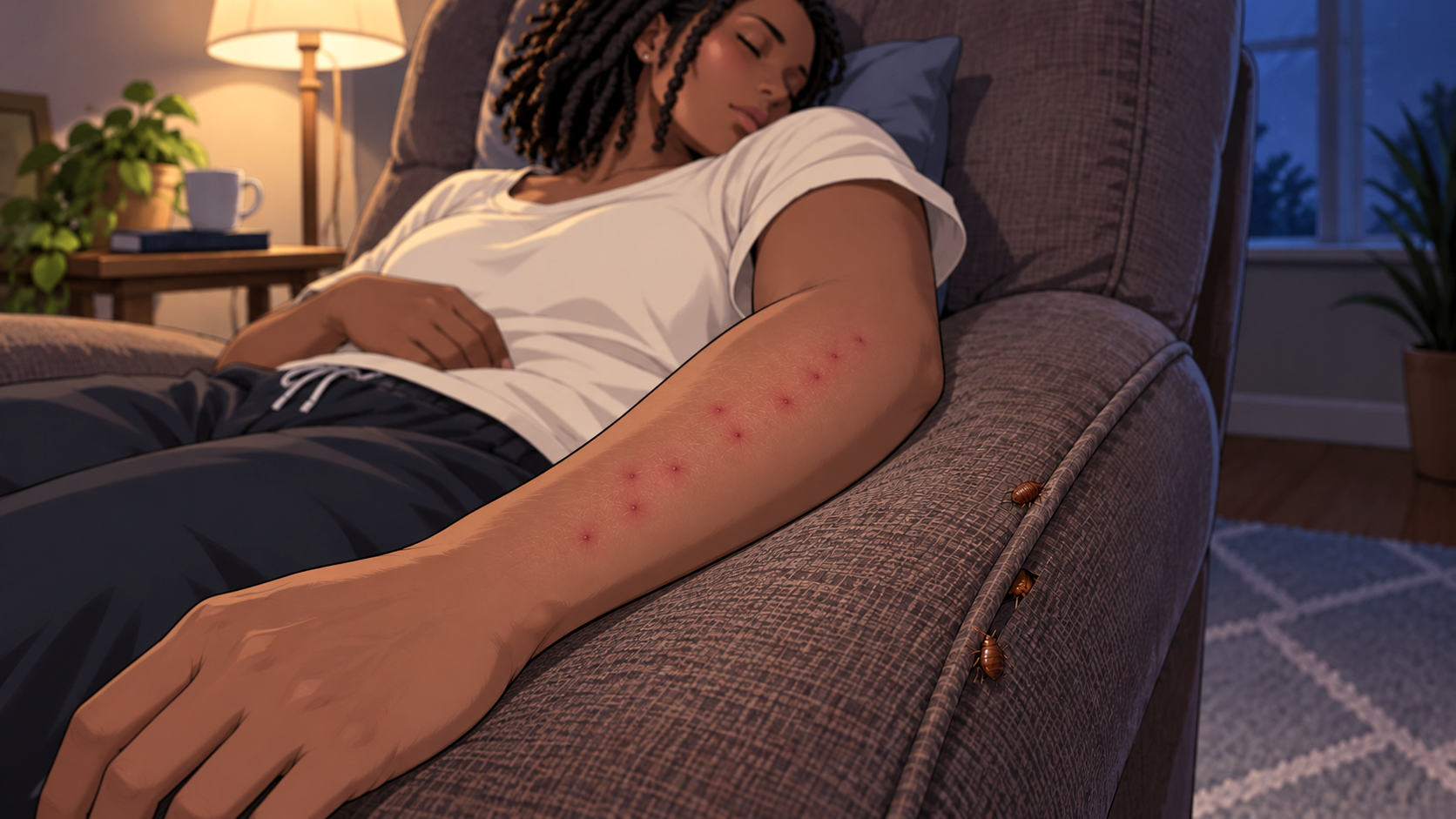
A row of three or four itchy bumps can look so deliberate that it is easy to imagine a bed bug moving down your arm and biting at regular intervals. Bed bug bites really can appear in lines and clusters, but there is no fixed pattern that every person develops. Some bites are grouped closely together, while others appear scattered across exposed skin. Bed bugs can leave lines or clusters when a single bug feeds repeatedly in a small area. Several bugs feeding on nearby exposed skin can also contribute to grouped marks. However, bed bug bites may be clustered, straight, or random, so the pattern alone cannot confirm that bed bugs caused them. Bed bug bite patterns can vary considerably That makes the familiar line of bites useful as a reason to investigate, not as a diagnosis. What you find around the bed carries much more weight than whether the bumps form a neat row.
One Bed Bug Can Be Responsible for Several Marks
Finding four bumps does not mean four bed bugs fed on you. A single insect can account for multiple nearby lesions. Published observations of repeated feeding by individual bed bugs describe small clusters of itchy papules or wheals associated with repeated feedings by one bug.
This helps explain why the marks can look grouped even without a large number of insects feeding at once. However, there is no rule saying that repeated feeding must create a perfectly straight row. Bite marks may be random or linear, and individual reactions differ considerably. Straight and random bed bug bite patterns are both recognized presentations.
So counting your bumps is a poor way to estimate how many bed bugs are present. Three marks could involve repeated feeding, while an infestation containing multiple insects might leave someone with few or even no visible marks. Our guide to bed bug bite clusters looks more closely at what grouped reactions can look like.
Several Bed Bugs Can Add to the Same Patch of Bites
There is another route to a cluster. More than one bed bug may feed on the same sleeping person, putting separate feeding sites relatively close together.
Bed bugs tend to stay near places where people sleep or rest for extended periods. Mattresses, box springs, bed frames, headboards, furniture, and nearby cracks can all provide hiding places. They emerge to obtain blood meals and then return to protected areas. Bed bug feeding and hiding behavior helps explain how multiple insects in the same sleeping area can reach one person during periods of rest.
Exposed skin also influences where marks may be noticed. Bed bugs commonly bite areas such as the head, neck, arms, hands, and legs, while clinical descriptions note that bed bug and flea bites can appear as clusters on unclothed areas. Clinical patterns of arthropod bites show why distribution on the body can provide context without proving which insect was responsible.
That is more useful than imagining that bed bugs deliberately choose a geometric pattern. They are trying to obtain a blood meal, not arrange the evidence they leave behind.
The Famous Three-Bite Pattern Is Not a Bed Bug Rule
You may have heard that three bites in a row automatically mean bed bugs. Treating that as a diagnostic rule can send an inspection in the wrong direction.
There is no required number of marks for a bed bug bite reaction. Bites can occur singly, in clusters, or in lines, while the reaction itself varies greatly between people. Bed bug bites can have several arrangements, and some people may show no reaction at all.
A line of three bumps is therefore compatible with bed bugs, but it is not proof of them. Four scattered bumps do not rule them out either. Even the absence of visible bites does not establish that nobody in the room was bitten.
This is one reason we would never use the shape of a rash as the deciding evidence. The pattern can tell you that an inspection is worthwhile. It cannot tell you with certainty what was hiding beside the bed.
Your Skin Reaction Can Change What the Pattern Looks Like
A bite mark is not the bite itself. It is your body’s reaction after feeding has already occurred, and those reactions vary considerably from one person to another.
Some people develop small marks. Others have more noticeable itching or swelling, while some show no physical signs. Marks can also appear later rather than becoming visible immediately after the feeding event. Individual reactions to bed bug bites range from no visible reaction to more pronounced responses.
That variability makes it difficult to reconstruct the previous night’s feeding simply by studying the skin. Imagine two people sharing the same bed. One could wake with obvious grouped marks while the other sees nothing. The difference does not establish which person was bitten more often.
For the same reason, a new group of visible bumps does not tell you precisely when the bites occurred. Our guide to bed bug bite reactions goes deeper into how differently people can respond.
Lines and Clusters Can Come From Other Causes
The biggest problem with identifying bed bugs from a bite pattern is that bed bugs do not own the pattern.
Other arthropod bites can produce itchy red bumps, and fleas can also leave clustered lesions. Clinical guidance on bites from insects and other arthropods specifically notes that both flea and bed bug bites can occur as clusters of red papules.
There are other sources of confusion too. Skin reactions can resemble insect bites even when another cause is responsible. That makes a photograph of red bumps much less definitive than many online bite charts suggest.
Our bed bug bites versus flea bites comparison can help you investigate those two possibilities. There are separate guides for comparing bed bug and mosquito bites and bed bug bites with hives when the skin reaction itself is causing confusion.
A Bite Pattern Cannot Confirm Bed Bugs
This is the point we would give the most weight when looking at a suspicious row of bumps. Bed bug bite reactions are not specific enough to diagnose an infestation on their own.
Confirmation becomes much stronger when an actual adult or nymph is collected from a sheltered area near where the person was bitten. Physical identification is the stronger diagnostic evidence because inflammatory reactions alone are not specific to bed bugs.
That changes what you should do after noticing a line of bites. Rather than spending an hour comparing your arm with photographs online, spend that time checking the environment.
Inspect mattress seams, the box spring, bed frame, headboard, and nearby protected cracks. Bed bugs are small and flat, and they hide in tight spaces close to sleeping and resting areas. Our bed bug inspection guide walks through that search in more detail.
Look for Evidence That Cannot Be Explained by the Bite Pattern
The strongest case for bed bugs comes from combining clues from the room rather than trying to squeeze certainty out of the skin.
Look for live bed bugs, shed exoskeletons, and rusty or dark spotting around the mattress and nearby furniture. These are recognized signs of bed bug activity around sleeping areas. Physical signs of a bed bug infestation provide evidence that a row of red bumps cannot supply by itself.
The insect may still be difficult to find when numbers are low. Bed bugs hide well, and a quick glance across the top of the mattress is not a complete inspection. If you have suspicious marks but no obvious insects, our guide to having bed bugs without seeing them explains why an early infestation can remain inconspicuous.
You can also compare anything you capture with what bed bugs actually look like. A confirmed specimen is far more persuasive than whether three bumps happen to sit in a straight line.
What to Do When a Line or Cluster Appears Overnight
Start with the room rather than treating the skin pattern as a verdict. Inspect the sleeping area carefully and capture any suspicious insect intact if possible. When you have marks but find nothing else, continue looking for physical evidence instead of assuming that every new bump confirms bed bugs.
For the bites themselves, avoid excessive scratching because broken skin can develop a secondary infection. Most bed bug bites need only minimal symptomatic care and good hygiene, although severe reactions or secondary infections may require medical treatment. Clinical care for bed bug bites explains the medical approach to bite reactions.
Persistent itching is a separate issue from identifying the infestation. Our guide to stopping bed bug bites from itching covers that side of the problem. Seek medical care for a severe, worsening, infected, or otherwise concerning reaction rather than using the number or arrangement of bumps to judge its seriousness.
Other Questions About Bed Bug Bite Lines and Clusters
Can one bed bug leave five or six bite marks?
Multiple marks do not provide a reliable insect count. Repeated feeding by an individual bed bug has been associated with clusters of lesions, so several marks do not automatically mean several bugs were feeding.
Can bed bug bites form a circle instead of a line?
Bite reactions do not have to follow one prescribed shape. Because the marks can be random or grouped, an unusual arrangement neither confirms nor rules out bed bugs. The physical evidence around the sleeping area remains more useful for identification.
Why does one person have clusters while their partner has no marks?
Visible reactions differ between people. One person can develop obvious itchy lesions while another person shows little or no physical reaction after exposure. The absence of marks on one sleeper therefore does not prove that only the other person encountered bed bugs.
Can old and new bed bug bites make one large cluster?
Marks can become noticeable at different times after feeding, so what appears to be one group on the skin does not necessarily document a single feeding event. Timing alone cannot reliably reconstruct when each bite occurred.
Do bed bug bites in a line mean the infestation is severe?
No. The arrangement of the marks does not measure infestation size. Determining the extent of a bed bug problem requires inspecting the sleeping area and looking for actual insects and other physical signs rather than counting or mapping bites.
4 thoughts on “Why Do Bed Bugs Bite in Lines or Clusters?”