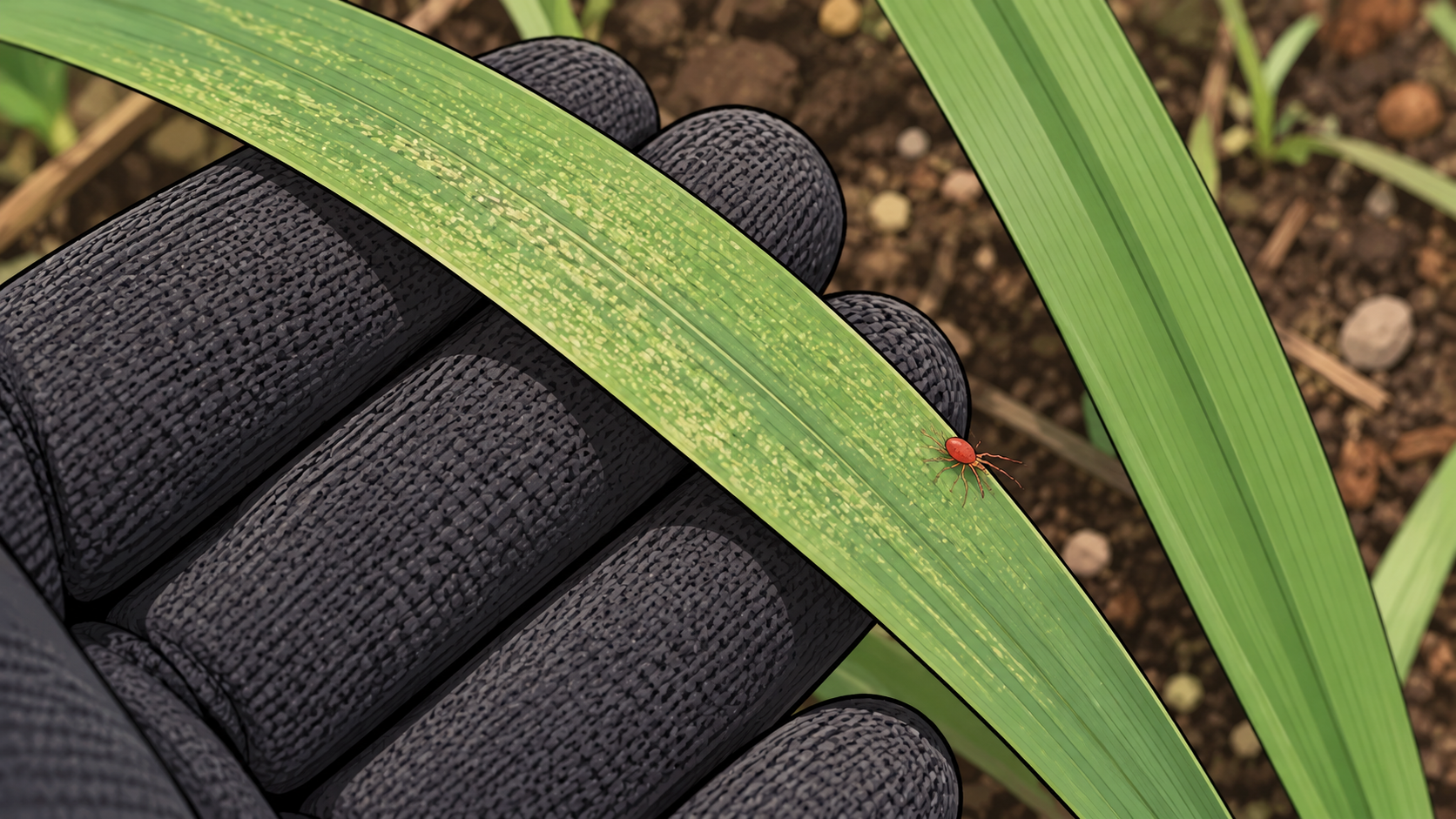
Clover mite damage starts small enough to overlook: pale flecks, irregular silvery streaks, or a washed-out cast where feeding has removed contents from plant cells. On turf, heavier feeding can progress into pale, yellowing, and eventually brown areas. Broadleaf plants may show silvered or bronzed foliage, and flowers can also carry feeding marks. None of these symptoms alone proves clover mites are responsible, so the most convincing diagnosis combines the damage pattern with actual mites on the affected plant.
Look Closely at the Discoloration
Clover mites feed by puncturing plant tissue and taking up cell contents, leaving tiny areas that have lost their normal green coloration. On grass blades, the characteristic result is small irregular silver streaks; another turf reference describes the same injury as silvery streaks or specks. Individual marks can be inconspicuous at first. As numerous feeding points accumulate, a blade or leaf may take on a pale or silver-gray appearance rather than showing a single sharply defined lesion. On broader-leaved hosts, clover mite feeding can produce bronzed or silver foliage, while flowers are also documented feeding sites. This visual pattern fits their plant-feeding diet and is more informative than looking for holes, because their feeding does not remove chunks of leaf tissue.
Grass Can Develop a Larger Pattern
A lawn gives you another diagnostic clue because thousands of individual feeding marks can merge into visible discoloration. Early injury may resemble faint streaking or flecking across individual blades; with heavier feeding, the turf becomes pale and may progress toward yellow or brown. Severe cases have produced light-brown irregular patches of dead grass, particularly near upright structures. A current turf-management reference likewise describes pale leaves followed by die-off. The lawn-specific extent and consequences belong in the separate article on clover mite lawn damage; for identification purposes, inspect individual blades at the margin of a discolored area rather than judging the brown patch from several feet away.
Do Not Diagnose Them From a Brown Patch Alone
Clover mite injury can imitate other plant problems surprisingly well. Turf symptoms are specifically known to be confused with winter injury, and drought, nutrient problems, diseases, and other plant-feeding mites can also produce discoloration. Other turf mites may create superficially similar flecking or silvering, so the shape and color of the damaged area are supporting evidence rather than a final identification.
Webbing can help narrow the possibilities. Clover mites do not produce webbing on plants, whereas some other plant-feeding mites do. Our separate explanation of whether clover mites make webs covers that feature in detail. Absence of webbing does not prove clover mites are present, but obvious mite webbing makes a clover-mite diagnosis less convincing.
Find the Mite Before Blaming the Damage
The best confirmation is to inspect symptomatic foliage with magnification and find mites whose anatomy matches the species. Clover mites are tiny, but adults have conspicuously elongated front legs that can look almost like antennae. Our clover mite identification guide covers their overall appearance, while the separate clover mite color guide is useful when the specimens are not the bright red you expected.
A hand lens is particularly useful on grass because the feeding marks themselves can be tiny. Examine both damaged and adjacent healthier tissue, looking for mites at the same time as the characteristic silvering. The season provides another piece of supporting evidence because clover mites have a cool-season activity pattern, but neither timing nor plant symptoms should substitute for finding the pest when a precise diagnosis matters.
Questions That Help With Plant Identification
Can clover mite damage appear on flowers as well as leaves?
Yes. Documented feeding injury includes small silver streaks on flowers as well as foliage.
Does clover mite damage create holes in leaves?
Their characteristic injury is discoloration from feeding on plant cells rather than holes made by chewing away pieces of leaf.
Can damaged leaves look bronze instead of silver?
Yes. Bronzing and silvering have both been documented on plants fed on by clover mites.
Does finding clover mites prove they caused every damaged area on the plant?
No. Their presence is strongest evidence when the mites occur on tissue showing a compatible feeding pattern. A plant can have clover mites and an unrelated disease, environmental injury, or another pest at the same time.