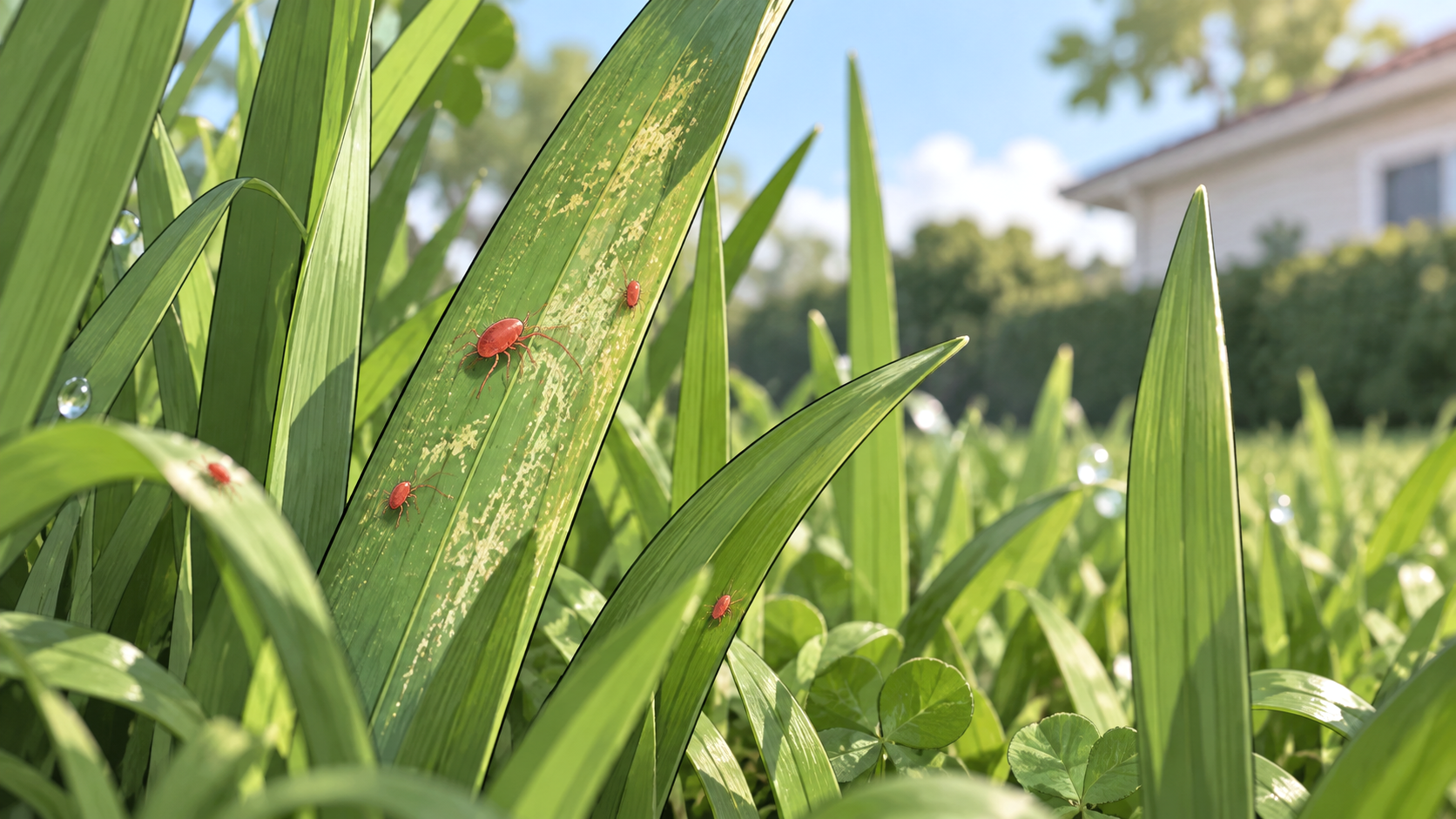
A lawn that comes out of winter with brown patches is easy to blame on cold weather, drought, or delayed spring green-up. Clover mites belong on that list too. Yes, clover mites can damage turfgrass, and sufficiently heavy feeding can thin or kill grass. Serious lawn injury is not inevitable, however. Some authorities describe clover mites primarily as nuisance pests with little apparent effect on turf, while turf specialists have documented substantial injury when populations become high and conditions favor damage.
The clearest cases have a recognizable setting. Cool-season mite activity, stressed grass, and affected turf concentrated near buildings or other upright surfaces. Clover mites are therefore capable of becoming a lawn pest without every lawn that supports them becoming visibly damaged.
The Worst Damage Can Leave Dead Turf
Clover mites feed directly on grass blades. Their feeding removes cell contents and can produce silver streaks along individual blades. With increasing injury, the grass loses its healthy green appearance, becomes pale, and can eventually die. Heavy infestations have been documented producing light-brown irregular patches of dead grass extending several feet from a building.
Severity can vary from minor thinning to complete loss within an affected patch, so the appearance of a few mites does not tell you how much damage the lawn will suffer. Maine’s pesticide-control guidance, for example, describes clover mites as causing no apparent harm to turfgrass, while other turf references document substantial localized injury. Those accounts are not necessarily incompatible. Clover mite populations, climate, turf condition, and feeding pressure differ from one lawn to another. The broader effect of clover mites on plants is a separate question from how that feeding plays out specifically in turf.
Damage Often Hugs a Structure
One of the more useful clues is where the failing grass sits. Documented clover mite injury occurs disproportionately near foundations, trees, fences, and other vertical surfaces. Colorado turf research reports that almost all injury occurs within about 10 feet of an upright surface, while the sun-exposed southern and western sides of structures are particularly common problem areas. Clover mites periodically leave the grass and climb upright surfaces for activities such as molting and egg laying, concentrating populations in these zones.
That distribution can produce an oddly specific lawn problem: a brown or thinning strip close to a house while turf farther into the yard looks substantially better. It also connects lawn populations with the familiar sight of clover mites on exterior walls and their later movement toward windows and other building openings. A damaged patch in the middle of an open lawn with no mites present deserves a wider diagnosis rather than being assigned to clover mites solely because the grass is brown.
Dry Grass Is More Vulnerable
Water stress repeatedly appears alongside damaging turf infestations. Current turf guidance notes that clover mite infestations are often associated with drought conditions, while Colorado records much of the worst injury in warm, dry areas around foundations. A lawn already struggling to maintain healthy growth has less capacity to tolerate additional feeding.
There is an interesting wrinkle here. Clover mites can also become numerous in lush or heavily fertilized lawns because abundant vegetation provides food, and newly landscaped or well-fertilized lawns can support large clover mite populations. Heavy fertilization is therefore not a sensible response to seeing mites. Turf should receive water and nutrients according to the needs of the grass rather than being pushed into excessive growth in an attempt to compensate for feeding.
Spring Damage Can Look Like Winter Injury
Clover mite lawn damage is unusually easy to miss because its timing overlaps with seasonal turf problems. Feeding injury can become conspicuous as grass emerges from dormancy, and pale or dying turf may resemble winter injury. In cooler regions, damaging activity is concentrated in late winter and spring before warmer weather suppresses clover mite activity. The complete clover mite seasonal cycle explains that timing.
Do not diagnose a lawn from the brown patch alone. Examine grass blades near the edge of the affected area and look for mites as well as compatible feeding injury. A hand lens helps because adults are extremely small, although their unusually long front legs are distinctive when magnified. The detailed visual signs belong in our guide to identifying clover mite damage.
A Damaged Lawn May Recover Without Pesticides
Water management can make a substantial difference where drought stress and clover mites occur together. Supplemental irrigation in dry mite-prone areas can reduce populations and help turf tolerate feeding. Current Georgia turf guidance likewise recommends a good irrigation schedule and notes that pesticides do not provide effective clover mite control in turf. That makes restoring appropriate growing conditions a more useful starting point than automatically spraying a brown patch.
Dead grass is different from stressed grass. If the crowns have survived, turf may resume growth as conditions improve; areas that have been completely killed will need repair or renovation. Before reseeding or treating, confirm what caused the loss so that the replacement grass is not being planted into an unresolved problem. If clover mites are also spreading beyond the lawn, the broader outdoor clover mite control page covers management beyond turf damage itself.
Lawn Questions Worth Separating
Can clover mites damage every type of lawn grass?
They feed on numerous grasses, but there is not good evidence establishing which turfgrass cultivars are reliably resistant to clover mites. Current turf guidance specifically notes the lack of studies on clover mite resistance among turfgrasses.
Will clover mite damage spread across the entire yard?
It can expand when populations are high, but documented injury is often concentrated near buildings, trees, fences, or other upright surfaces rather than distributed uniformly across the property.
Does a lawn damaged in spring always need reseeding?
No. Thinned or stressed grass may recover once mite pressure and environmental stress decline. Turf that is actually dead will not regrow from dead crowns and may require renovation.
Can clover mites damage artificial turf?
No. Clover mites feed on living plant material, so synthetic grass does not provide turf tissue for them to feed on.
One thought on “Can Clover Mites Damage Your Lawn?”