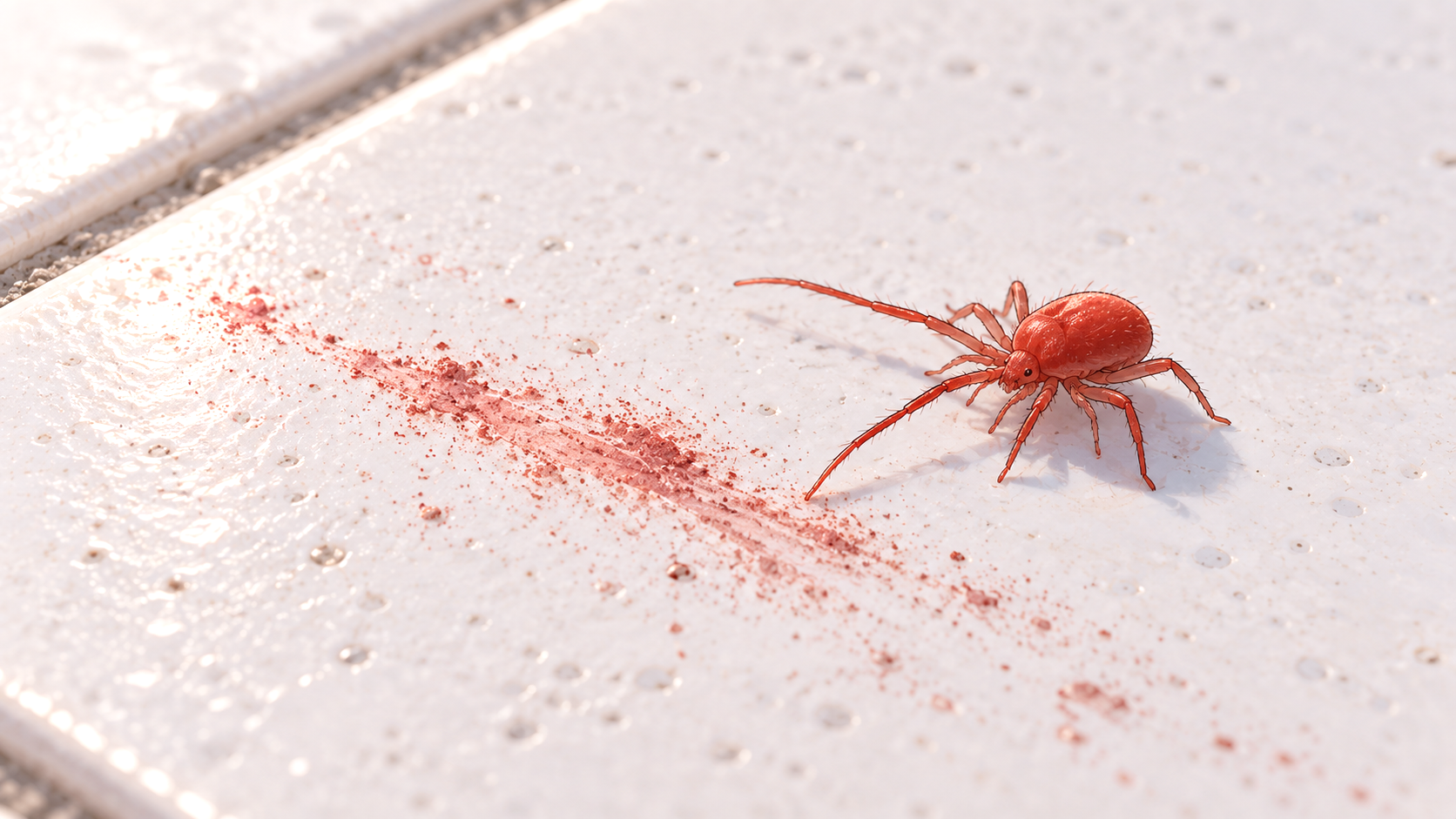
A clover mite crawling across a white window sill may leave no mark at all. Press a finger over it, and the result can be a surprisingly vivid rusty-red smear. Clover mites leave red stains because crushing their soft bodies releases pigmented internal material onto the surface. The stain comes from the mite itself. It is not human or animal blood. The effect is especially noticeable because clover mites are tiny. An individual measures less than a millimeter long, yet its reddish body can produce a mark considerably easier to see than the intact mite.
The Red Smear Is Not Blood From a Bite
A blood-red spot can make a crushed clover mite look as though it recently fed on a person or pet. Clover mites are actually plant feeders. They feed on grasses, clover, weeds, and other vegetation, and they do not bite humans or animals. Their reddish or reddish-brown coloration belongs to the mite itself, and crushed specimens characteristically produce rusty to blood-red spots.
Calling the smear “blood” can therefore lead identification in the wrong direction. A red spot left by a squashed arthropod does not prove blood feeding. Bed bugs, for example, are blood-feeding insects with entirely different biology, appearance, and indoor behavior, while clover mites and bed bugs can both be associated with reddish marks for unrelated reasons.
Crushing the Mite Creates the Stain
An undisturbed clover mite can simply walk across a surface. The staining problem begins when its soft body is compressed and its contents spread outward. This is why clover mites become particularly troublesome when large numbers gather on window sills, walls, curtains, furniture, or other places where they can accidentally be wiped, leaned on, or pressed under an object. Their bodies are only about 1/64 inch long and are described as soft, oval, and flattened, leaving little protection against pressure.
Vacuuming indoor mites avoids the mechanical action that produces the smear. Household management guidance specifically recommends vacuum removal to prevent staining, which is preferable to wiping or crushing active mites across the surface. Large indoor numbers are still an invasion from outside rather than evidence that the mites are successfully living and reproducing indoors.
Pale Surfaces Make a Tiny Accident Look Much Worse
The stain is easiest to notice where the color contrast is strong. White paint, pale walls, light curtains, window frames, paper, and similar materials can make a tiny reddish smear conspicuous. Clover mites commonly appear around sunny walls and windows, so the surfaces on which homeowners find them are often exactly the surfaces where an accidental stain stands out.
The mite itself is not always bright red. Adults can appear reddish, reddish-brown, or even greenish after feeding, while their color varies with life stage and feeding condition. The rusty-red mark produced when one is crushed is therefore more useful as a known consequence of crushing than as a way to judge the exact color of a living specimen.
Many Red Stains Usually Mean Many Mites Were Crushed
Clover mites can migrate in tremendous numbers from lawns and other vegetation toward structures. They may spread across exterior walls and squeeze through cracks around windows, doors, foundations, and siding. Once dozens or hundreds reach an indoor surface, a single wiping motion can crush many at once and turn individual specks into a larger streak.
The mites themselves do not eat furnishings or damage the building. Their ability to stain when crushed is one of the main reasons an otherwise harmless indoor invader becomes such a nuisance. Preventing repeated migrations through exclusion and changes around the foundation reduces the opportunity for those accidental smears to occur.
Questions About Clover Mite Red Marks
Can a clover mite leave a red trail while it walks?
Normally, an intact mite crawling across a surface does not paint a continuous red trail. Smearing strongly suggests that a mite has been crushed or damaged.
Does a red stain prove the pest was a clover mite?
No. The stain can support an identification when it accompanies other clover mite features, but color alone is insufficient. Their very long first pair of legs and tiny oval body provide much better identifying evidence.
Why do clover mite stains sometimes look brown rather than bright red?
The mites themselves vary from reddish to reddish-brown, and a thin smear can look different depending on the surface, lighting, amount of material released, and whether the mark has dried.