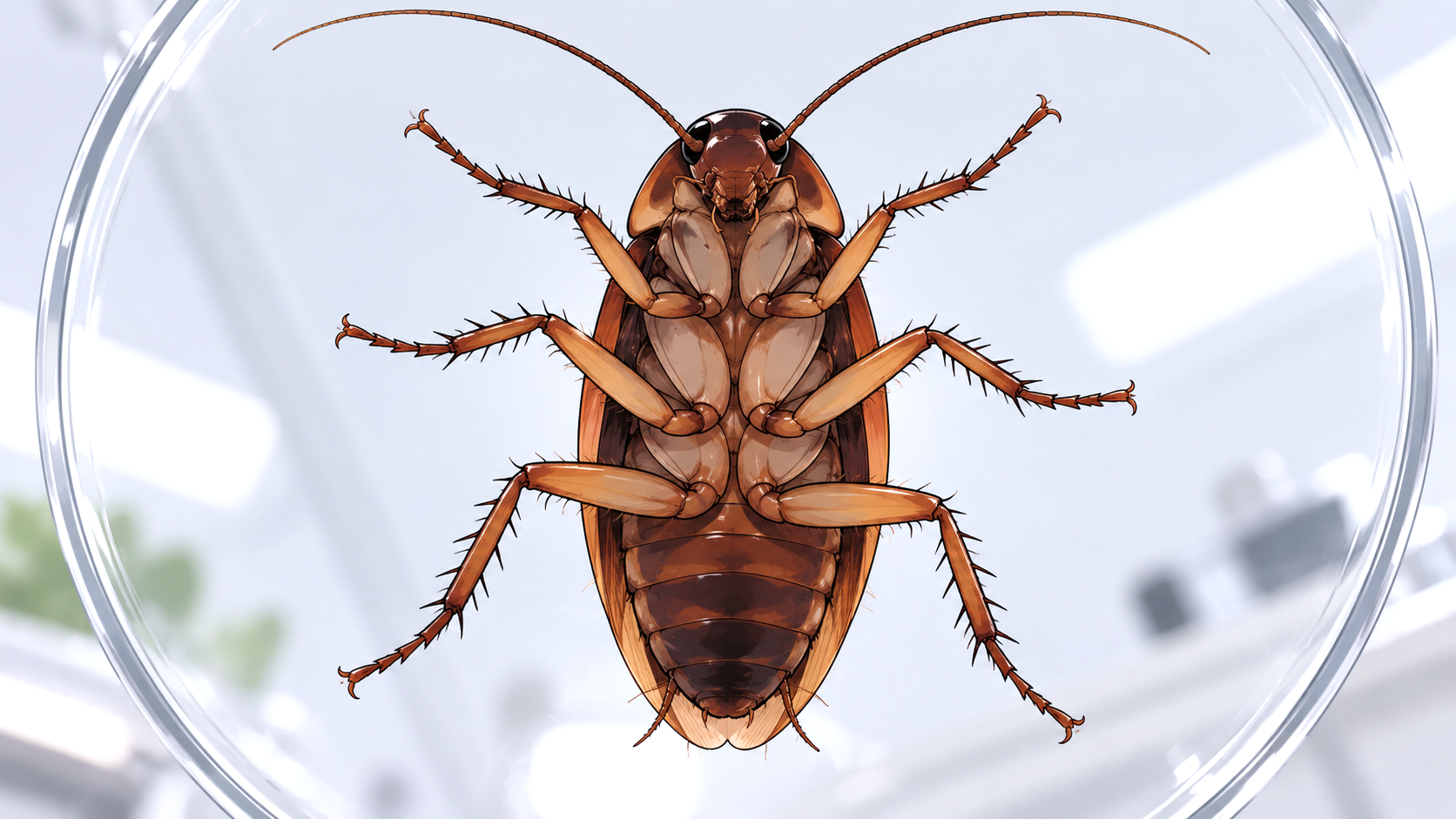
A cockroach has six legs, with three on each side of its body. One pair attaches to each of the three thoracic segments, giving the insect a front, middle, and hind pair. All cockroach species share this six-legged arrangement because cockroaches are insects, although the proportions and details of the legs vary among species.
Those six legs do considerably more than carry the body. Their arrangement helps cockroaches accelerate quickly, maneuver through clutter, climb many surfaces, and remain stable while moving at speed.
A Cockroach Has Three Pairs of Legs
All six legs connect to the thorax rather than the abdomen. The first pair attaches to the prothorax, the middle pair to the mesothorax, and the hind pair to the metathorax. This three-pair arrangement is part of the insect body plan and one reason cockroaches qualify as insects.
The pairs are not identical in proportion. The front legs are generally the shortest, while the hind legs are longer. Looking at all three pairs together can therefore make the legs seem less orderly than the simple number six suggests, particularly when a cockroach is running. For identification, counting six legs can support a cockroach ID, but it cannot establish one by itself. Adult cockroach appearance combines the legs with a flattened body, long antennae, coloration, markings, and other visible characteristics.
Each Cockroach Leg Is a Chain of Moving Sections
A cockroach leg is jointed rather than a single rigid appendage. From the body outward, its principal sections include the coxa, trochanter, femur, tibia, and tarsus. The tarsus itself consists of smaller segments and ends in structures that help the insect grip or attach to surfaces. Those names can make a simple leg sound unnecessarily complicated, but the segmented construction is what gives it a large range of movement.
Prominent spines are especially noticeable on the legs of many cockroaches. They can make the legs look almost bristly in a close photograph and are useful when distinguishing a cockroach from some smooth-legged household insects. Leg structure is only one portion of cockroach anatomy, so features elsewhere on the body should still be considered when identification is uncertain.
Six Legs Let a Cockroach Run Without Moving Them All Together
A running cockroach can coordinate its legs in an alternating tripod gait. During this pattern, three legs support or propel the animal while the other three advance, then the groups alternate. Experimental work on American cockroaches has documented this alternating tripod pattern during rapid running.
The arrangement gives the animal multiple points of contact while allowing fast strides. Cockroaches can also alter how they use their legs when terrain becomes complicated. Experiments with large obstacles found that cockroaches changed their leg and body movements while negotiating clutter, then returned to their regular running gait after passing through it.
Speed can make counting the legs surprisingly difficult in a live insect. A still photograph usually provides a better view, especially when deciding between a cockroach and another fast household arthropod. For example, earwigs and cockroaches both have six legs, so leg number does little to separate them.
Cockroach Feet Help Explain Their Climbing Ability
At the end of each leg, cockroaches have structures suited to gaining traction on different surfaces. Research on cockroach feet has documented both claws and specialized pads. The claws can engage rough surfaces, while smooth attachment structures contribute to movement across surfaces where claws alone cannot obtain a useful hold. Experiments with Madagascar hissing cockroaches found that claws and attachment pads work together across different substrates.
The pads do not all perform the same job. Cockroaches have tarsal pads called euplantulae and a distal pad called an arolium. During vertical climbing, different pads provide traction depending on whether a leg is pushing or pulling. Additional experiments have measured how the smooth foot pads generate adhesion and friction.
Those tiny structures help explain a familiar household observation: a cockroach can move across surfaces that look difficult for such a relatively heavy insect to grip. Surface texture still affects attachment, so climbing performance is not identical on every material.
A Cockroach Can Lose a Leg and Still Move
Finding a cockroach with five visible legs does not mean it belongs to a five-legged species. A leg can be lost through injury, leaving an otherwise normal cockroach temporarily short of the standard six.
Immature cockroaches have an additional advantage because regeneration can occur as they continue developing and molting. Experiments on the American cockroach have demonstrated substantial leg-regeneration ability during the nymphal stages. Regeneration is tied to subsequent molts, so an adult that has completed its molts cannot simply replace a missing leg in the same way. The developmental context belongs with cockroach molting and the cockroach life cycle rather than changing the basic leg count.
A damaged specimen can consequently be misleading during identification. Count the attachment points and examine the rest of the body instead of assuming that every leg originally present must still be visible.
Leg Clues That Can Help With a Cockroach ID
Do baby cockroaches have six legs?
Yes. Cockroach nymphs have three pairs of legs just like adults. Their lack of fully developed wings and differences in body proportions can change their overall appearance, which is why baby cockroaches can look different from adults even though the leg count remains six.
Do cockroaches have more legs than beetles?
No. Both are insects and have six legs. Other features are needed for a reliable cockroach-versus-beetle identification.
Are the hairs on cockroach legs actually spines?
Many of the conspicuous pointed projections visible on cockroach legs are cuticular spines rather than ordinary soft hairs. Their size and arrangement vary, so they should not be used alone to identify a species.
Can a cockroach walk after losing more than one leg?
Cockroach locomotion is adaptable enough that individuals can continue moving after leg loss, although the effect depends on which legs are missing and the extent of the injury. A damaged cockroach should therefore not be ruled out simply because its gait looks unusual.
3 thoughts on “How Many Legs Does a Cockroach Have?”