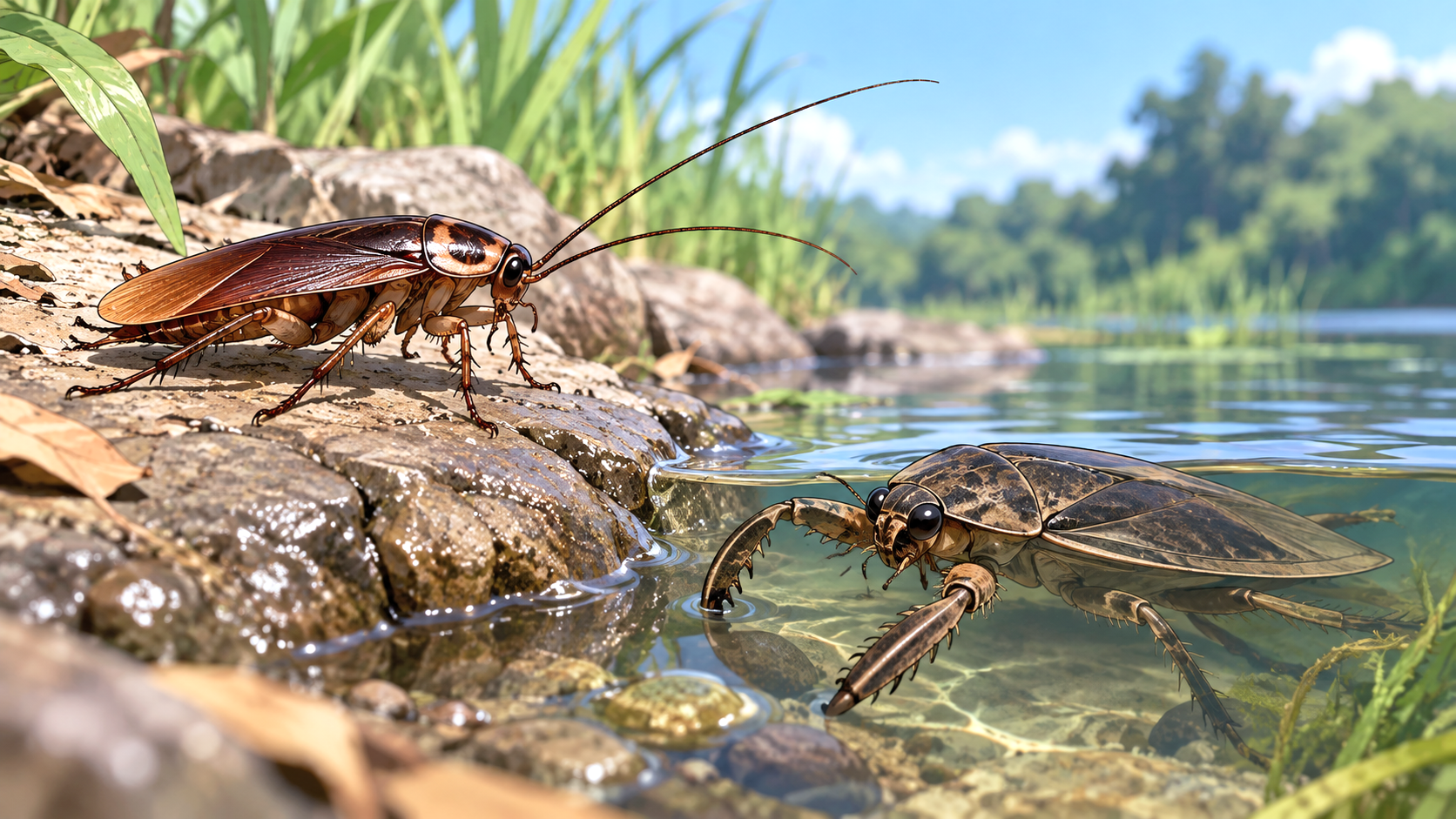
“Water bug” is an awkward name for identification because people use it for two very different insects. Oriental and American cockroaches are sometimes called water bugs, but true giant water bugs are aquatic insects in the family Belostomatidae. A genuine giant water bug is not a cockroach.
If you are comparing a cockroach with a true water bug, look at the front legs, antennae, habitat, and body proportions. Giant water bugs have short, largely concealed antennae and powerful grasping front legs. Cockroaches have conspicuously long antennae and the familiar running-leg arrangement of adult cockroaches.
“Water Bug” Can Mean Two Completely Different Things
The nickname often creates the confusion before anyone examines the insect. Oriental cockroaches (Blatta orientalis) favor cool, damp environments and are commonly called water bugs. American cockroaches (Periplaneta americana) also receive the name in some regions. Neither is aquatic. They remain cockroaches in the order Blattodea, and their association with damp locations does not turn them into true water bugs.
Entomologically, giant water bugs belong to the family Belostomatidae within the order Hemiptera. They are aquatic predators adapted to life in freshwater. The National Park Service describes giant water bugs as true bugs, a taxonomic group separate from Blattodea. The difference therefore runs much deeper than two common names for similar-looking insects.
When someone calls a dark roach in a basement a “water bug,” they may simply mean a cockroach. When the insect came from a pond, has grasping front legs, and looks built for swimming, “water bug” may mean an actual belostomatid.
The Front Legs Give Away a True Water Bug
A giant water bug has a distinctive pair of raptorial front legs. They are thick, bent, and adapted for seizing prey. The hind legs are broader and modified for swimming. North Carolina State University’s identification characters for Belostomatidae include grasping forelegs with a large claw and a flattened oval body.
Cockroach legs have a completely different appearance. All three pairs are walking and running legs rather than one oversized prey-grabbing pair. They are generally long and conspicuously spiny. The three pairs of cockroach legs attach to the thorax and work together during running, climbing, and maneuvering.
The antennae provide another fast check. Cockroach antennae are long, slender, and difficult to miss. Giant water bugs have short antennae tucked beneath the eyes. On a clear photograph, that contrast can settle an identification before coloration becomes relevant.
Their Similar Flat Brown Bodies Hide Very Different Equipment
Both insects can be brown, oval, flattened, and winged, which explains why a quick glance may not be enough. A large cockroach can also overlap a giant water bug in overall size. Body shape and color should therefore be combined with more diagnostic features rather than treated as proof.
The mouthparts are particularly different. Cockroaches have chewing mouthparts. Giant water bugs possess the piercing-sucking beak characteristic of true bugs and use it to feed on prey. Their front legs hold the victim while the beak penetrates it. Those specialized predatory features are absent from cockroach anatomy.
Winged adults create another source of surprise because both insects can appear away from where you expect them. Some cockroaches fly, and adult giant water bugs can also fly between aquatic habitats. Belostomatids are sufficiently attracted to artificial lights that they are also called electric light bugs. A giant water bug found beneath lights in a parking lot may consequently be nowhere near the water when you encounter it.
Where You Found It Can Narrow the Choice Quickly
True giant water bugs live in freshwater environments such as ponds, marshes, lake margins, and slow-moving portions of streams. They are predators of aquatic animals rather than household scavengers. Adults sometimes fly to lights and end up on sidewalks, driveways, sports fields, or buildings, so finding one on dry ground does not erase its aquatic biology.
Cockroaches encountered around buildings occupy a different set of habitats. The exact location depends on species. Oriental cockroaches favor damp basements, drains, crawl spaces, and similar protected areas, while American cockroaches can inhabit sewers, utility areas, and other warm, moist sites. Those differences are part of why cockroach type affects where an infestation develops.
A cockroach beside a floor drain is therefore not evidence that you found a true water bug. Plumbing-related sightings can instead involve cockroaches associated with drains and surrounding voids. Conversely, a large insect collected from a pond deserves a close look at its legs and antennae before anyone labels it a roach.
Do Not Handle a Giant Water Bug to Check
Identification by hand is unnecessary and can hurt. Giant water bugs are predatory true bugs with a strong piercing beak. They can deliver a painful defensive bite when mishandled, and the University of Florida advises caution when handling them.
A photograph is safer and usually more useful. Capture the whole insect from above if possible, then examine the front legs and antennae. If it has massive grasping forelegs and very short antennae, a giant water bug becomes much more plausible. Long antennae and six similarly arranged running legs point toward a cockroach.
For a cockroach found indoors, species and context determine whether further inspection is warranted. An isolated outdoor species that wandered inside has different implications from repeated sightings of an indoor pest, so finding one cockroach should be evaluated from more than the nickname someone gave it.
Questions That Come Up With “Water Bugs”
Are Oriental cockroaches actually water bugs?
They are cockroaches. “Water bug” is only a common nickname associated partly with their preference for damp places. Oriental cockroaches belong to Blattodea, while true giant water bugs belong to Hemiptera.
Can giant water bugs live in a house?
A giant water bug may fly to lights and turn up around a building, but it is an aquatic predator rather than a household-infesting cockroach. Its normal habitat is freshwater.
Is a water bug the same as a palmetto bug?
Not reliably. Both expressions are informal common names applied inconsistently to cockroaches, while “water bug” also has a genuine aquatic meaning. The term palmetto bug can refer to large cockroaches rather than one universally defined species.
Can both cockroaches and giant water bugs fly?
Yes, depending on the cockroach species. Adult giant water bugs can fly, and some cockroaches also have functional flight wings. Flight alone cannot distinguish them.
One thought on “Cockroach vs. Water Bug: How to Tell Them Apart”