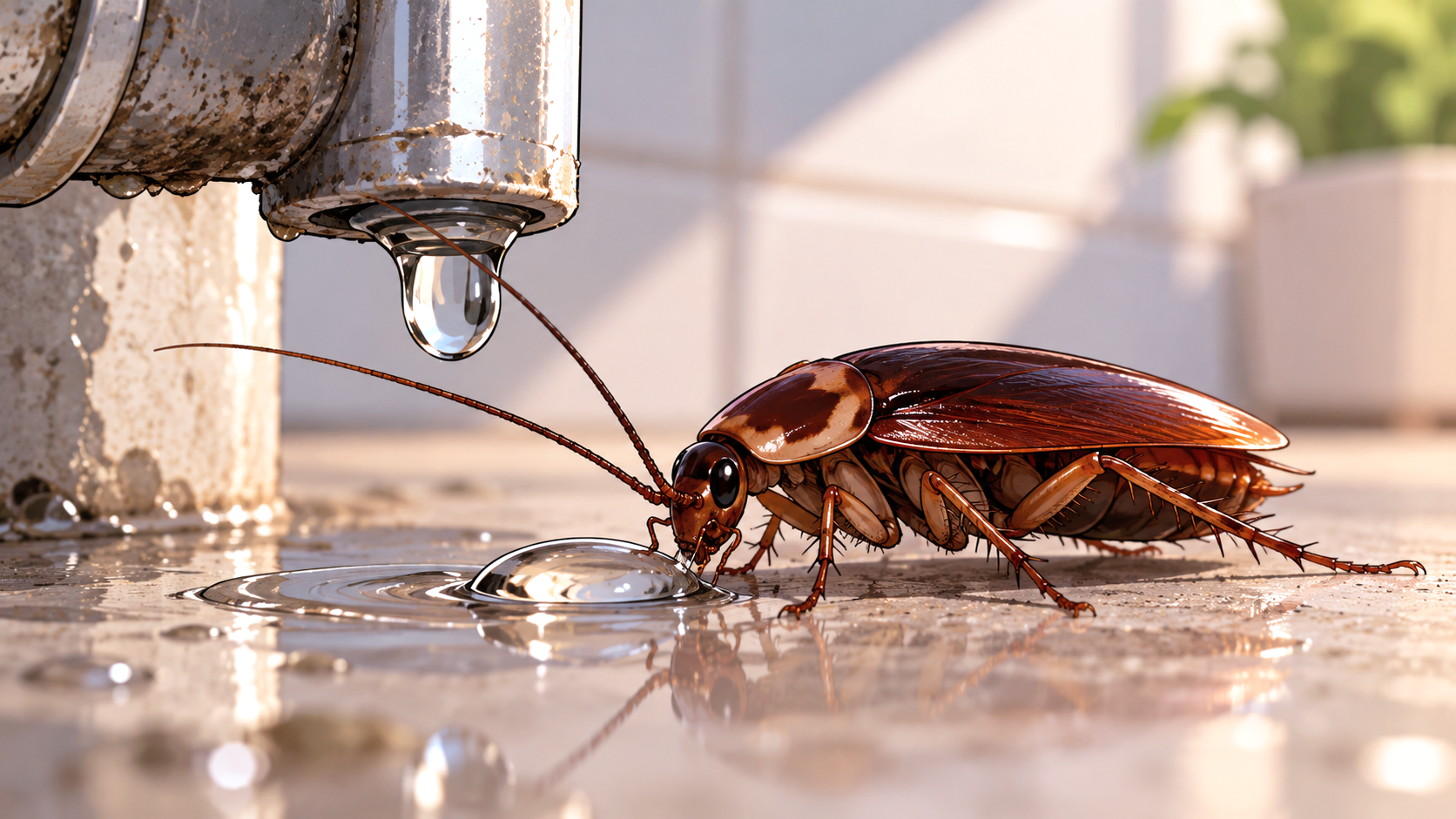
A cockroach does not need a visible bowl or puddle to find water indoors. A dripping pipe joint, condensation beneath a sink, moisture in a drain, or liquid left around a pet bowl may be enough to give it access to water. Removing obvious standing water while leaving these smaller sources untouched can therefore accomplish less than expected. Cockroaches drink water and require moisture to maintain their body water. Without access to drinking water or other moisture, many household cockroaches survive for days rather than indefinitely. There is no universal survival time because species, temperature, humidity, life stage, hydration level, and moisture obtained from food all affect dehydration.
Water Can Come From Places That Barely Look Wet
Cockroaches can drink exposed liquid, but household water sources are often much smaller. Sink traps, appliance drip pans, condensation, leaking faucets and pipes, wet surfaces, toilet areas, plant trays, pet bowls, beverage containers, and moisture-rich foods can all contribute. An EPA integrated pest management manual identifies these kinds of small indoor moisture sources as potential drinking water for cockroaches, while Health Canada recommends repairing leaks, reducing condensation, ventilating damp areas, and avoiding continuously available pet water when managing infestations.
Moist food complicates any attempt to measure how long a cockroach has gone “without water.” An insect denied an open water source may still obtain some moisture through what it eats. The general cockroach diet and direct access to liquid therefore need to be considered separately when interpreting survival claims.
“One Week Without Water” Is Not a Biological Deadline
A frequently repeated estimate says cockroaches die after about a week without water. The EPA has used that figure in household pest guidance, contrasting roughly a month without food with about a week without water. It is useful as a general pest-management message, but it should not be treated as a countdown that applies to every cockroach under every condition.
Controlled research demonstrates why a single number is inadequate. German cockroach survival changes with temperature, relative humidity, resource availability, and life stage. In experiments where both food and water were absent, higher relative humidity increased survival. Earlier work with first-instar German cockroaches likewise found that survival during food and drinking-water deprivation depended strongly on relative humidity. A warm, dry environment and a cool, humid one do not impose the same dehydration stress.
Cockroaches Lose Water Even When They Are Not Drinking
Like other terrestrial insects, cockroaches continuously face water loss across the body surface and through respiration and excretion. Their exoskeleton limits that loss but cannot eliminate it. Measurements in American cockroaches have shown that most measured water loss occurs through the cuticle rather than the respiratory system.
Behavior can reduce dehydration as well. German cockroach nymphs form tighter aggregations under drier conditions, and experiments indicate that this grouping can influence evaporative water loss. Other cockroach research has found that particular respiratory gas-exchange patterns are associated with reduced total and respiratory water loss during food and water restriction. These mechanisms help explain survival under temporary scarcity without making cockroaches independent of water.
Different Cockroaches Have Different Moisture Demands
Where a species normally lives gives a useful clue to its relationship with moisture. German cockroaches commonly occupy kitchens and other areas where water is readily available. Oriental cockroaches are strongly associated with damp environments such as basements, drains, crawl spaces, and areas around leaking plumbing. Brown-banded cockroaches tolerate drier locations and are more likely than several other household species to occur in furniture, upper cabinets, closets, and rooms away from plumbing. EPA guidance specifically notes that brown-banded cockroaches require less moisture than other common cockroaches.
Those ecological differences are one reason the type of cockroach present can change where an inspection should concentrate. A dark cockroach repeatedly appearing around a damp basement or floor drain also deserves different interpretation from a brown-banded cockroach occupying dry furniture.
Removing Water Can Make a Home Less Supportive Without Eliminating an Infestation by Itself
Moisture reduction is a useful part of cockroach management because it removes a basic resource. Health Canada recommends repairing leaking faucets and pipes, reducing condensation, and dehumidifying damp areas, while EPA integrated pest management guidance similarly emphasizes removing standing water and correcting plumbing problems.
Drying an area does not guarantee that every cockroach will disappear. Hidden leaks may remain, neighboring units can provide resources in multi-unit buildings, and some species tolerate dry conditions better than others. Food, shelter, entry routes, and the established population still need attention. Repeated sightings around plumbing may therefore contribute to the wider evidence of a cockroach infestation rather than proving that a single leak is sustaining the entire population.
Questions About Cockroaches and Water
Can cockroaches drink from condensation?
Yes. Condensation can provide accessible moisture, which is why wet pipes and persistently damp surfaces are relevant during an inspection. EPA guidance specifically recommends addressing condensation and indoor moisture that can support cockroaches.
Can cockroaches become dehydrated even when food is available?
Yes. Food and water are not interchangeable resources. Recent experiments found substantial effects from water stress in German cockroaches, including measurable body-water loss during dehydration-related treatments. Moist foods can supply some water, but dry food does not remove the physiological need for adequate hydration.
Does a cockroach near a sink mean it came through the drain?
No. Sinks combine moisture, food residue, plumbing gaps, cabinets, and protected crevices, so several features can bring cockroaches into the same small area. A cockroach found there may have approached the water without entering through the drain.
Are baby cockroaches more vulnerable to dry conditions?
Water balance can vary with life stage, and very young German cockroach nymphs show humidity-dependent survival under deprivation. Their appearance alone, however, cannot reveal how dehydrated they are; cockroach nymphs are identified by their physical features, not by presumed moisture status.
2 thoughts on “Do Cockroaches Drink Water? How Long Can They Survive Without It?”