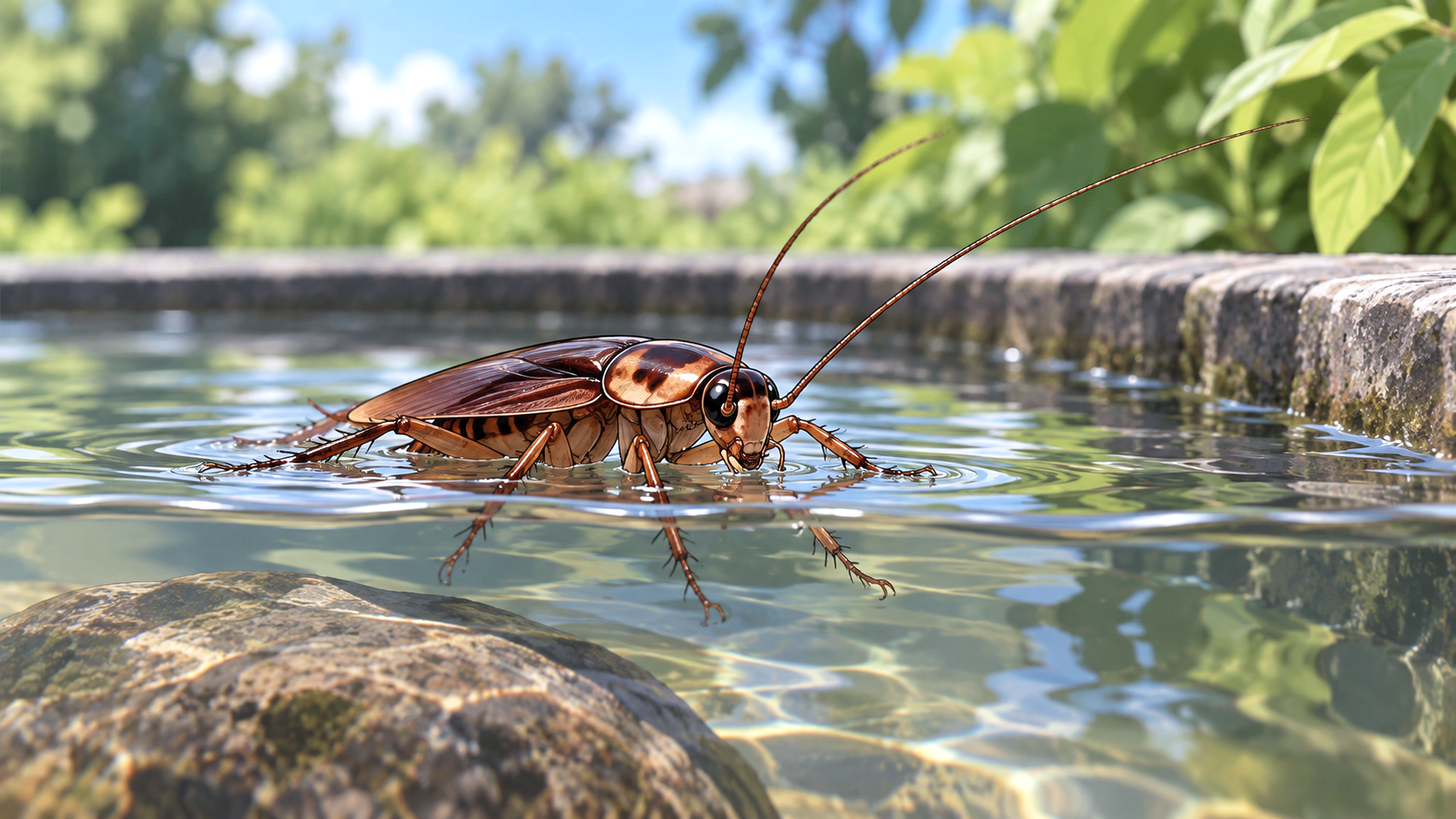
Some cockroaches can propel themselves across the surface of water, including American cockroaches, but they are terrestrial insects rather than aquatic swimmers. Floating or paddling does not mean they can breathe underwater. A submerged cockroach eventually runs out of usable oxygen, and survival time varies too much by species and conditions for one universal drowning time.
The word “swim” also creates some confusion. A cockroach moving across a puddle, floating after falling into a toilet, and remaining completely submerged are three different situations. Only the first involves sustained movement at the water’s surface.
American Cockroaches Can Propel Themselves Across Water
American cockroaches are capable of genuine surface swimming. Observations summarized in the scientific reference Cockroaches: Ecology, Behavior, and Natural History describe American cockroaches swimming in a straight line at about 10 centimeters per second. Their legs continue working in an alternating pattern similar to the gait used while walking, providing propulsion through the water.
Their bodies also tend to remain buoyant. A water-repellent outer surface and surface tension help keep the insect afloat, so a cockroach dropped into ordinary water may bob back toward the surface instead of immediately sinking. Once there, leg movements can carry it toward an edge or object that provides a route out.
This ability fits the broader mobility of American cockroaches. They are fast terrestrial runners capable of navigating difficult surfaces and confined spaces; laboratory work has documented American cockroaches running at speeds approaching 1.5 meters per second. Water slows and changes their movement, but an accidental fall into a puddle does not automatically immobilize them.
Swimming ability also varies among cockroach species, just as flight ability differs among cockroach types. It is safer to describe cockroaches as insects that can include competent surface swimmers rather than claiming that every species swims equally well.
Floating Is Easier Than Living Underwater
A cockroach at the surface still has access to atmospheric oxygen. A fully submerged cockroach does not. Cockroaches breathe through openings called spiracles connected to an internal tracheal system, rather than using lungs or extracting dissolved oxygen from water. Recent research on underwater robotic cockroaches explicitly describes ordinary cockroaches as terrestrial insects that depend on atmospheric oxygen entering through their spiracles.
Researchers demonstrated that limitation by fitting Madagascar hissing cockroaches with miniature “diving suits” that generated and delivered oxygen. Suit-equipped insects remained active underwater for two to three hours, while untreated control cockroaches suffocated within two minutes under the experimental conditions.
That result is also a useful warning against assigning every cockroach the same underwater survival time. Popular claims often give a precise number of minutes that “a cockroach” can survive submerged, but cockroaches comprise many species with different physiologies, and experimental conditions differ. Water temperature, activity, species, access to trapped air, and whether the insect remains completely submerged can all change the outcome. Surface swimming and underwater survival should not be treated as interchangeable abilities.
Water Is Something Cockroaches Need, Not Somewhere Household Species Live
Cockroaches have a close relationship with moisture without being aquatic insects. German cockroaches, for example, actively use water resources, and laboratory observations found differences in how adults moved among food, water, and harborage sites. Restricting access to water can also shorten survival in cockroach species because maintaining body water is physiologically important.
Those needs explain why cockroaches frequently occur around plumbing, kitchens, bathrooms, basements, and other damp locations. They do not establish an underwater colony simply because they appear near a sink or tub. Cockroaches need access to water while still depending on terrestrial shelter and air.
Moisture tolerance also differs from swimming ability. Cockroach physiology includes mechanisms that limit water loss; experiments have found that some cockroaches using discontinuous gas exchange lose less respiratory and total body water. Those adaptations help terrestrial insects conserve moisture. They do not turn household cockroaches into animals adapted to permanent submersion.
A Cockroach in the Toilet May Not Drown Before It Escapes
Flushing a live cockroach is unreliable as a control method. Buoyancy can return the insect toward the surface, and a cockroach that reaches a climbable surface may escape before prolonged submersion becomes fatal. Health Canada recommends disposing of trapped cockroaches using methods such as soapy water or freezing a sealed trap rather than relying on plain water alone.
Soap changes the situation. Experimental immersion tests using dishwashing-liquid solutions caused German and American cockroaches to sink rapidly, with air bubbles observed escaping from abdominal spiracles. That laboratory result does not make household detergent a substitute for a complete infestation-control program, but it helps explain why plain water and soapy water can affect a cockroach differently.
A cockroach discovered in a toilet also does not prove that it swam through a long water-filled pipe to reach the bowl. Cockroaches appearing around drains and plumbing can involve pipe openings, dry or defective traps, gaps around plumbing, sewer-associated species, and movement through parts of the plumbing system that are not continuously filled with water.
Cockroaches Near Water Are Easy to Confuse With True Water Bugs
The common name “water bug” causes another source of confusion. People sometimes use it for large cockroaches, particularly American or Oriental cockroaches found in damp areas. True aquatic bugs are different insects adapted to life in water.
A cockroach paddling across the surface has not suddenly become a water bug. Cockroaches belong to the order Blattodea and retain the body plan and terrestrial biology that identify cockroaches as insects. True water bugs belong to Hemiptera and have their own aquatic adaptations.
Location alone can therefore mislead identification. A large dark insect found beside a pool, drain, pond, or flooded basement needs physical features considered alongside its behavior. Comparing a suspected cockroach with a true water bug is more useful than identifying it solely because it was moving in water.
Swimming Does Not Explain Most Cockroaches Found Indoors
The ability to cross water is impressive but contributes little to most indoor infestations. Household cockroaches usually spread by running through accessible spaces, entering through structural openings, moving between connected units, or being transported with belongings and goods. Their ability to squeeze through extremely narrow spaces has been demonstrated experimentally, with American cockroaches capable of rapidly traversing confined crevices.
Repeated cockroaches around a sink are consequently better investigated as a moisture, harborage, entry, or plumbing issue than as evidence that insects are routinely swimming into the house. The conditions that bring cockroaches into bathrooms include moisture and numerous protected spaces around fixtures and plumbing.
One cockroach floating in a toilet is also a different problem from finding nymphs, droppings, egg cases, or repeated adults around the room. Those additional signs of cockroach infestation provide much stronger evidence that a population is established nearby.
Questions About Cockroaches and Water
Can cockroaches climb out of a bathtub or sink?
It depends on the surface. Cockroaches are strong climbers on many materials, but extremely smooth, steep surfaces can prevent them from gaining enough grip. A cockroach trapped in a slick bathtub may therefore remain there even though it could readily climb a textured wall or object.
Can cockroach eggs survive getting wet?
Brief contact with water does not guarantee destruction of an egg case. An ootheca protects the developing eggs, and simply rinsing an intact cockroach egg case should not be treated as a reliable disposal method.
Can cockroaches come through a swimming-pool drain?
A cockroach beside a pool does not establish that it traveled through the pool’s water-filled plumbing. Outdoor cockroach species can reach pool areas over land, through nearby structures, or by flight where the species is capable of it.
Do cockroaches prefer wet places?
Household species often benefit from accessible moisture, but their preferred conditions differ. A damp location can supply water while cracks, appliances, cabinets, debris, or structural spaces provide the shelter they actually occupy.