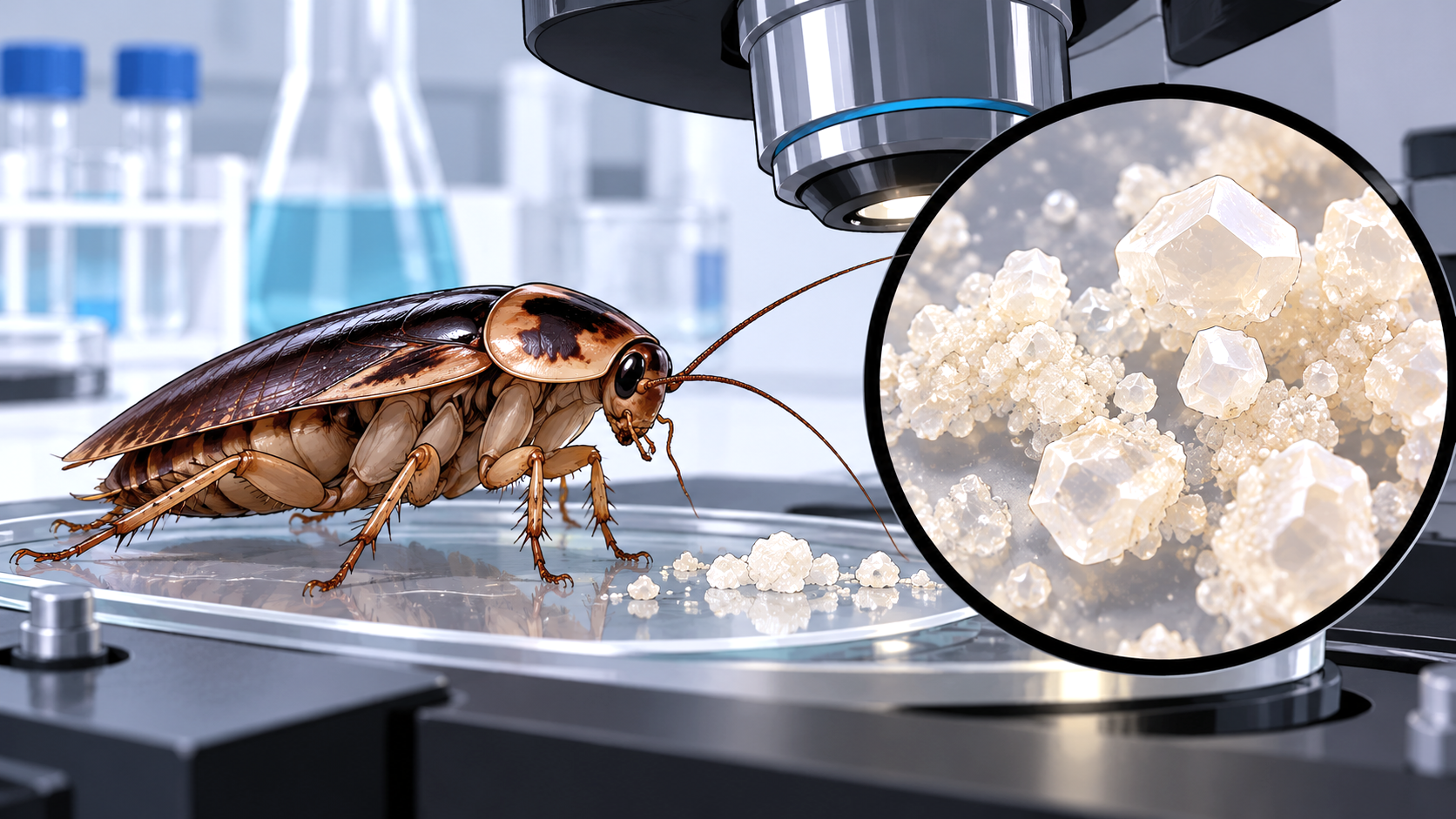
Cockroach milk is real but it is not a dairy-like drink. The name refers to a nutrient-rich secretion made by the female Pacific beetle cockroach, Diploptera punctata, to nourish embryos developing inside her body. Some of that material forms protein crystals inside the embryos’ digestive tracts.
Cockroach Milk Comes From One Unusual Species
Diploptera punctata has a reproductive system unlike the familiar cockroaches found around homes. Instead of depositing an egg case and leaving the embryos to develop within it, the female retains her offspring internally and gives birth to live young. During pregnancy, genes involved in producing milk proteins become highly active as the mother supplies developing embryos with nutrients.
The secretion comes from a specialized brood sac that surrounds the embryos. Its wall releases a fluid containing proteins, carbohydrates, amino acids and lipids. The embryos consume this material while developing, making “milk” a reasonable biological analogy even though there are no mammary glands or nipples involved.
This reproductive strategy is exceptional among cockroaches. The more familiar cockroach reproductive process usually involves an ootheca containing multiple eggs, although the way the ootheca is carried or deposited varies by species. D. punctata instead represents an unusual branch within the considerable reproductive diversity found among different types of cockroaches.
The Famous Crystals Form Inside the Embryos
Cockroach milk is often described online as though the female produces solid crystals. She actually produces a fluid first. Laboratory analysis found that the brood sac releases a protein- and carbohydrate-containing secretion that provides nourishment during embryonic development.
After an embryo consumes the secretion, some of its milk proteins crystallize inside the midgut. Detailed structural analysis found that these naturally formed protein crystals contain glycosylated proteins associated with lipids. The crystals therefore develop inside the offspring rather than being secreted from the mother as tiny solid pieces of milk.
Storing nutrients in this form can provide the growing embryo with a concentrated reserve. The unusual structure is one reason the species has attracted scientific interest far beyond ordinary studies of the cockroach life cycle.
Cockroach Milk Really Is Nutrient-Rich
The unusual secretion contains a substantial mixture of macronutrients. Chemical analysis of dried D. punctata brood-sac secretion found approximately 45% protein, 5% free amino acids, 25% carbohydrate and 16 to 22% lipid, while analysis of the protein identified the common amino acids expected in a complex nutritional source. The developing embryos therefore receive proteins, carbohydrates, lipids and free amino acids rather than a secretion dominated by a single nutrient.
Later molecular work showed that some of the milk proteins can bind fatty acids, helping package several nutritional components into the maternal supply. That mixture supports rapid development before birth. Unlike the baby cockroaches normally seen after hatching, D. punctata offspring receive substantial maternal nourishment while still developing inside the female.
Its nutritional richness is therefore real, but the intended consumer is a developing cockroach embryo. Nutrient density alone does not establish that the same material is useful or appropriate as human food.
The “Three Times More Nutritious Than Cow’s Milk” Claim Is Misleading
One of the most repeated cockroach-milk claims originated from research into the molecular structure of its protein crystals. Scientists estimated that a crystal could contain more than three times the energy of an equivalent mass of dairy milk. Online retellings frequently turned that energy-density comparison into the broader statement that cockroach milk is three or four times “more nutritious” than cow’s milk.
Those statements are not equivalent. Energy density measures how much energy is contained in a given amount of material. It does not determine whether a food provides better nutrition overall. Digestibility, nutrient balance, serving size, bioavailability, safety and individual dietary requirements all affect the nutritional value of something intended for people.
The research also did not involve feeding cockroach milk to humans or demonstrating a health benefit. It examined the composition and structure of crystals produced for cockroach embryos. Calling the material a human superfood therefore adds a conclusion the underlying research did not establish.
You Cannot Milk Household Cockroaches
German, American, Oriental and other pest cockroaches are not miniature sources of this secretion. A person who discovers cockroaches living inside a house has encountered an entirely different biological situation. There is no dairy-like fluid that can be squeezed from an adult household cockroach.
Even D. punctata produces extremely small quantities. Laboratory measurements found that a single brood sac could produce no more than about 0.4 milligrams of protein during a 24-hour period at the higher end of secretion during pregnancy. Obtaining that material required researchers to collect tiny quantities directly from the reproductive system, which bears little resemblance to conventional milk production.
Raising vast numbers of pregnant cockroaches simply to harvest those minute quantities would be an impractical route to a beverage. Scientific interest instead comes from the species’ unusual reproductive biology, including the hormonal regulation that allows live-bearing cockroaches to nourish embryos internally.
Cockroach Milk Has Not Been Established as a Human Food
Finding protein, carbohydrates and fat in a biological substance does not establish that people can safely consume it. The published work on cockroach milk has primarily examined reproduction, embryo nourishment, milk proteins and crystal structure rather than testing the secretion as a human food.
Questions such as allergenicity, digestibility, contamination, safe intake, manufacturing consistency and long-term effects would require appropriate evaluation before the material could reasonably be promoted for human consumption. The structural studies behind the headlines do not answer those questions.
Cockroach milk research also has little connection to the sanitation concerns associated with pest cockroaches. Household species can carry microorganisms on and within their bodies after moving through contaminated environments. Controlled study of a reproductive secretion from D. punctata is a separate subject and does not make pest cockroaches a food source.
A Real Biological Curiosity, Not a Carton of Milk
The strange part of the cockroach-milk story is already interesting without the superfood mythology. Diploptera punctata evolved an uncommon form of live birth in which developing offspring receive a complex maternal secretion. The embryos can then package components of that secretion into nutrient-rich protein crystals.
Scientists have studied those crystals because their structure, composition and role in embryo development are unusual. Nothing in that research requires the additional claim that cockroach milk is about to replace dairy milk, appear in supermarkets or become a proven nutritional supplement.
Questions About Cockroach Milk
Do baby cockroaches drink cockroach milk through a nipple?
No. D. punctata has no mammary glands or nipples. Nutrients are secreted by the brood sac and consumed by embryos while they develop inside the mother.
Does every female cockroach produce milk when she has eggs?
No. The familiar cockroach egg case represents a very different reproductive arrangement. Milk production of the kind discussed here is associated with the unusual live-bearing biology of D. punctata, not ordinary egg production in household species.
Can cockroach milk be made without harvesting it from cockroaches?
Scientists can study the genes and proteins involved and may investigate ways of producing individual proteins through biotechnology. Producing a particular protein, however, would not automatically reproduce the complete natural secretion or turn it into an approved food.
What does cockroach milk taste like?
Published research has concentrated on the secretion’s biological function, composition and molecular structure rather than establishing a standardized human food product with a documented consumer taste. Claims assigning it a familiar flavor should therefore be treated cautiously.