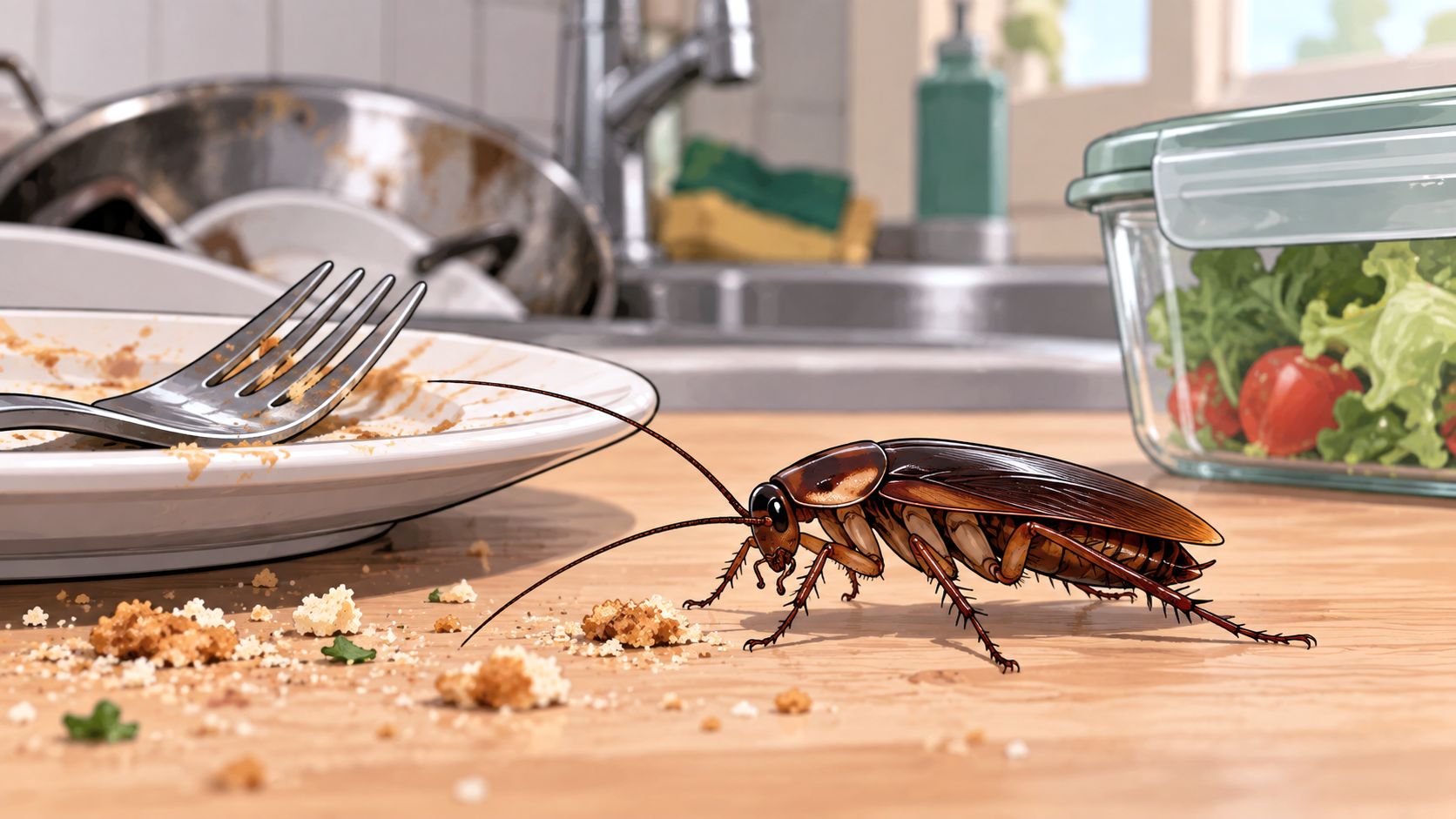
Cockroaches routinely cross boundaries that should remain separate in a home or food facility. The insect can forage in garbage or sewage and later enter a cabinet, cross a counter, or reach exposed food. Microorganisms acquired in one place can travel with it. As such, cockroaches can carry bacteria, fungi, parasites, and other microorganisms, including species capable of causing human disease. Contamination can occur when microbes on their bodies or within their digestive systems reach food and surfaces through physical contact, feces, or regurgitated material. However, carrying a pathogen does not prove that a cockroach caused a specific infection.
Cockroaches Can Pick Up Pathogens From Contaminated Places
Household pest species are mobile scavengers. Their broad diet brings them into contact with garbage, decomposing material, food waste, animal excreta, sewage, and other microbial reservoirs. Pathogens can adhere to the outer body or enter the digestive tract during feeding. A large systematic review identified at least 78 bacterial species from 42 genera associated with cockroaches, although the presence and prevalence of individual organisms vary considerably between environments and studies.
The species most closely associated with human buildings receive particular attention because they repeatedly move between contaminated sites and places people use. German and American cockroaches feature prominently in pathogen research, but the cockroach species found around homes and buildings differ in habitat and behavior. An outdoor species that accidentally enters a house should not automatically be assigned the same contamination profile as a persistent population living around a commercial kitchen or sewer system.
The Main Pathway Is Mechanical Contamination
Cockroaches are generally discussed as mechanical carriers rather than biological vectors in the way mosquitoes transmit malaria parasites or certain ticks transmit pathogens that depend on those vectors. Microbes can be transported externally on the cockroach’s body and internally after ingestion. They may then reach another surface through direct contact, fecal deposits, or regurgitated material. Current research describes contact transfer, feces, and regurgitation as important dissemination routes.
Food areas make this route particularly relevant. Health Canada warns that cockroaches can contaminate food and food-preparation surfaces after traveling through garbage or sewers, and U.S. food-safety policy recognizes cockroach movement between filth and human food as a significant contamination pathway. Visible cockroach feces around food-storage or preparation areas therefore deserve attention as contamination evidence rather than merely a cosmetic nuisance.
Which Pathogens Have Been Found on Cockroaches?
Research has recovered numerous medically important bacteria from cockroaches, including species or strains belonging to Salmonella, Escherichia, Klebsiella, Pseudomonas, Staphylococcus, Enterococcus, Shigella, and other genera. The CDC’s environmental infection-control guidance lists multiple Gram-negative and Gram-positive bacteria isolated from cockroaches in healthcare settings. Reviews of food-related research have additionally documented bacteria, fungi, parasites, and viruses associated with cockroaches.
Salmonella has received particular attention. A 2026 systematic review and meta-analysis covering 31 studies and 8,021 samples found an overall pooled Salmonella contamination prevalence of 15.2%, with substantial variation among studies. That figure should not be interpreted as a universal household probability. Geography, cockroach species, sampling location, laboratory method, sanitation, and other factors differed across the underlying research.
Finding a Pathogen on a Cockroach Does Not Prove Human Transmission
Laboratory detection establishes carriage. Demonstrating that a particular cockroach transferred the organism to a person and caused illness requires a much stronger chain of evidence. Reviews repeatedly identify this limitation. Although cockroaches carry numerous potential pathogens, the precise contribution of cockroaches to human infections remains incompletely defined.
The difference prevents an important exaggeration. It is reasonable to say that cockroaches can contaminate food and surfaces with microorganisms they carry. It is not reasonable to diagnose someone’s gastrointestinal illness as cockroach-transmitted simply because cockroaches were present in the building. Foodborne illness can originate from many sources, and symptoms alone cannot identify a cockroach as the route.
Antibiotic-Resistant Bacteria Add Another Concern
Some cockroaches collected from healthcare, community, and food-related environments have carried bacteria resistant to multiple antimicrobial drugs. A 2025 systematic review of hospital-collected cockroaches found medically important organisms including E. coli and Pseudomonas aeruginosa, with antibiotic resistance reported across many of the included studies. Research has also identified resistant organisms from cockroaches outside hospitals.
These findings do not mean that a household cockroach is likely to give someone an antibiotic-resistant infection. They demonstrate that cockroaches can acquire resistant bacteria from contaminated environments and potentially transport them elsewhere. Healthcare facilities warrant especially strict pest exclusion because vulnerable patients, clinical surfaces, waste, drains, food areas, and antimicrobial-resistant organisms can coexist within the same building.
What Contamination Means at Home
Food that has obvious cockroach contamination should be discarded rather than salvaged. Foodborne illness occurs when food is contaminated with harmful bacteria, viruses, or parasites, and contamination cannot reliably be judged by smell or taste. Exposed preparation surfaces should be cleaned appropriately, while food should be stored in sealed containers that prevent further access.
Repeated contamination also signals a pest problem that needs attention at its source. Egg cases, nymphs, feces, and recurring trap catches are among the evidence of an established cockroach infestation. Where activity is concentrated around plumbing, cockroaches moving through drains or adjacent pipe routes may require a different inspection from insects established inside kitchen cabinets.
Questions About Cockroaches and Pathogens
Can cockroach eggs carry bacteria?
An egg case found in a contaminated environment can have microorganisms on its exterior, but the public-health evidence for cockroach-associated pathogen movement focuses primarily on mobile cockroaches, their body surfaces, digestive systems, feces, and regurgitated material. An ootheca is primarily evidence of cockroach reproduction, not a way to identify a particular pathogen.
Can cockroaches contaminate dishes and utensils?
Yes. A cockroach moving across a food-contact item can potentially deposit material carried on its body or in feces. Wash contaminated dishes and utensils appropriately before reuse rather than simply brushing away visible debris.
Does killing the cockroach remove the contamination it already left behind?
No. Removing the insect stops that individual from moving farther, but feces and contaminated material already deposited on surfaces remain until cleaned. Control and sanitation therefore perform different jobs during an infestation.
Does one cockroach mean my food has been contaminated?
Not necessarily. One cockroach sighting does not reveal every place the insect traveled. Food with visible evidence of cockroach contact or contamination should be discarded, while the surrounding area can be inspected for further activity.
Where cockroaches are established around food, concentrate first on separating the insects from anything people eat or prepare food on. Discard visibly contaminated food, clean affected food-contact surfaces, secure stored food, and address the infestation so the contamination route does not remain active.
3 thoughts on “Do Cockroaches Carry Disease?”