Natural cockroach control works best when it makes a home difficult for cockroaches to occupy rather than trying to replace a conventional insecticide with a homemade spray. Removing food and water, reducing shelter, trapping insects, and blocking movement can all reduce cockroach survival without routine pesticide application. An established indoor population, however, can persist in spaces that cleaning alone cannot reach.
To get rid of cockroaches naturally, remove accessible food and water, reduce clutter and hiding places, use sticky traps to locate activity, vacuum accessible cockroaches and debris, and seal useful entry or travel routes. These methods can substantially reduce favorable conditions, but severe indoor infestations may not be eliminated without additional targeted control.
Make the Room Less Useful to Cockroaches
Food removal has to extend beyond obvious crumbs. Cockroaches have a broad scavenging diet and can exploit grease films, food residue beneath appliances, garbage, pet food, spills, and other organic material. Store food in tightly closed containers, clean cooking residue from difficult edges, remove garbage regularly, and avoid leaving pet food exposed unnecessarily. Integrated pest management guidance emphasizes sanitation and removal of pest resources because changing the environment can suppress pests without relying solely on chemical treatment.
Water can be just as important. Repair dripping faucets and plumbing leaks, dry persistent wet areas, and investigate condensation beneath sinks or around appliances. Cockroaches actively obtain water from their surroundings, although moisture requirements vary by species. Health Canada similarly recommends eliminating water sources and keeping kitchens clean as part of cockroach management.
Clutter reduction removes protected spaces while making inspection easier. Stacked cardboard, paper bags, crowded cabinets, and long-undisturbed storage can create narrow harborages that are difficult to inspect or clean. Cardboard can be especially useful shelter because cockroaches readily occupy its folds and gaps, even though eating paper or cardboard is a different question from using it as cover.
Traps Can Do More Than Catch a Few Cockroaches
Sticky traps contain no insecticidal active ingredient and can physically capture cockroaches that cross them. Their greater value in an infestation is often diagnostic. Several monitors placed along wall edges, beside appliances, beneath sinks, and near suspected harborages can reveal where activity is concentrated. Cockroaches commonly travel along edges, so a trap pressed against a wall or cabinet junction can be more informative than one placed in the middle of a floor.
Mark each trap with its location and date, then compare catches rather than relying on nighttime sightings. Nymphs appearing repeatedly on a monitor are especially useful evidence because baby cockroaches indicate a nearby reproductive population more readily than a single wandering adult. Trapping is unlikely to eliminate a substantial infestation by itself, but it tells you where cleaning, vacuuming, repairs, and exclusion deserve the most attention.
A Vacuum Can Remove Cockroaches and Infestation Debris Immediately
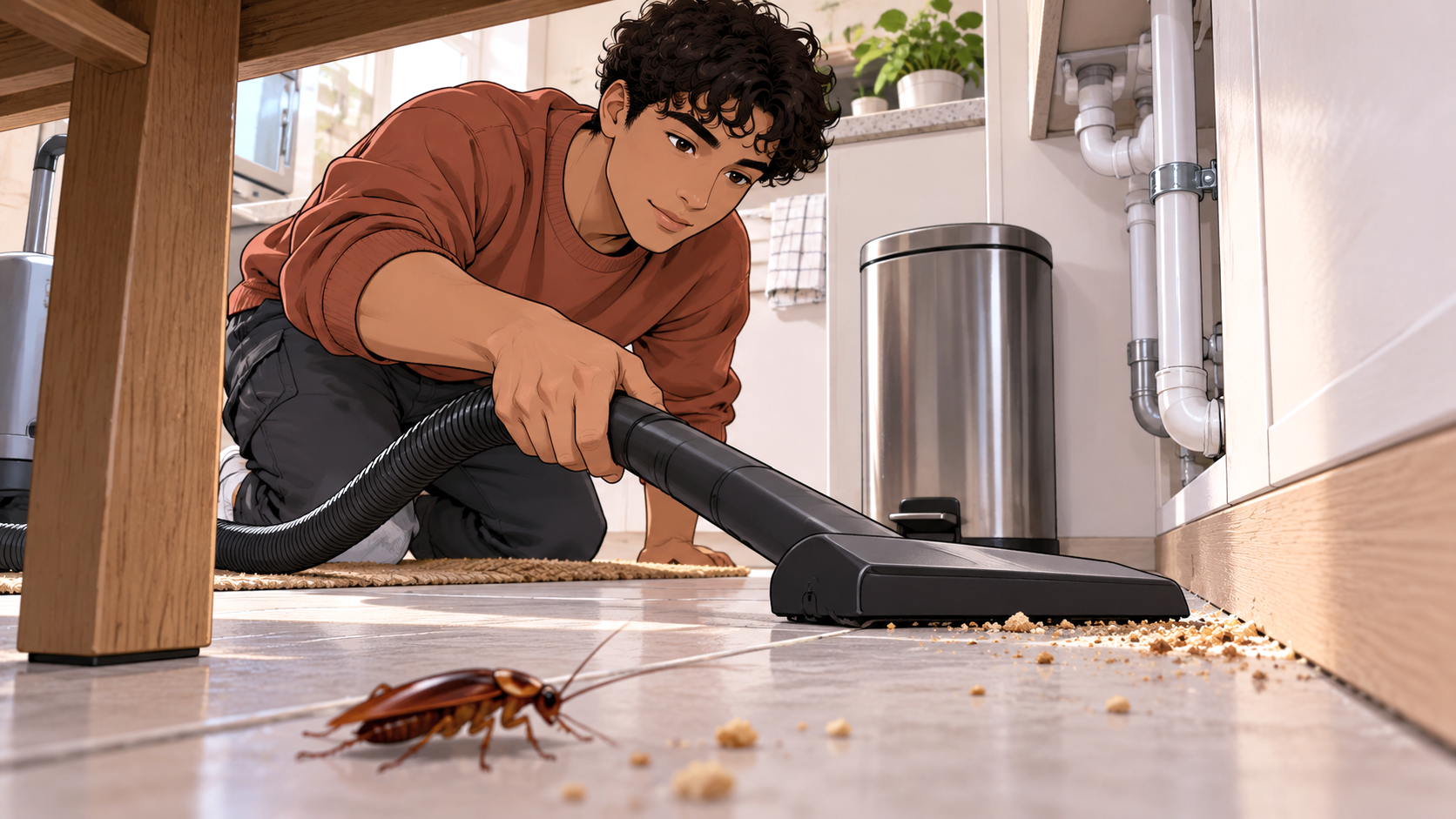
Vacuuming provides something many homemade remedies cannot: physical removal. Accessible adults, nymphs, shed skins, egg cases, fecal material, and food debris can be removed from cracks, cabinet edges, appliance areas, and other reachable harborages. Integrated cockroach-management programs have long included vacuuming as a nonchemical population-reduction technique, particularly when substantial numbers are concentrated in known hiding places.
Use a crevice attachment where practical and avoid damaging electrical or appliance components. The vacuum contents should be contained and discarded promptly so captured cockroaches cannot escape. Vacuuming is also useful where cockroach droppings reveal concentrated activity, although contaminated surfaces may still require appropriate cleaning after loose debris has been removed.
Seal Routes That Cockroaches Are Actually Using
Caulk can close narrow cracks around cabinets, baseboards, plumbing penetrations, utility lines, and structural joints once inspection identifies useful movement routes. Door sweeps and repairs to screens or exterior gaps can reduce entry by outdoor species. In apartments, sealing accessible penetrations may also limit movement between connected spaces, although cockroaches can originate elsewhere in a multi-unit building, making coordinated management necessary when activity extends beyond one unit.
Do not seal blindly around plumbing without understanding the source. A cockroach seen beside a sink may have emerged from a wall gap around the pipe rather than through the drain opening itself. When insects appear repeatedly around plumbing, identifying the actual drain or pipe route prevents exclusion work from targeting an opening the insects never used.
Diatomaceous Earth Is Natural, but It Is Still a Pesticide
Diatomaceous earth is often presented online as if “natural” means unrestricted and harmless. Pesticidal diatomaceous earth works physically by damaging the protective waxy layer of an insect’s exoskeleton and promoting water loss. Laboratory research has demonstrated insecticidal activity against German cockroaches, but effectiveness depends on formulation, exposure, placement, humidity, and other conditions.
Only a product labeled for the intended pest and location should be used for pest control. EPA requires pesticide products to carry directions governing where, how, and how much product may be applied. Food-grade material sold for unrelated purposes is not automatically an appropriate substitute for a registered pest-control product. Airborne dust can also irritate the respiratory tract, and products containing substantial crystalline silica present additional inhalation concerns. Natural origin does not remove the need to minimize dust and follow the label.
Essential Oils Are Not a Reliable Stand-Alone Infestation Plan
Some plant essential oils and their constituents can repel or kill cockroaches under laboratory conditions. Research has demonstrated activity from compounds found in certain botanical oils, including contact and fumigant effects against German cockroaches. Laboratory efficacy, however, does not establish that spraying diluted peppermint, eucalyptus, tea tree, or another homemade oil mixture around a kitchen will eliminate a reproducing population hidden throughout a structure.
Repellency can also work against the goal of population control if it merely shifts cockroaches into untreated harborages. Concentrated essential oils are biologically active substances rather than harmless fragrances, and some can irritate skin or airways or pose risks to pets depending on the compound and exposure. A pleasant-smelling homemade spray should therefore not replace monitoring and physical population reduction.
Baking Soda, Vinegar, and Similar Kitchen Remedies Are Poor Foundations for Control
Online cockroach remedies frequently combine familiar household ingredients with claims that are much stronger than the evidence supporting them. Vinegar can be useful as a cleaning product in appropriate situations, but wiping a surface with vinegar does not remove cockroaches living inside cracks, appliances, or wall voids. Baking-soda recipes face a similar problem: even if individual insects consume a homemade mixture, there is no dependable reason to expect it to reach enough of a hidden population to eliminate an established infestation.
A natural method earns its place by changing something the cockroach population actually depends on or by physically removing insects. Drying a leak removes water. Cleaning grease removes food. Vacuuming removes cockroaches and debris. Sealing an active penetration removes a travel route. Sticky monitors measure and capture activity. Those actions have clear functions even when no pesticide is used.
Know When the Nonchemical Approach Has Stalled
Continue monitoring after sanitation, repairs, vacuuming, and exclusion. A reduction in trap catches shows that the pressure on the population is having an effect. Persistent nymphs, fresh fecal material, egg cases, or continuing catches in several locations indicate that cockroaches remain established. Their egg-to-nymph-to-adult development also means that disappearing adults alone cannot confirm that the population is gone.
Heavy German cockroach infestations are particularly difficult to eliminate through sanitation and trapping alone because large numbers can occupy inaccessible harborages and reproduce indoors. At that stage, the broader cockroach control process may need targeted treatment in addition to the environmental work already completed. Keeping sanitation, moisture correction, monitoring, and exclusion in place still improves the conditions under which any later control method has to operate.
Practical Questions About Natural Cockroach Control
Will keeping the lights on make cockroaches leave?
No. Light can alter when and where cockroaches move, but illumination does not remove their food, water, shelter, or reproductive population. Cockroaches can remain concealed while the room is bright and resume foraging when conditions suit them.
Can cold temperatures get rid of cockroaches naturally?
Cockroaches are affected by temperature, but using ordinary winter weather or lowering a household thermostat is not a dependable whole-home eradication method. Protected indoor harborages can remain much warmer than outdoor air, and plumbing or building damage can occur if a structure is deliberately allowed to freeze.
Can I simply remove cockroaches by hand whenever I see them?
Removing every cockroach you encounter reduces the population by those individuals, but visible insects may represent only part of an established infestation. Repeated sightings and other infestation evidence provide a better basis for deciding whether physical removal alone is keeping up with reproduction.
Do ultrasonic pest repellers count as a natural solution?
They avoid conventional pesticide application, but that does not establish effectiveness. The Federal Trade Commission has previously challenged sellers over unsupported claims made for ultrasonic pest-control devices, so they should not replace methods that can be measured through declining cockroach activity.