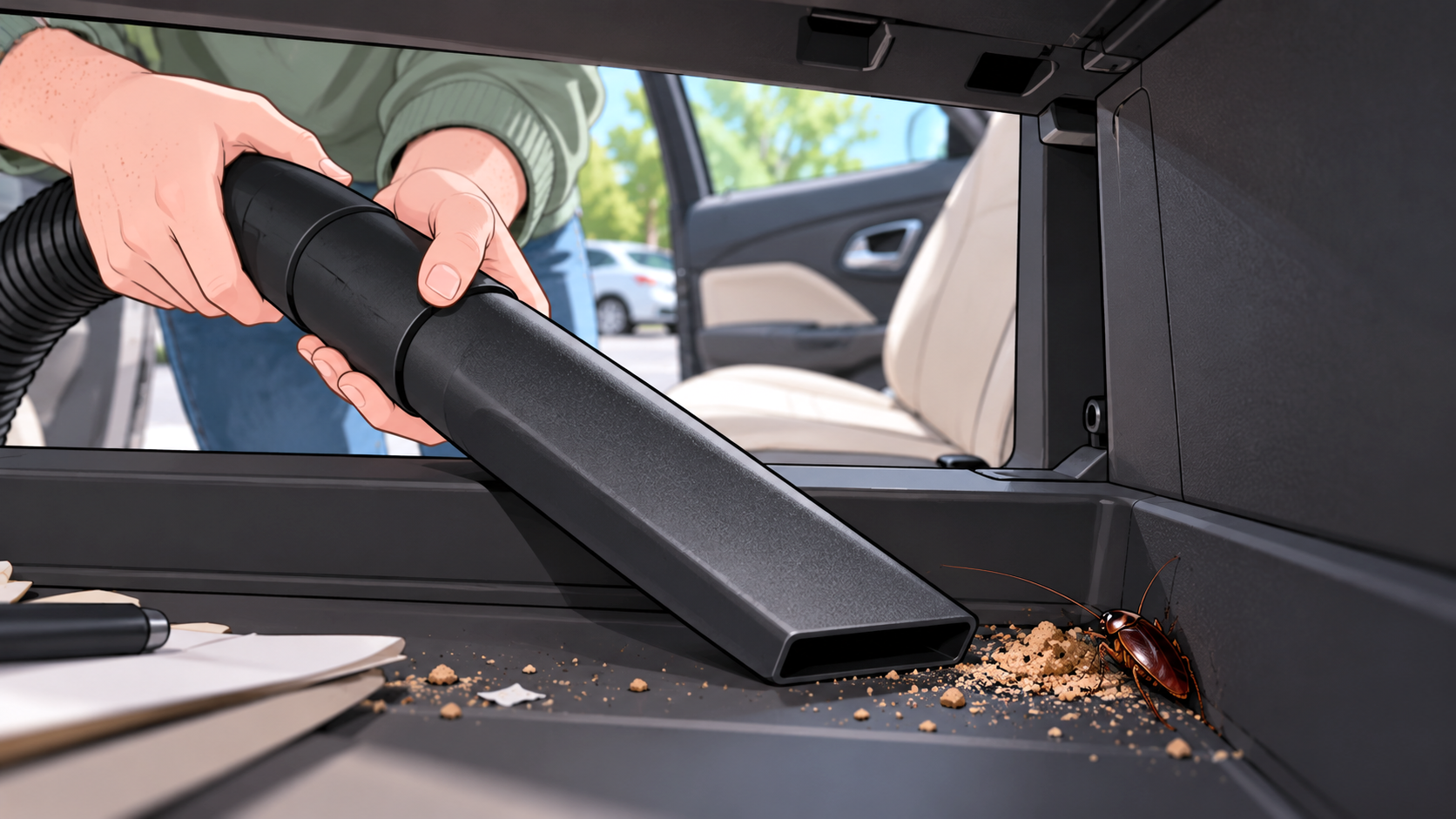
A car can support cockroaches when it repeatedly provides what they need in a compact space. Crumbs disappear beneath seat rails, drink residue dries inside cup holders, food packaging collects under seats, and rarely disturbed compartments offer shelter. Cockroaches can also arrive as hitchhikers in bags, boxes, groceries, takeout containers, or other belongings. Once you find more than an occasional stray, cleaning only the visible upholstery is unlikely to address everything hidden inside the passenger compartment.
To get rid of cockroaches in your car, empty the vehicle, vacuum food debris and accessible insects from seats, carpets, rails and storage areas, clean spills and residues, place sticky monitors in protected locations, and inspect items that regularly move between the car and home. If pesticide treatment is needed, use only a product whose label specifically permits the intended use and location.
Empty the Car Before Deciding Where the Cockroaches Are Hiding
Remove loose belongings from the passenger compartment and trunk, but do not immediately carry everything indoors. Cockroaches and egg cases can hitchhike on transported objects, so bags, cardboard boxes, reusable grocery containers, work equipment, and other items from an affected vehicle deserve inspection before being moved elsewhere. Items containing food residue should be cleaned, while unnecessary cardboard and trash can be discarded.
Once the clutter is out, inspect with a flashlight. Look beneath and between seats, along carpet edges, around seat rails, beneath removable floor mats, inside the center console and glove compartment, and around other accessible trim gaps. Fecal spotting, shed skins, egg cases, and nymphs can provide evidence that cockroaches are established rather than occasionally entering with transported items. Finding small cockroach nymphs is particularly important because immature stages indicate reproduction has occurred somewhere accessible to the population.
The Vacuum Needs to Reach Where Food Actually Falls
A quick pass over the middle of the floor mat misses many of the places that make a vehicle attractive to cockroaches. Move adjustable seats through their normal range so you can reach exposed sections of the rails and carpet. Vacuum beneath the seats, between seat cushions where accessible, around console edges, along carpet seams, beneath removable mats, and inside storage compartments. Pay close attention to dried food, crumbs, pet treats, spilled drinks, and debris pushed into narrow gaps.
Cockroaches can consume many different forms of food and organic residue, so there may be no single obvious food source. Vacuuming removes both food particles and accessible cockroaches or egg cases, while cleaning sticky residues removes material a dry vacuum cannot pick up. Health Canada includes regular vacuuming and removal of food sources among cockroach-control measures because environmental cleanup and population control work together.
Avoid flooding dashboard seams, electrical controls, seat mechanisms, or other components with water or cleaning solution. Follow the vehicle manufacturer’s instructions for cleaning sensitive surfaces and electronics.
Sticky Monitors Can Reveal Whether the Car Still Has Activity
After cleaning, small sticky cockroach monitors can help answer a question that visual inspection cannot: are cockroaches still moving through the vehicle when nobody is there? Position monitors only where they cannot interfere with pedals, seat operation, airbags, wiring, vents, or driving controls. Protected floor areas beneath stationary portions of seats or other safe, inaccessible locations may be useful depending on the vehicle.
Date the monitors and check them regularly. Sticky traps are useful for locating cockroach activity and monitoring populations, although trapping alone may not eliminate an established population. Catches can also help with identification. German cockroaches, for example, behave differently from some larger species that are more likely to wander in from outdoor or structural environments, so confirming the type of cockroach involved can change what you investigate next.
An empty monitor after one night proves little. Cockroaches are primarily nocturnal, and their activity can be uneven. Leave monitors long enough to establish a pattern, especially if the original sightings were intermittent.
Check What Moves Between Your Car and Home
A vehicle infestation can be repeatedly replenished if the same objects travel between two infested environments. Work bags, backpacks, reusable grocery bags, food-delivery equipment, cardboard cartons, children’s bags, and other frequently transported belongings deserve attention. Inspect them before returning them to a cleaned vehicle.
The reverse route matters as well. Carrying an infested box or bag from the car into the kitchen can introduce cockroaches into a building. If cockroaches are also appearing indoors, determine whether you have a separate household cockroach problem rather than assuming every insect originated in the vehicle. Cleaning the car repeatedly will have limited value if cockroaches continue hitchhiking back inside with the same belongings.
Be Cautious With Pesticides Inside a Vehicle
A car is a small enclosed space where people spend time in direct contact with seats, steering controls, belts, flooring, and interior surfaces. It also contains electronics, ventilation components, and materials that may react poorly to solvents or other formulations. A pesticide labeled for indoor residential cockroach control is not automatically labeled for use inside an automobile.
Read the complete product label before applying anything. Pesticide labels specify permitted sites, application methods, precautions, and restrictions, and products should be used only according to those directions. In Canada, pest-control products must carry a PCP registration number and be used according to their approved labels. If the label does not permit the intended application in a vehicle, do not improvise a vehicle treatment from household directions.
The same caution applies to cockroach baits. Baits can be useful tools in an overall cockroach control program, but suitability for a vehicle depends on the individual product label. A bait or station must also never be positioned where it could roll beneath pedals, obstruct seat movement, become accessible to a child or pet, or interfere with vehicle safety equipment.
Do Not Set Off a Household Bug Bomb in the Car
A vehicle should not be treated as a miniature room for a total-release fogger. Foggers discharge their pesticide formulation and propellant into an enclosed space, and many contain flammable propellants. EPA warns that improper fogger use can cause fires or explosions and specifically warns against using these products in small enclosed spaces.
A car contains numerous electrical systems and is far smaller than the residential spaces for which many fogger directions are written. Using an unlabeled fogger inside a vehicle also creates unnecessary pesticide deposition across surfaces that occupants touch. If cleaning and monitoring show persistent activity that you cannot reach, professional treatment is a safer next step than assuming a household aerosol can be adapted to automotive use.
Heat From Parking in the Sun Is Too Uncontrolled to Be a Treatment Plan
Closed vehicles can become extremely hot in direct sunlight, but cabin temperature varies with outdoor temperature, cloud cover, vehicle color, glazing, shade, time of day, and the location inside the car. A hot dashboard does not establish that every protected crevice beneath carpeting, inside trim, or elsewhere in the vehicle reached a lethal temperature for the required duration.
Deliberately trying to turn the vehicle into a heat chamber also creates risks for electronics, batteries, pressurized containers, adhesives, medications, and other heat-sensitive materials. Normal parking in the sun may expose some cockroaches to stressful temperatures, but it is not a controlled whole-vehicle eradication method.
Do Not Forget the Egg Cases
Removing adults does not necessarily remove every developing cockroach. Female cockroaches produce egg cases called oothecae, and their handling differs among species. German cockroach females, for example, retain the ootheca for much of its development before depositing it shortly before the young emerge.
Vacuuming accessible egg cases is therefore useful, but the absence of visible adults immediately after cleaning should not end monitoring. The cockroach life cycle includes egg, nymph, and adult stages, and newly emerged nymphs can expose activity that the first cleaning did not reach. Continue checking traps and inspecting previously active areas rather than judging success from a single cockroach-free drive.
Questions That Matter in a Cockroach-Infested Car
Can cockroaches damage the wiring in my car?
Do not assume unexplained electrical trouble was caused by cockroaches. Cockroaches can occupy protected spaces around equipment, but wiring damage has many more common causes and requires proper automotive diagnosis. Have electrical faults inspected rather than dismantling dashboards or electrical assemblies to search for insects.
Should I remove the seats to clean underneath them?
Only if the vehicle manufacturer’s procedures allow you to do so safely and you understand the components involved. Modern seats may contain airbags, occupancy sensors, electrical connectors, pretensioner-related components, heating systems, or powered mechanisms. A professional detailer or automotive technician may be the safer option when debris or cockroach activity extends into inaccessible areas.
Will running the air conditioner get rid of cockroaches?
No. Ordinary air-conditioning use does not turn the entire vehicle into an environment that reliably eliminates cockroaches. If insects repeatedly appear around vents, the observation can help locate activity, but avoid spraying pesticide into the HVAC system unless a product is expressly labeled for that application.
Should I stop eating in the car after treatment?
If food residue contributed to the infestation, keeping food out of the vehicle makes recurrence less likely. At minimum, remove packaging promptly, clean spills when they occur, and avoid allowing crumbs and discarded food to accumulate beneath seats or in storage areas.