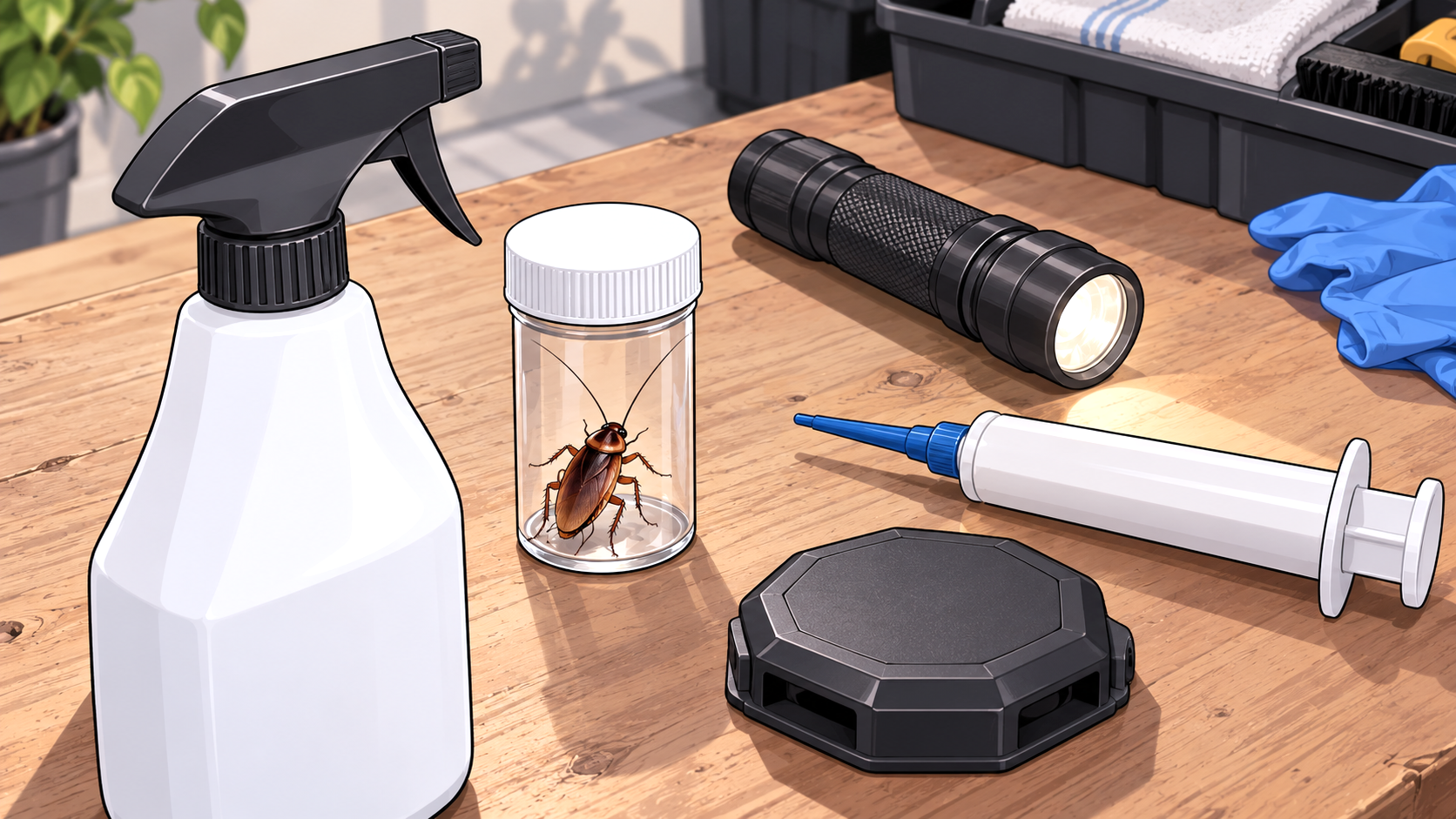
The best cockroach killer depends on where the insects are hiding and which species you have, but for established indoor German cockroach infestations, gel baits with active ingredients such as indoxacarb, fipronil, dinotefuran, or abamectin are generally stronger choices than routine pyrethroid sprays. Insect growth regulators can add population-level control by disrupting development and reproduction. Sprays remain useful for selected applications, but resistance and poor exposure can sharply reduce their performance.
We would not choose a cockroach product by the largest “kills on contact” claim on the can. A cockroach dropping within seconds after a direct spray proves that the exposed insect received a lethal dose. It says little about the rest of a population inside cabinet joints, wall gaps, appliance voids, or other harborages. Recent testing of common consumer residual insecticides found a substantial difference between direct spray performance and short exposure to treated household surfaces, particularly against field populations of German cockroaches.
Gel Baits Are Our First Choice for Most Indoor German Cockroach Infestations
Gel baits earn the top position because they place a lethal active ingredient inside food that cockroaches willingly consume. Common bait actives include indoxacarb, fipronil, dinotefuran, abamectin, imidacloprid, and hydramethylnon. These chemicals do not all work identically, and resistance can occur, but bait-based programs have performed very well in residential cockroach management. Research comparing urban control strategies has found baits generally more effective than conventional spray-heavy approaches, while targeted placement also limits the need to spread insecticide across large indoor surfaces.
Placement has as much influence on the result as the active ingredient. Small bait placements near harborages and travel routes give cockroaches a realistic opportunity to feed, whereas gel placed far from activity may remain untouched. An EPA-registered cockroach gel label, for example, directs users to apply bait into cracks, crevices and areas where cockroaches harbor or enter. Food debris, grease, and competing food sources can also interfere with bait acceptance. The mechanics of using cockroach baits and gels effectively therefore matter more than simply buying a syringe with a familiar active ingredient.
Resistance prevents us from naming one chemistry as universally superior. Field German cockroach populations with reduced susceptibility to fipronil and indoxacarb have been documented, and bait performance can also decline through behavioral changes in feeding. A product that performs extremely well in one building can disappoint in another. Persistent feeding without a corresponding population decline is a reason to reassess the treatment rather than endlessly replenish the same formulation.
Indoxacarb and Fipronil Are Strong Bait Actives, Not Guarantees
Indoxacarb is a widely used cockroach bait active ingredient. It is a pro-insecticide, meaning insect metabolism converts it into a more active toxic form after exposure. That characteristic has made indoxacarb gels important tools for German cockroach management, including products such as Advion. Anyone considering that specific formulation will get a more useful assessment from the dedicated look at Advion cockroach gel than from treating every indoxacarb product as interchangeable.
Fipronil acts on insect nervous-system chloride channels and also has a long history in cockroach baits. Both fipronil and indoxacarb can produce secondary exposure within cockroach harborages, although the strength of that effect varies with the formulation and susceptibility of the population. Research on field German cockroaches has documented reduced secondary-kill performance alongside insecticide resistance, another reason not to turn a useful active ingredient into a guarantee.
Resistance has now been documented to several major cockroach insecticides. Field populations studied between 2018 and 2020 carried physiological mechanisms associated with reduced susceptibility to both fipronil and deltamethrin. Product choice therefore needs to remain flexible. If a correctly placed bait remains readily available but the infestation is not declining, changing active ingredients can make more sense than increasing the quantity of the same bait.
Abamectin, Dinotefuran and Hydramethylnon Give You Other Bait Options
Abamectin affects chloride channels in the insect nervous system and appears in some cockroach bait formulations. Dinotefuran is a neonicotinoid that targets nicotinic acetylcholine receptors. Hydramethylnon disrupts cellular energy production. Having chemically different choices is valuable when previous treatment history or poor performance makes repeating one active ingredient unattractive.
The label remains the deciding document for any particular product. Two packages marketed as “roach killer” may contain different actives, concentrations, formulations, permitted treatment sites, and application instructions. Before purchasing, look past the brand name and find the active ingredient panel. That habit also makes it easier to recognize when two apparently different products rely on essentially the same chemistry.
Rotating brand names alone does not necessarily rotate insecticides. If two gels contain the same active ingredient, switching between them may change formulation but not the principal toxicant. Conversely, resistance management is more complicated than randomly alternating chemicals after every application. Cockroach populations can carry resistance mechanisms affecting multiple insecticides, so continued monitoring matters more than following a rigid brand schedule.
Insect Growth Regulators Attack the Population Differently
An insect growth regulator, or IGR, does not need to behave like a fast contact spray to be useful. Hydroprene and pyriproxyfen interfere with insect development, and cockroach IGR products can disrupt normal maturation or reproduction. That makes them particularly relevant when the goal is sustained population suppression rather than immediately knocking down a visible adult.
Some registered formulations combine an insecticide with an IGR. One cockroach gel label containing both types of chemistry describes effects including disrupted nymph development and reduced reproduction. Combination products can therefore attack different parts of the population process without requiring you to judge success by how many dead adults appear immediately after treatment.
IGRs are not a substitute for finding active harborages or reducing competing resources. They are better understood as one component within a complete cockroach-control program that matches treatment to the infestation and then measures whether activity is declining.
Pyrethroid Sprays Have a Serious German Cockroach Resistance Problem
Permethrin, cypermethrin, deltamethrin, bifenthrin, cyfluthrin, lambda-cyhalothrin, and related pyrethroids are common in household insecticide sprays. They act on insect sodium channels and can produce rapid knockdown in susceptible cockroaches. Their weakness is not that pyrethroids inherently fail to kill cockroaches. Their weakness is the widespread resistance found in German cockroach populations.
The issue has been documented for decades and remains current. A 2024 study of California field populations found decreased sensitivity to deltamethrin and identified a metabolic mechanism associated with pyrethroid resistance in German cockroaches. Another study of apartment populations found resistance to cypermethrin averaging more than 200 times that of a susceptible laboratory strain. (pmc.ncbi.nlm.nih.gov) More recent testing of consumer aerosols also found poor residual performance against field-collected German cockroaches. (pubmed.ncbi.nlm.nih.gov)
Aerosol sprays can still kill cockroaches that receive adequate direct exposure. We would not translate that into a recommendation to spray every baseboard and cabinet edge. Broad applications can expose people and pets unnecessarily, may miss protected harborages, and can perform poorly when resistant cockroaches contact dried residues. If you want a spray, choose one labeled for the cockroach species and treatment location, then use it only where the label permits.
Boric Acid and Silica-Based Dusts Fit Places Where Sprays Do Not
Dust formulations occupy a different niche from liquids and gels. Boric acid has established insecticidal activity against cockroaches and can remain available in protected, dry locations when applied correctly. Heavy piles are unnecessary and can reduce the chance that cockroaches travel through the deposit. The effectiveness and safety considerations for boric acid against cockroaches deserve separate treatment because the household powder is not simply a slower version of an aerosol spray.
Silica-based desiccant dusts damage the protective waxy layer associated with the insect cuticle, causing water loss rather than poisoning the nervous system. Diatomaceous earth can also act through physical desiccation, although product composition and application matter. Anyone choosing between these powders needs to account for the limitations of diatomaceous earth rather than assuming every dust works equally well.
Dusts belong in locations specified by their labels, not scattered openly across floors and countertops. Cracks, voids, and other inaccessible harborages may suit certain labeled products because the deposit can remain undisturbed. Moisture, cleaning, excessive application, and human or animal access can change whether a particular site is appropriate.
We Would Skip Bug Bombs for an Indoor Cockroach Infestation
Total-release foggers distribute insecticide into exposed room space, but German cockroaches spend much of their time inside protected harborages that fog droplets may not adequately penetrate. Field research in infested apartments found that total-release foggers failed to reduce German cockroach populations while depositing pesticide residues on household surfaces. The associated research also identified high pyrethroid resistance among the cockroaches collected from those homes. (pmc.ncbi.nlm.nih.gov)
That combination gives us little reason to choose a fogger when more targeted options exist. Bug bombs used against cockroaches also carry application and exposure considerations that go beyond choosing an active ingredient. A product that fills a room with insecticide is not automatically reaching the cracks where the population is concentrated.
Match the Product to the Infestation Before You Buy Anything
For a typical indoor German cockroach infestation, we would start by identifying active harborages and removing competing food and water, then use well-placed gel bait with an appropriate active ingredient. An IGR can complement population suppression where its label and the situation support it. Dusts have value in suitable protected spaces. We would reserve sprays for targeted labeled uses rather than making routine broadcast spraying the center of the treatment.
Species can alter that plan. German cockroaches living and reproducing indoors present a different control problem from large outdoor species occasionally wandering inside. Confirming which type of cockroach is present can prevent unnecessary indoor pesticide use when exclusion would address the source more directly.
The amount of activity also changes the decision. A few insects concentrated around one appliance and widespread evidence of a cockroach infestation do not represent the same treatment challenge. Monitoring before and after treatment provides a better measure of progress than counting the cockroaches visible immediately after spraying.
Households with animals need an additional filter. A pesticide being effective against cockroaches does not establish that every placement is appropriate around a dog or cat. Product labels specify application sites and precautions, while choosing cockroach killers around pets requires controlling access and exposure as well as selecting an effective treatment.
Questions to Ask Before Choosing a Cockroach Killer
Does a higher active-ingredient percentage mean a better product?
No. Concentration cannot be compared meaningfully without considering the active ingredient, formulation, exposure route, and label directions. A small concentration in an attractive bait may deliver insecticide efficiently through feeding, while a stronger residual spray can perform poorly if resistant cockroaches receive only brief contact.
Should I combine several cockroach insecticides at once?
More products do not automatically produce better control. Unplanned combinations can increase pesticide use, interfere with bait acceptance, duplicate the same mode of action, or create applications the labels do not permit. Build treatments around compatible roles rather than the number of products available.
How long should I give a cockroach product before deciding it failed?
Use the product label and ongoing monitoring rather than expecting every formulation to produce immediate visible mortality. Baits and IGRs can operate on different timelines from contact sprays. Continued activity without a downward trend can indicate poor placement, competing food, reinfestation, resistance, or a treatment that does not match the infestation.
When is buying another DIY product no longer worthwhile?
Repeated failure despite correct identification, sanitation, monitoring, and labeled treatment suggests that simply changing products may not solve the underlying issue. Extensive activity, inaccessible harborages, recurring infestations, or movement between units can make professional cockroach treatment the more appropriate next step.