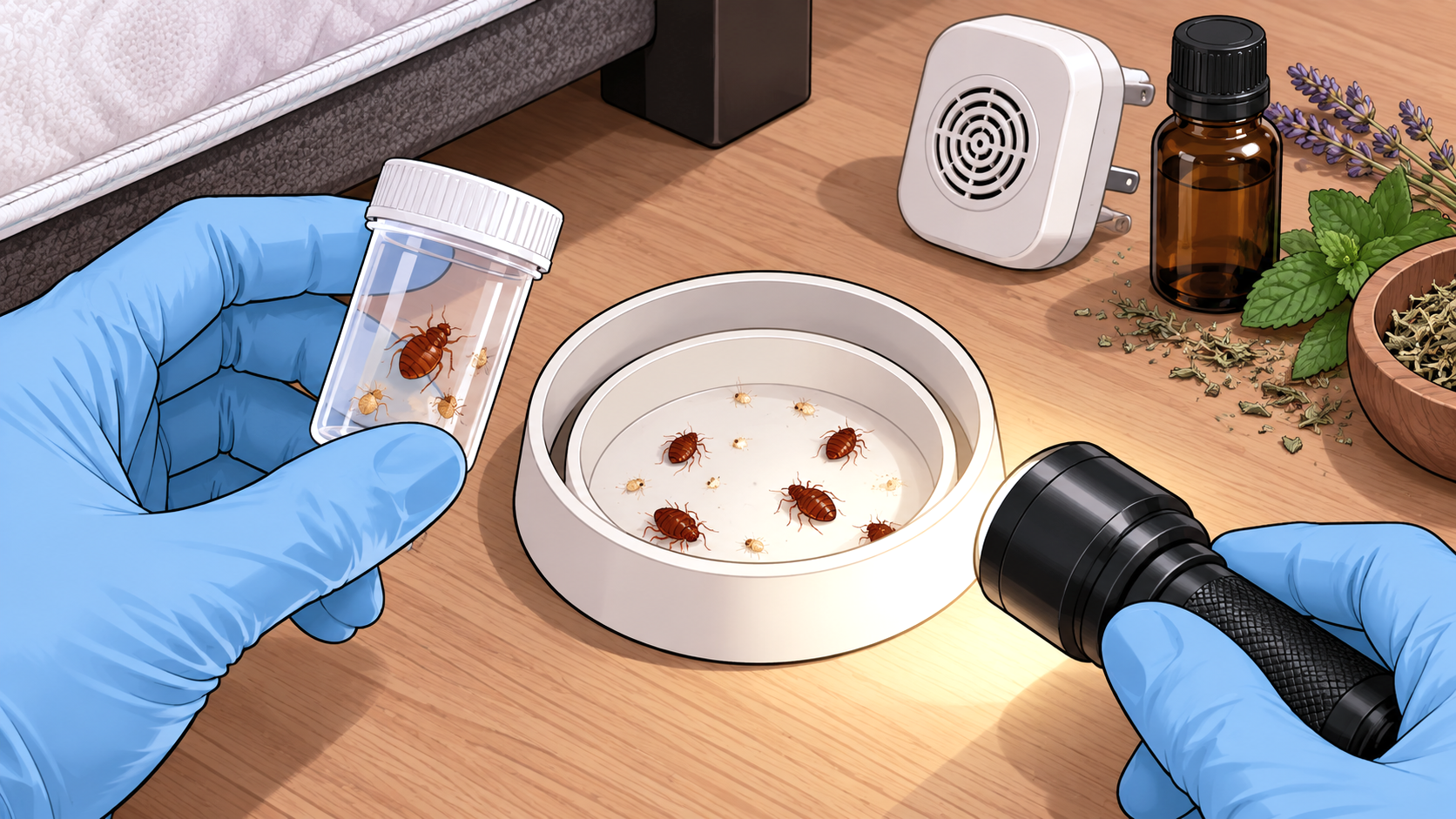
Bed bugs attract a remarkable amount of bad advice. Some myths encourage people to ignore an infestation, while others lead to unnecessary pesticide use or ineffective home remedies. The facts are less dramatic: bed bugs crawl rather than jump, cleanliness does not determine where they appear, bites cannot confirm an infestation, and successful control usually requires more than one tactic.
Myths About What Bed Bugs Can and Cannot Do
One persistent myth says bed bugs can fly or jump onto people. They do neither. Bed bugs are wingless insects that move by crawling across floors, walls, furniture, clothing, and other surfaces. Their ability to spread between belongings can make their arrival seem sudden, but bed bugs do not fly or jump. Their movement also explains why belongings can become important transport routes. Bed bugs can conceal themselves in seams and folds, allowing them to travel unnoticed in luggage and backpacks when those items leave an infested location. Travelers can transport them in luggage and clothing without ever seeing one crawl aboard.
Another myth treats bed bugs as microscopic. Adults, nymphs, and eggs can be seen without magnification, although their small size and concealed habits make them easy to miss. Adult bed bugs are commonly described as roughly apple-seed-sized, while immature stages are smaller and lighter. Being tiny is therefore not the same as being invisible, and bed bugs can be visible to the naked eye. Their flattened bodies allow them to occupy narrow cracks that make detection difficult even when the insects themselves are large enough to see. Adults, nymphs, and eggs are visible without a microscope.
Keeping the bedroom light on is not a reliable defense either. Bed bugs commonly feed when people are sleeping, but darkness is not an absolute requirement for feeding. Artificial light does not create a protective barrier around a sleeping person, and keeping a room brightly lit will not prevent bed bug bites. Their host-seeking behavior involves cues such as body heat and carbon dioxide, so sleeping with the lamp on simply trades darkness for a higher electric bill.
Myths That Can Make an Infestation Easy to Misread
A clean home is not protected from bed bugs. They feed on blood rather than household dirt, and they occur in everything from private residences to hotels and other places where people sleep. How clean a location is does not determine whether bed bugs are present. Clutter can give them additional hiding places and complicate inspection, but it is not the food source drawing them inside. Treating an infestation as evidence of poor housekeeping adds stigma without helping anyone find the insects.
Skin marks create another common source of false certainty. Waking with itchy bumps does not prove bed bugs caused them because other arthropods and several skin conditions can produce similar reactions. Some people also develop little or no visible reaction after bed bug bites. Physical evidence around sleeping areas carries more weight, including live insects, shed skins, eggs, fecal spotting, and characteristic stains. Bites are a poor indicator for confirming bed bugs, so photographs of unexplained welts should not replace an inspection. When bed bugs really are responsible, their bites can vary considerably in appearance.
The claim that every person in an infested room will wake covered in identical bites creates the same problem. Reactions differ between people, and visible marks may not appear immediately. A household in which one person has obvious welts while another appears unaffected can still have bed bugs. Some people develop no physical signs after being bitten, which makes comparing skin reactions between family members an unreliable way to accept or dismiss an infestation.
Disease claims also need separating from the genuine health effects of bed bugs. Bed bugs are public-health pests, but they are not known to transmit diseases to people. Their bites can cause itching, sleep disruption, allergic reactions in some people, and secondary skin infections associated with scratching. Those consequences are real without turning bed bugs into established human disease vectors. Bed bugs are still considered pests of public-health importance, so correcting the disease myth should not be mistaken for saying an infestation is harmless.
Treatment Myths Can Cost More Than the Infestation
The idea that one pesticide application should wipe out every bed bug is especially troublesome. Bed bugs hide in protected spaces, eggs may escape some treatments, and resistance has developed in some populations to insecticides with particular modes of action. Resistance to several insecticides has been documented in bed bugs, which helps explain why repeatedly applying more of the same product can fail. Effective control usually combines inspection, monitoring, physical measures, sanitation or clutter reduction where useful, and properly selected treatments. Their biology and hiding behavior are among the reasons bed bugs can be unusually difficult to eliminate.
More pesticide is not automatically better. Applying excessive amounts, treating surfaces not listed on a label, or improvising with chemicals intended for another purpose can create hazards without solving the infestation. Pesticides used against bed bugs must be applied according to their labels, including restrictions on where and how they may be used. Resistance also makes repeated use of an ineffective insecticide a poor substitute for changing the control strategy. The site’s examination of why bed bugs become resistant to pesticides deals with that issue separately from the broader myth that stronger spraying automatically produces better results.
Household chemicals create their own mythology. Bleach is often treated online as though anything capable of disinfecting a surface must also be a practical insect treatment. Disinfection and bed bug control are different jobs. Even when direct chemical contact can injure an insect, that does not turn a household cleaner into a reliable infestation treatment capable of reaching concealed bugs and eggs. The limitations of using bleach against bed bugs and their eggs are more important than whether a direct splash can kill an exposed specimen. We would not build a control plan around a cleaner that was never designed to solve the infestation.
Heat produces a different misunderstanding. Bed bugs are vulnerable to sufficiently high temperatures, but simply making a room feel hot is not equivalent to a controlled heat treatment. Improvised heating can leave cool refuges where insects survive and can introduce fire or equipment hazards. Clothes dryers can be useful for appropriate items because dryer heat can kill bed bugs when used correctly, while whole-room treatment requires controlled conditions rather than turning up a household thermostat. Professional heat is therefore not just “a very hot room.”
Throwing away every bed, sofa, or chair is another expensive reaction that often accomplishes less than people expect. Many infested items can be treated, and moving furniture through a home or leaving usable infested pieces where someone else may collect them can spread the problem. Public-health guidance specifically notes that furniture often can be treated instead of discarded. When disposal really is necessary, infested furniture and belongings need to be handled carefully rather than carried through the property uncontained.
Less Obvious Bed Bug Claims Worth Checking
Can bed bugs infest a five-star hotel?
Yes. Bed bugs can occur in high-end lodging as well as inexpensive accommodations because cleanliness, price, and hotel category do not prevent guests or belongings from introducing them. Lodging establishments rely heavily on inspection and early detection because bed bugs can enter with guests’ clothing, luggage, and belongings.
Does one bed bug automatically prove there is a breeding infestation?
No. A single confirmed bed bug deserves investigation, but one isolated insect does not by itself establish the size or status of an infestation. Public-space guidance notes that a single bed bug sighting is not automatically evidence of an infestation. Inspecting nearby harborages and monitoring for further evidence is more informative than immediately assigning an infestation level.
Will bed bugs disappear if you leave the home empty?
Vacating a room for a short period is not a dependable control method. Bed bugs can survive for months without feeding, so removing the immediate blood meal does not guarantee that hidden insects will die before people return. Their ability to persist without frequent feeding is one reason abandoning the bedroom is not a treatment strategy.
Can bed bugs enter an apartment from another unit?
Yes. Multi-unit buildings can allow bed bugs to move between adjoining spaces through structural gaps and routes around pipes or wiring. Building-wide inspection may therefore need to extend beyond the first unit where insects are found. Guidance for building owners recommends examining units adjacent to a confirmed infestation, rather than assuming every apartment represents an isolated problem.