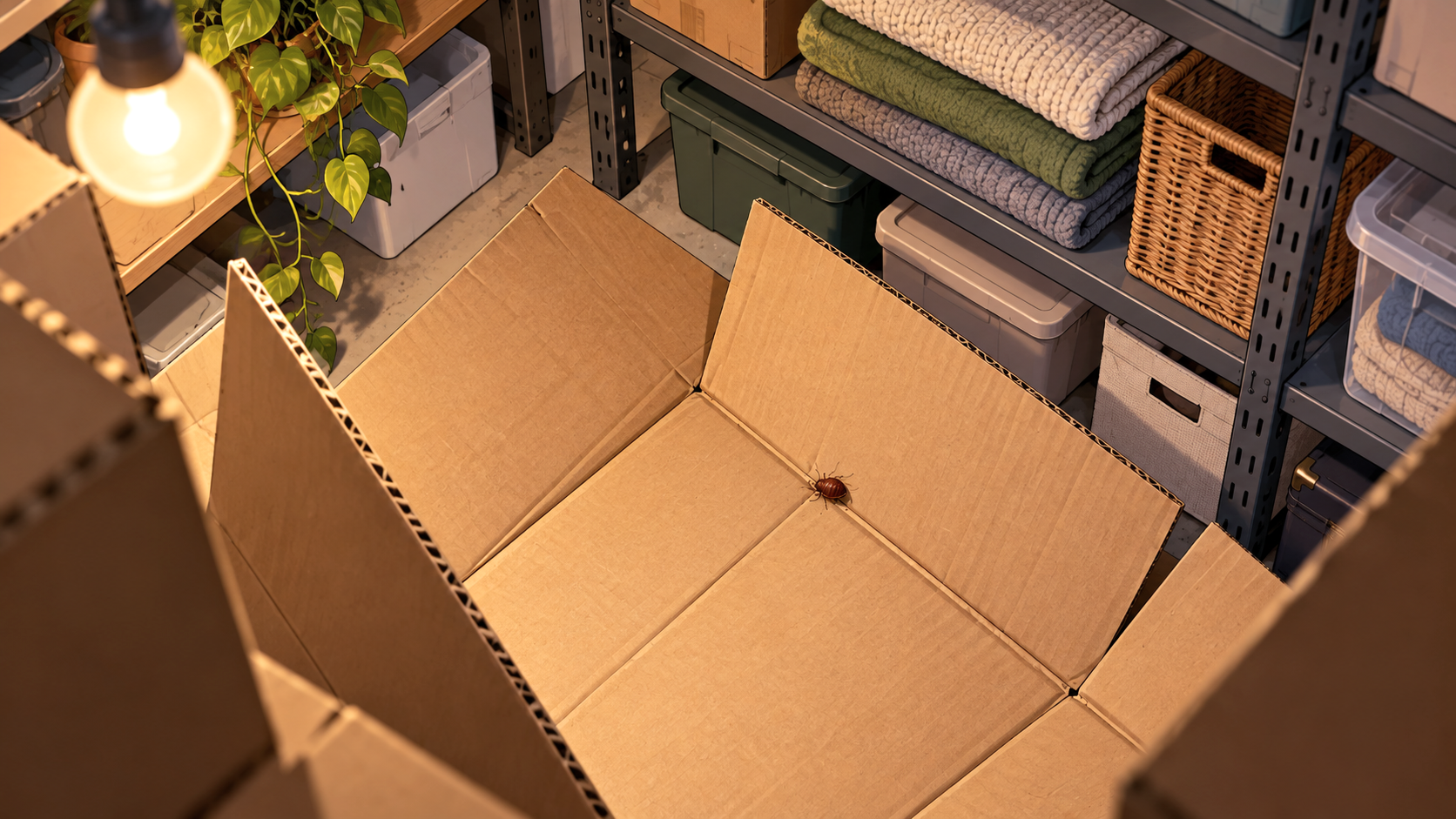
Bed bugs can live and hide in cardboard boxes. They do not eat cardboard, but corrugated channels, folded corners, tape seams, and stacked boxes provide dark, narrow shelter. Cardboard becomes more significant when it sits near a bed or sofa, remains undisturbed for long periods, or is part of a cluttered infestation.
Corrugated Cardboard Gives Bed Bugs More Shelter Than a Smooth Container
A cardboard box contains far more crevices than its flat exterior suggests. The corrugated layer creates narrow internal channels, while folded flaps, crushed edges, handles, tape lines, and overlapping panels form additional gaps. Bed bugs can exploit openings only a few millimeters wide because their bodies are extremely flat. Cracks approximately the width of a credit card can conceal a bed bug, so the structure of corrugated packaging gives them many places to disappear from view.
Cardboard is therefore useful as a harborage rather than a food source. Bed bugs obtain nutrition only from blood and ordinarily remain close enough to sleeping or resting hosts to feed periodically. Their blood-feeding biology explains why a box under a bed is far more relevant than an identical box stored in an isolated location where no host is available.
Boxes Under or Beside a Bed Carry the Greatest Concern
Location changes the likelihood that a box will become occupied. Bed bugs generally concentrate around places where people sleep, although they can spread farther as an infestation grows. A box beneath a bed, beside a headboard, behind a nightstand, or next to an upholstered chair provides convenient shelter between meals.
Bed bugs commonly remain within several feet of sleeping hosts, and cardboard added to that zone increases the number of potential harborages. Boxes stored elsewhere in an infested room can still contain insects, but a stack directly beside the bed deserves closer attention than cartons in a remote utility room.
The same distribution pattern helps distinguish early activity from a more widespread bed bug infestation. Bugs occupying numerous boxes throughout a bedroom are more concerning than one hitchhiker found on a recently delivered carton.
Cardboard Boxes Can Move Bed Bugs From One Place to Another
Boxes are also transportation objects. Bed bugs can enter packaging in an infested home, storage area, workplace, moving truck, or other location and remain concealed while the box is carried elsewhere. They are recognized hitchhikers on boxes, furniture, bedding, clothing, and luggage, which means a carton can move an insect without containing an established breeding colony.
This is particularly relevant during moving, self-storage, and redistribution of used boxes. Reusing cartons that came from an infested apartment introduces more uncertainty than using new packaging stored in a clean area. Likewise, moving boxes out of an infested bedroom and immediately unpacking them elsewhere can transfer bugs that were hidden in folds or contents.
The transport risk overlaps with, but is not limited to, bed bugs arriving through shipped packages. Household storage boxes can become harborages long after the original delivery has been forgotten.
Bed Bug Eggs Can Be Hidden on Cardboard
Cardboard can hold more than mobile insects. Females attach small pale eggs to protected surfaces, and rough fibers, corrugations, folded seams, and the underside of flaps offer suitable concealed sites. Eggs are only about 1 mm long, so even an apparently empty carton can contain something difficult to notice without close inspection.
Bed bug eggs are small enough to be overlooked easily, especially against pale cardboard fibers or dried adhesive. Their size and appearance also make visual clearance of a heavily creased box less dependable than inspection of a smooth plastic container.
A few dark spots alone do not prove eggs or bed bugs are present. Cardboard naturally collects dirt, ink, water stains, adhesive marks, and mold, so look for identifiable insects, cast skins, eggs, or characteristic fecal spotting rather than interpreting every mark as infestation evidence.
Leaving a Box Empty for a Few Weeks Will Not Reliably Clear It
Removing the contents or moving a box away from the bed does not guarantee that hidden bugs will starve quickly. Bed bugs are unusually tolerant of long gaps between blood meals, and adults can withstand prolonged periods without feeding because they conserve water efficiently and reduce activity when food is unavailable.
That ability means a box forgotten in a closet or storage room can remain risky longer than expected. The exact survival period depends on life stage, temperature, humidity, and previous feeding history, but simply waiting several weeks is not a dependable treatment. The broader limits of bed bug survival without feeding make long-term storage a poor substitute for inspection or treatment.
Removing Excess Cardboard Makes an Infestation Easier to Treat
Large amounts of cardboard increase the number of cracks pest-control efforts must account for. During bed bug preparation, excess boxes are commonly removed because bed bugs can hide inside cardboard. Fewer boxes also make floors, baseboards, furniture legs, and wall junctions easier to inspect and treat.
Removal should be controlled rather than rushed. Carrying open boxes from an infested bedroom through unaffected rooms can drop insects or eggs along the route. Place disposable boxes directly into heavy plastic bags or otherwise contain them before removal, especially when live bugs have already been found.
Reducing clutter also improves the effectiveness of inspection because bed bugs become harder to locate as the number of available harborages increases. Clutter around sleeping areas provides additional hiding places, so replacing stacks of cardboard with simpler storage can make monitoring considerably easier.
Plastic Bins Are Usually Better for Long-Term Storage
A smooth plastic storage bin with a tight-fitting lid offers fewer folds and internal channels than corrugated cardboard. It is also easier to inspect, wipe clean, and isolate during treatment. Replacing unnecessary cartons with plastic containers is specifically included in bed bug preparation guidance because cardboard provides more shelter.
Plastic does not repel bed bugs, and a poorly fitted lid or clutter around the bin can still allow insects to hide nearby. The advantage is reduced structural complexity, not immunity. Clear plastic also makes it easier to inspect the contents without repeatedly opening the container.
For belongings that have already been exposed, do not simply transfer them from an infested cardboard box into a clean bin. Treat or inspect the items first so the new container does not merely enclose the infestation.
Do Not Carry an Infested Box Through the House Unsealed
Once you find a confirmed bed bug on or inside a box, contain the entire carton before moving it. A large plastic trash bag or similarly secure enclosure can prevent mobile insects from dropping onto floors, stairs, furniture, or vehicle upholstery while the box is being removed.
Moving belongings carelessly is one way infestations expand. Bed bugs and eggs can be displaced when objects are disturbed, so infested items should be sealed before transport. If the box is disposable and the contents can be handled separately, eliminating the cardboard is usually simpler than attempting to preserve it.
Do not move suspect boxes into another bedroom merely to create space. Keeping potentially infested possessions contained within the treatment area reduces the chance of creating new harborages elsewhere.
Vacuuming Helps With Exposed Bugs but Cannot Clear Corrugated Channels
A crevice attachment can remove visible adults, nymphs, shed skins, and debris from accessible box seams. Vacuuming is useful when the contents need to be inspected before disposal, but suction cannot reliably reach eggs glued deep inside corrugations or insects hidden beneath inaccessible folds.
Vacuuming can reduce bed bug numbers without eliminating every individual, so a cheap disposable box with confirmed activity is rarely worth painstaking treatment. The contents deserve more attention than the container itself.
If valuable belongings were stored in the box, inspect and treat them according to their material. Clothing, books, electronics, photographs, and hard objects cannot all be treated identically.
Spraying Cardboard With Insecticide Is Usually a Poor Tradeoff
Saturating shipping or storage boxes with pesticide can leave residues on contents while still missing insects inside internal corrugations. Cardboard also absorbs liquids readily, making precise pesticide placement difficult. A product registered for cracks, crevices, furniture, or baseboards should not automatically be applied to packaging unless its label permits that surface.
For disposable cartons, removal is generally simpler. The full bed bug control process should concentrate treatment on occupied structural harborages and salvageable belongings rather than preserving inexpensive cardboard.
If pesticides are necessary elsewhere in the room, use products according to their labels and integrate them with inspection, physical removal, heat where appropriate, monitoring, and clutter reduction.
A Box With Bed Bugs Does Not Mean Everything Inside Is Infested
A bug tucked beneath an exterior flap may never have entered the contents. Conversely, insects can be hidden among objects even when none are visible on the box. Treat the contents as exposed rather than automatically infested.
Remove items methodically over a hard, uncluttered surface where any crawling insect can be seen. Dryer-safe textiles can be separated for heat treatment, hard objects can be inspected individually, and sensitive items may require isolation or another material-appropriate method. Avoid dumping the contents onto a bed or carpet.
Physical evidence around the storage area can show whether the box is merely transporting a hitchhiker or sits within an established harborage. Live bugs, cast skins, eggs, and fecal marks are among the early evidence worth checking.
Questions About Bed Bugs in Cardboard Boxes
Do bed bugs eat cardboard?
No. Bed bugs feed on blood. Cardboard serves only as shelter and transportation.
Can bed bugs lay eggs inside cardboard boxes?
Yes. Eggs can be attached to folded seams, corrugated channels, rough surfaces, or other protected parts of a box.
Can bed bugs live in moving boxes?
Yes. Moving boxes can pick up bugs in an infested home and carry them to the new property, particularly when boxes remain packed near beds or upholstered furniture.
Should you throw away every cardboard box during an infestation?
Not necessarily every carton in the property, but unnecessary boxes in affected sleeping or resting areas should usually be removed because they create additional hiding places.
Can bed bugs escape from a taped cardboard box?
Possibly. Ordinary moving boxes may still have gaps around seams, handles, crushed corners, or overlapping flaps. Tape alone should not be treated as bed bug-proof containment.
Can you reuse cardboard boxes after a bed bug infestation?
Disposable boxes that were stored in an infested area are generally not worth preserving when clean alternatives are available. New or uncontaminated containers reduce the number of uncertain harborages carried forward.
Do plastic totes prevent bed bugs?
A tightly sealed plastic tote provides fewer hiding spaces and better containment than cardboard, but bugs can still occupy the exterior or enter if the lid does not seal well.
Can boxes stored in a garage still contain live bed bugs?
Yes. Ordinary garage temperatures and lack of a nearby host do not reliably kill every bed bug, especially over short storage periods.
What should you do if you find bed bugs in stored boxes?
Contain the boxes before moving them, discard unnecessary cardboard, inspect the contents individually, and check the surrounding room for additional evidence. Measures used to prevent bed bugs from spreading through a home are more effective when suspect storage is dealt with before boxes are carried into unaffected rooms.
One thought on “Can Bed Bugs Live in Cardboard Boxes?”