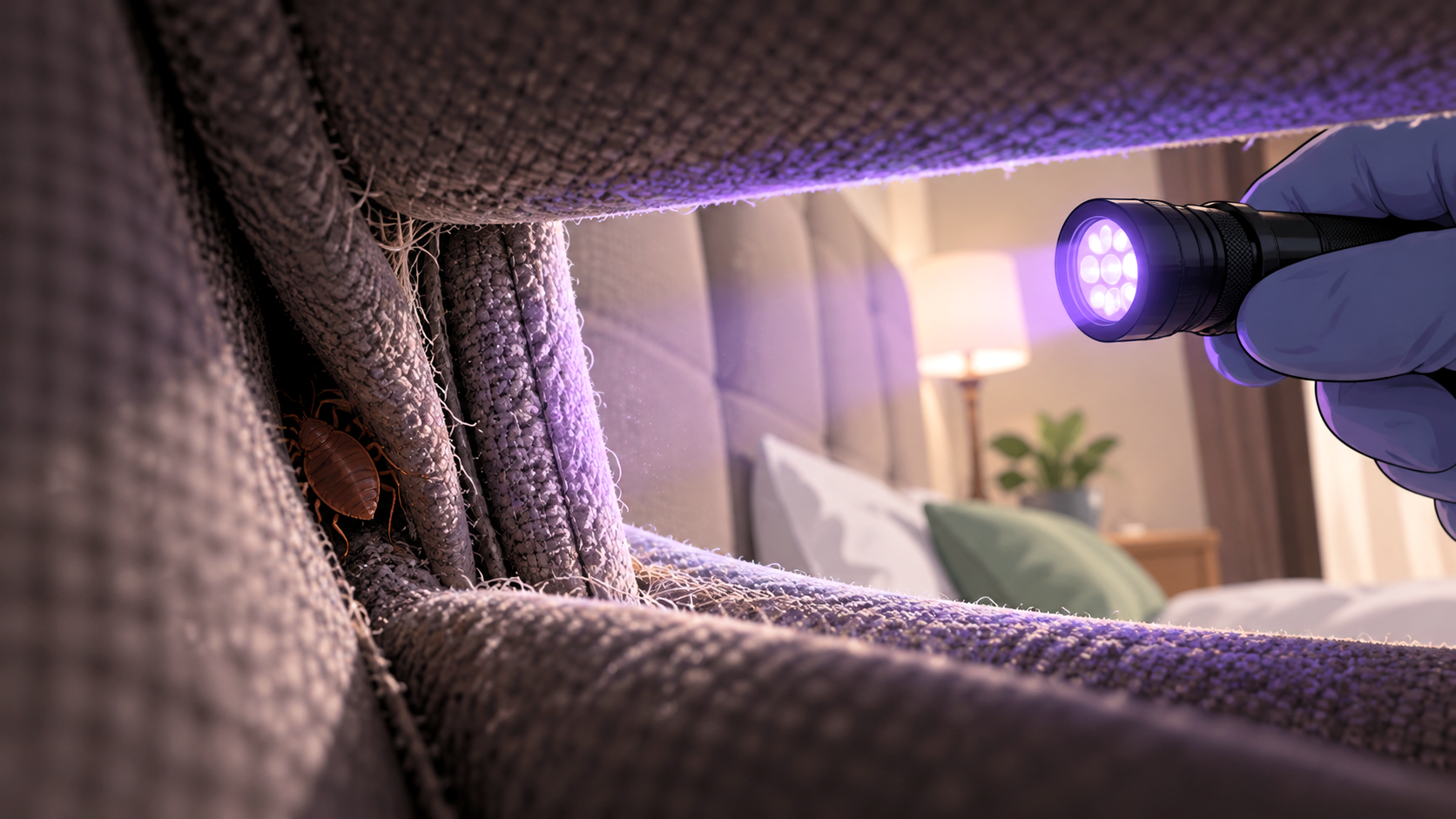
UV-C can kill bed bugs under direct experimental exposure, but UV light is not a practical stand-alone bed bug treatment. Bed bugs spend most of their time inside seams, joints, cracks, and other shaded harborages where ultraviolet radiation cannot reach them. UV-C strong enough to cause biological damage can also injure human skin and eyes.
UV-C Has Killed Bed Bugs Under Direct Laboratory Exposure
Ultraviolet radiation is divided into UVA, UVB, and UVC according to wavelength. UVC carries more energy than the UV radiation that normally reaches Earth’s surface and is commonly used for germicidal applications. Research on arthropods has found high mortality in bed bug eggs and first-instar nymphs exposed directly to UV-C, showing that bed bugs are biologically vulnerable to sufficiently intense ultraviolet exposure.
That finding does not mean shining a household UV lamp around a bedroom will eradicate an infestation. Laboratory insects can be positioned directly beneath a known light source with no mattress seam, wood joint, fabric fold, dust layer, or furniture panel blocking the radiation. Real infestations contain exactly those protected spaces. Bed bugs’ ability to remain deep inside narrow cracks and concealed harborages makes direct irradiation of every insect unrealistic.
UV Light Cannot Kill a Bed Bug It Cannot Reach
UV treatment is fundamentally a line-of-sight process. A lamp can irradiate an exposed surface, but it does not travel through a mattress, upholstery, wood, clothing, cardboard, or a wall. A bug hidden beneath mattress piping may receive little or none of the dose delivered to the top surface a few centimeters away.
Bed bugs commonly occupy mattress seams, box springs, bed frames, headboards, dressers, cracks, and crevices. Eggs may be attached even farther inside protected gaps. Their small size and concealed placement make complete exposure especially difficult.
Moving a handheld UV lamp across visible furniture therefore treats only exposed areas. Any surviving female, nymph, or egg beyond the beam can allow the infestation to continue.
A Black Light Is Not the Same as a Germicidal UV-C Lamp
Consumer “black lights” generally operate in the UVA region, often around 365 to 395 nanometers. Germicidal UVC occupies much shorter wavelengths, roughly 100 to 280 nanometers. The categories have different energies and should not be treated as interchangeable simply because both are described as ultraviolet light. The UV spectrum and its UVA, UVB, and UVC divisions explain why a purple-glowing inspection flashlight is not equivalent to a germicidal lamp.
Black lights are therefore not a dependable way to kill bed bugs. Bed bugs can perceive portions of the light spectrum, and research into bed bug vision and responses to different wavelengths has examined UV sensitivity, but visual response does not establish lethal exposure.
Buying a UV flashlight because it emits “UV” does not provide a validated bed bug treatment.
UV Can Reveal Some Bed Bug Fecal Material Without Confirming an Infestation by Itself
Ultraviolet light has a more plausible role in inspection than in eradication. Bed bugs produce several types of fecal spots, including clear deposits that researchers found were visible under ultraviolet illumination. That can make otherwise difficult-to-see contamination easier to notice on certain surfaces.
Fluorescence is not specific to bed bugs. Laundry residues, bodily fluids, cleaning products, fibers, food residues, and other household materials can also appear differently under UV. A glowing mark therefore cannot diagnose bed bugs by itself.
Confirmation should still rely on recognizable evidence such as live insects, cast skins, characteristic spotting, or eggs. The broader early signs of bed bugs are more useful when several forms of evidence point to the same harborage rather than when one fluorescent stain is viewed in isolation.
Strong UV-C Creates a Human Exposure Hazard
The intensity capable of damaging an insect is also relevant to human safety. Artificial UVC can cause severe skin burns and painful eye injuries, including photokeratitis after relatively brief exposure. Some lamps can also produce ozone, adding a respiratory hazard.
Handheld devices deserve particular caution. Testing of some consumer UV wands found unsafe UV-C emission capable of injuring skin or eyes within seconds. Protective glasses alone do not turn an unvalidated UV device into a safe pest-control system because reflected radiation and exposed skin remain concerns.
Do not aim high-output UVC lamps at mattresses, bedrooms, pets, people, or occupied rooms in an attempt to reproduce laboratory mortality.
Sunlight Through a Window Is Not a Bed Bug UV Treatment
Natural sunlight contains UVA and some UVB at ground level, while solar UVC is absorbed by the atmosphere. UVC from the sun does not reach Earth’s surface, so putting a mattress beside a sunny window does not reproduce experimental UVC exposure.
Direct sun can heat an object, but that becomes a heat-treatment question rather than a UV treatment. Temperature must reach lethal levels throughout every harborage, not merely make the exposed fabric hot. Bed bugs hidden on the shaded side or deep inside a mattress can remain protected even when the surface is receiving intense sunlight.
Controlled heat, steam, laundering, freezing of suitable items, encasements, monitoring, and registered pesticides have much clearer roles in integrated bed bug control.
UV Light Should Not Replace Methods That Reach Harborages
Successful treatment has to reach insects where they actually live. Steam can penetrate some seams and shallow cracks, dryer heat can treat suitable fabrics, encasements can trap insects in mattresses and box springs, interceptors can monitor movement, and appropriately selected pesticides can target permitted harborages. EPA’s do-it-yourself control framework combines multiple methods because no exposed-surface treatment addresses every hiding place.
The bed bug elimination process should therefore not be delayed while repeatedly irradiating visible surfaces. If a UV device appears to kill an exposed bug, that demonstrates only what happened to that insect, not what happened to the rest of the population.
Visible survivors, new cast skins, eggs, or continued spotting after treatment indicate that occupied harborages remain. Confirming whether you actually have bed bugs before choosing a control method also avoids exposing yourself to UV radiation over marks or insects that were misidentified.
Questions About UV Light and Bed Bugs
Does UV-C kill bed bug eggs?
Direct UV-C exposure can damage and kill bed bug eggs under experimental conditions. Household treatment remains unreliable because eggs hidden beneath fabric, inside joints, or behind other materials are shielded from the light.
Can a UV sterilizing wand kill a bed bug you can see?
A sufficiently powerful device may injure or kill a directly exposed insect, but consumer wands vary greatly in output and some emit hazardous radiation. Killing one exposed bug does not treat concealed harborages.
How long do you have to shine UV light on bed bugs?
There is no validated household exposure time that can be applied to arbitrary UV lamps. Mortality depends on wavelength, irradiance, distance, exposure duration, insect stage, and whether the bug is directly illuminated.
Will a black light make bed bugs come out of hiding?
There is no dependable household method in which black light draws concealed bed bugs into the open for treatment. Their host-seeking behavior relies on multiple cues rather than a simple attraction to ultraviolet light.
Can UV light penetrate a mattress?
No. Ultraviolet radiation does not penetrate deeply through mattress fabric, padding, foam, wood, or other opaque materials, leaving internal harborages protected.
Can UV inspection replace bed bug traps?
No. UV may make some residues easier to see, while traps and interceptors physically capture moving insects. Bed bug monitoring devices provide a different type of evidence from fluorescence.
Does leaving bedding in direct sunlight kill bed bugs?
Sunlight alone is not a dependable UV treatment. If solar heating raises the entire item to lethal temperatures, mortality would result from heat rather than from ordinary outdoor UVC exposure.
Is UV safer than pesticide treatment?
Not automatically. UV avoids pesticide residue, but powerful UVC can injure skin and eyes. Treatment choice should be based on a method’s demonstrated effectiveness, the location being treated, and its specific safety requirements.