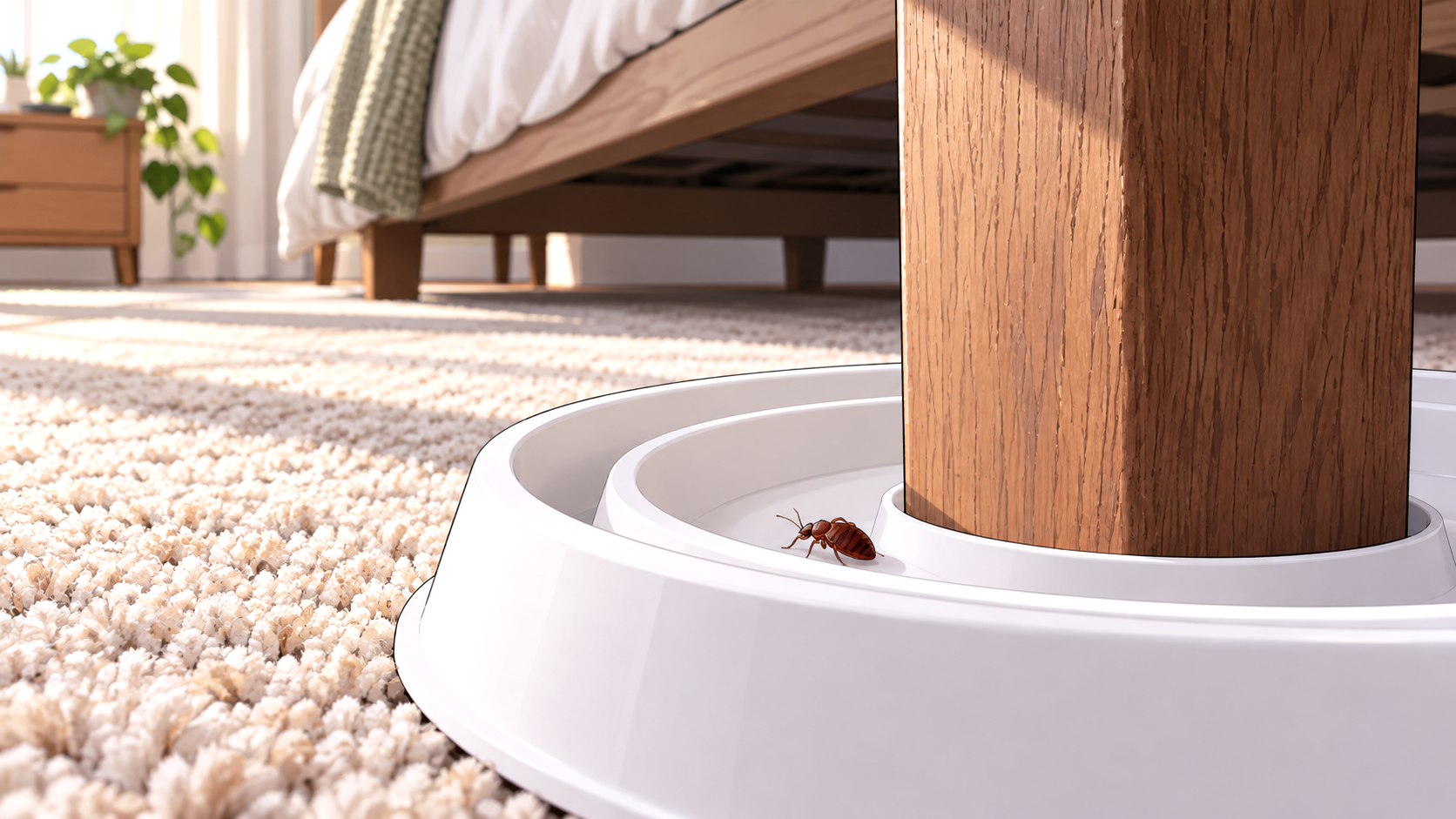
Bed bug traps can work, but their value depends on the type of trap and what you expect it to do. Interceptor traps are particularly useful for detecting low-level infestations and measuring activity over time. Active traps using carbon dioxide, heat, or chemical lures can attract host-seeking bugs. Neither type should be treated as a guaranteed stand-alone cure for an established infestation.
Interceptor Traps Are Most Useful When the Bed Becomes the Bait
A passive interceptor is a pitfall-style device placed beneath a bed, couch, or chair leg. Bed bugs moving between the furniture and the surrounding room climb into the trap and encounter a smooth inner surface that prevents escape. The sleeper provides the attraction, so the interceptor itself does not need a chemical lure.
This simple arrangement can outperform visual inspection when only a few insects are present. In lightly infested occupied apartments, interceptors deployed for seven days detected more low-level infestations than visual inspection and caught numbers comparable with a dry-ice active monitor operated for one day. That makes interceptors especially useful when the physical signs of bed bugs are sparse or difficult to locate.
For the setup to work properly, the furniture leg must be the practical route onto the bed. Keep the bed away from the wall, prevent blankets from reaching the floor, and remove objects that create alternative bridges. EPA’s bed-isolation setup similarly places interceptors beneath every bed leg while keeping bedding off the floor.
A Trap With Nothing in It Does Not Prove the Room Is Clear
Bed bugs do not move continuously, and a trap can only catch an insect that encounters it. Bugs already living in a mattress, headboard, bed frame, or couch may feed without ever crossing an interceptor beneath a furniture leg. Recently fed individuals may also remain hidden for days before moving again.
A negative trap is therefore evidence, not a guarantee. Confidence grows when several monitoring methods agree: repeated empty traps, no live insects during inspection, no fresh fecal spotting or cast skins, and no other continuing signs. The process of determining whether bed bugs are actually present should not hinge on one empty device.
Monitoring also needs time. EPA recommends checking interceptors regularly and keeping them in place during long-term post-treatment monitoring, rather than removing them after one quiet night.
Active Traps Can Find Bugs When No Person Is Sleeping in the Room
Some traps create host-like cues instead of waiting for bed bugs to cross them accidentally. Carbon dioxide is particularly useful because exhaled CO₂ is one of the signals bed bugs use while locating a host. Heat and certain chemical odors can add attraction.
In experimental arenas, pitfall traps combining carbon dioxide with heat or chemical cues captured more than 86% of released bed bugs within six hours. A later comparison showed that increasing the CO₂ release rate increased trap catches, while an experimental chemical lure improved the performance of a passive interceptor by roughly 2.2 times under the tested conditions. Trap design and carbon dioxide output strongly affected monitor performance.
Active monitors are particularly useful in vacant bedrooms, apartments, hotel rooms, or other spaces where no sleeping person is continuously supplying host cues. Their performance should still be judged as detection rather than automatic eradication.
Carbon Dioxide Usually Contributes More Than Heat Alone
Bed bugs respond to more than one host signal, but those cues are not equally powerful. Experiments comparing attractants found CO₂ significantly more attractive than heat by itself. Combining CO₂ with heat and odor cues increased captures further in some configurations.
A trap using carbon dioxide, heat, and a chemical lure collected thousands of bugs during testing in an infested apartment, with far greater catches when carbon dioxide was present. Another field-tested design generated CO₂ from sugar and yeast and performed similarly to a dry-ice monitor carrying the same lure. One day of active monitoring matched the catch from multiple passive interceptors deployed for 11 days in the apartments evaluated.
These results do not mean any homemade bowl of yeast will work equally well. Trap geometry, escape prevention, CO₂ release rate, placement, and competing human hosts all affect performance.
Glue Traps Are Less Dependable Than a Good Pitfall Design
Ordinary sticky boards can catch a bed bug that happens to cross them, but they do little to encourage a concealed bug to enter the adhesive. Dust, carpet fibers, and other debris can also reduce stickiness, and a poorly placed glue board may remain empty even with bed bugs nearby.
Pitfall interceptors are generally better suited to routine bed bug monitoring because they exploit predictable movement around beds and upholstered furniture. Rutgers identifies pitfall-style monitors as among the most cost-effective tools for detecting bed bugs, while modern comparative work continues to show that capture performance varies substantially among trap designs.
Sticky traps can still provide incidental evidence, but an empty glue board should carry less weight than a correctly installed monitoring system around the places where people routinely sleep or rest.
Traps Can Reduce a Small Population, but Detection Is Their Stronger Role
Every bed bug captured in a trap is one less insect capable of feeding or reproducing, so extensive trapping can contribute to population reduction. In apartments with low-level infestations, continuous deployment of numerous passive interceptors produced significantly lower bed bug counts than controls, and 50% of the trap-treatment apartments had no detectable bugs after 16 weeks.
That does not make trapping equivalent to treatment for a typical infestation. The experiment involved many traps distributed throughout apartments and months of continuous monitoring. Eggs and bugs that never entered the devices remained outside their reach. A mild infestation differs substantially from a widely dispersed one, and trap-only suppression becomes less realistic as the number of occupied harborages increases.
Interceptors have a stronger role inside an integrated program. In apartment treatments combining steam, encasements, dusts or sprays, and follow-up visits, interceptors captured large numbers of bugs while providing better population estimates than visual inspection.
Trap Counts Can Show Whether Treatment Is Moving in the Right Direction
A trap is useful not only because it catches insects but because it produces a count that can be compared from one inspection to the next. Ten bugs this week, three at the next check, and none during repeated later checks provides more useful information than relying on bite frequency alone.
Bites are poor monitoring tools because skin reactions vary among people and can appear after a delay. Regular interceptor counts provide physical evidence of population activity around the furniture. Professional and research programs routinely use trap counts alongside inspection to measure treatment progress; interceptors have also been used to document substantial reductions during nonchemical and silica-gel treatment programs.
A downward count supports progress, but a sudden zero should not end monitoring immediately. The broader bed bug elimination process still needs to account for concealed survivors and later-emerging nymphs.
Placement Determines Whether an Interceptor Can Work
Place one interceptor beneath every leg supporting the bed or upholstered furniture being monitored. The leg should sit securely in the center well without touching the outer wall of the trap. The furniture itself should not touch walls, curtains, nightstands, electrical cords, or another object that gives bugs a route around the interceptor.
Dust and debris can also reduce performance by making an escape surface easier to climb. Check traps routinely and clean them according to their design. EPA’s instructions for homemade interceptors use a rough exterior that bugs can climb and a slippery interior that keeps them contained.
Trap placement should follow where people spend long periods resting rather than where a device is easiest to hide. A couch used nightly can deserve monitoring as much as the bed.