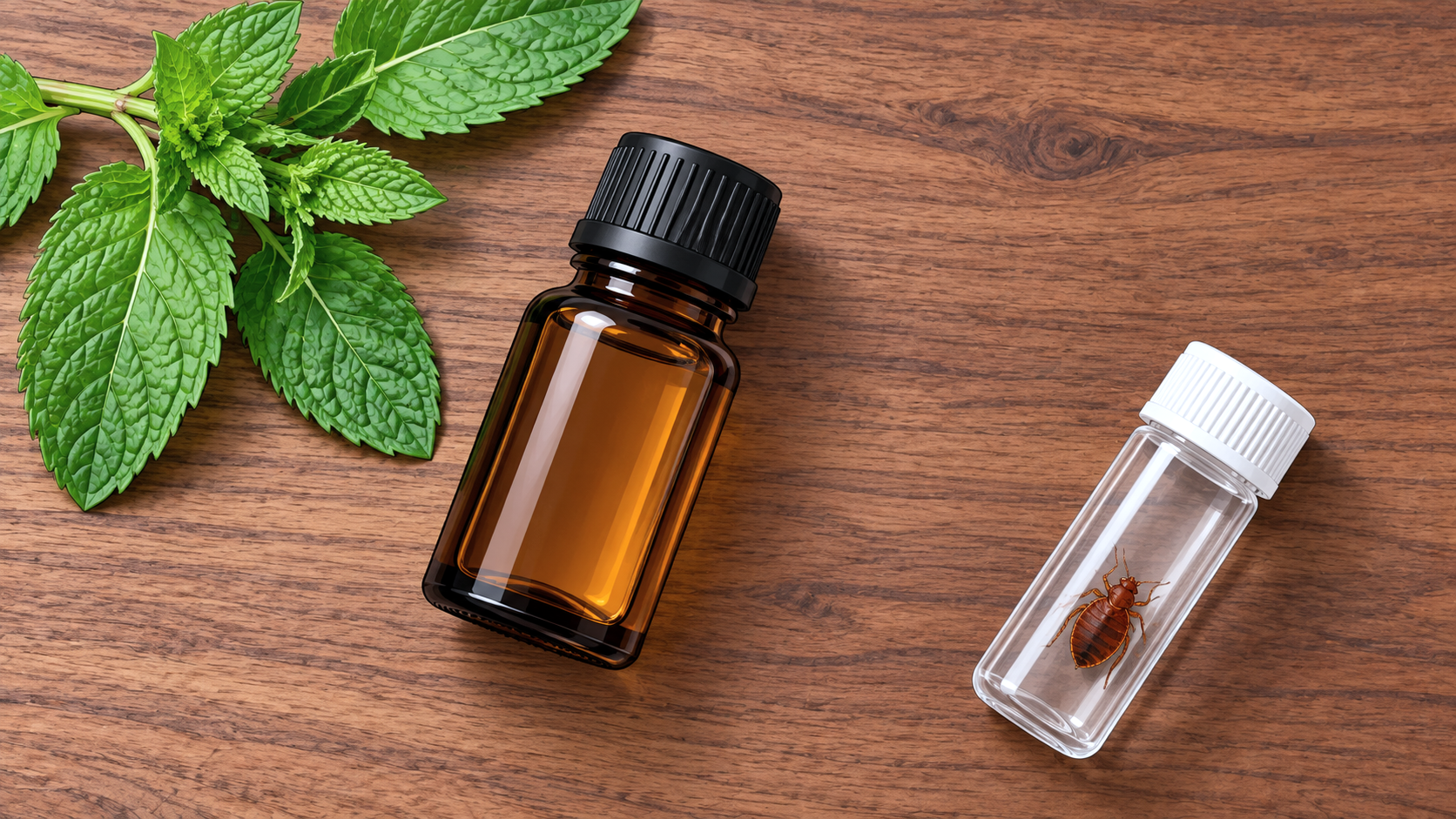
Peppermint oil can injure or kill bed bugs when sufficiently concentrated material contacts them directly, but it is not a dependable way to eliminate an infestation. The amount reaching hidden bugs, the formulation, exposure time, and life stage all affect the result. Homemade peppermint sprays and diffusers cannot be assumed to reproduce laboratory toxicity.
Peppermint Oil Has Insecticidal Compounds, but That Does Not Make It a Proven Bed Bug Treatment
Peppermint oil contains a mixture of volatile compounds, with menthol and menthone among its characteristic constituents. Essential oils as a group can show direct insecticidal activity against bed bugs, but their performance varies substantially. In testing of 18 essential oils, every oil produced some topical toxicity while even the strongest essential oil was less potent than the tested silicone and paraffin oils.
Research on individual essential-oil compounds also found menthone capable of killing bed bugs through topical or vapor exposure, although it was weaker than the most active compounds tested, such as carvacrol and thymol. In direct topical tests, several botanical compounds required doses thousands of times greater than the conventional insecticide used for comparison. Menthone also showed substantially lower fumigant potency than the strongest compounds in the experiment.
Those experiments establish biological activity, not a household recipe. Peppermint oil from an aromatherapy bottle can differ in composition, concentration, additives, and application from purified laboratory chemicals.
Killing a Bed Bug You Spray Is Easier Than Clearing an Infestation
Direct contact gives an oil its best chance of affecting an insect because the chemical reaches the body at once. A bedroom infestation presents the opposite situation. Most bed bugs are concealed inside mattress piping, box springs, furniture joints, headboards, baseboards, screw holes, and other sheltered spaces rather than sitting exposed on a flat surface.
A spray that kills one visible insect can therefore leave most of the population untouched. This limitation is shared by many plant-based products. Rutgers testing found that most essential-oil and detergent bed bug products performed poorly compared with the few formulations that achieved high direct-spray mortality.
Hidden harborages are a major reason bed bugs are unusually difficult to eliminate. Peppermint oil does not solve the delivery problem simply because its odor spreads through the room.
Peppermint Smell Is Not a Reliable Barrier Around the Bed
Repellency and mortality are separate properties. An odor may alter insect movement at one concentration without killing anything, while a lethal dose may require much greater contact. Essential-oil constituent experiments found that some plant compounds caused avoidance, but treated barriers did not reliably prevent bed bugs from reaching a warmed blood meal.
Peppermint’s strong smell should therefore not be interpreted as protection from bites. Host-seeking bed bugs respond to several cues associated with a nearby person, and an odor placed around the mattress does not create an impenetrable boundary.
Other supposed smells that bed bugs avoid have the same limitation: short-term behavioral effects do not equal eradication.
A Peppermint Diffuser Cannot Reproduce Fumigant Testing
Vapor toxicity studies use known quantities of individual chemicals inside sealed chambers of known volume. A household diffuser releases essential oil into a room with uncontrolled air exchange, absorption into furnishings, and large differences in concentration from one location to another.
In laboratory fumigant assays, even purified essential-oil constituents required comparatively high airborne concentrations to produce substantial adult mortality. Conventional dichlorvos vapor was hundreds of times more potent than the strongest botanical compound in the comparison. Essential-oil vapor toxicity depended strongly on the specific compound and concentration.
A pleasant peppermint smell across a bedroom therefore says nothing about whether lethal concentrations exist inside a box spring, behind a headboard, or beneath a baseboard.
Homemade Peppermint Sprays Have No Standard Effective Concentration
DIY recipes vary from a few drops of peppermint oil in water to highly concentrated mixtures containing alcohol, detergent, vinegar, or other ingredients. These formulas have not been standardized for bed bug control, and oil does not disperse evenly in plain water without suitable formulation.
The National Pesticide Information Center warns that homemade essential-oil pest sprays are rarely effective and lack standardized safety or first-aid directions. Bed bugs may also move away from disturbed harborages without being killed, making later treatment more difficult.
A product specifically intended for bed bugs is different from a homemade mixture because its formulation, treatment sites, and application instructions can be evaluated. The bed bug pesticides and active ingredients used for control should be judged by their registered uses rather than by whether an ingredient sounds natural.
Peppermint Oil Should Not Be Sprayed Freely Onto Skin or Bedding
Essential oils are biologically active substances. Concentrated peppermint oil can irritate skin and eyes, and repeated exposure can cause unwanted reactions. Applying it directly to the body in an attempt to repel bed bugs is particularly inappropriate because there is no established peppermint treatment for preventing bed bug feeding on human skin.
Pesticides and repellents intended for one purpose should not be redirected onto people or sleeping surfaces without authorization for that use. EPA guidance specifically warns against applying unapproved pesticides or repellents to the body for bed bugs.
Soaking mattresses, pillows, or sheets in concentrated essential oil also creates unnecessary exposure while doing little to reach the protected harborages that sustain an infestation.
Peppermint Oil Does Not Give Dependable Egg Control
An infestation cannot be cleared by considering exposed adults alone. Bed bug eggs are attached in protected locations and can be difficult to notice because of their small size. The appearance and placement of bed bug eggs make thorough contact with an improvised spray unlikely.
Essential-oil products have shown highly variable performance against eggs, and many botanical formulations that affect mobile bugs do not provide complete ovicidal control. A few dead adults after spraying therefore cannot demonstrate that the infestation has been eliminated.
Continued monitoring remains necessary because newly hatched nymphs may appear after an apparently successful surface treatment.
Formulated Botanical Pesticides Are Not Equivalent to Peppermint Oil
Some registered or commercially formulated botanical bed bug products contain essential-oil-derived compounds, but their performance cannot be transferred to a bottle of pure peppermint oil. Formulations may contain several active ingredients, surfactants, carriers, solvents, or other substances that affect penetration and persistence.
Research on combinations of essential-oil constituents has shown that certain mixtures can produce greater toxicity than the individual components alone. Formulation chemistry therefore matters as much as the plant from which an ingredient originated.
Cold-pressed neem oil provides a useful comparison. It is a specific biochemical pesticide with registered bed bug uses, whereas neem oil’s role against bed bugs cannot simply be generalized to every essential oil. EPA evaluates bed bug pesticide claims so that registered products must have data supporting effectiveness when used according to their labels.
Peppermint Oil Can Waste Time During an Active Infestation
Repeatedly spraying peppermint around a room may produce odor and occasionally kill an exposed insect without changing the hidden population enough to stop reproduction. During that delay, surviving bugs can continue feeding, laying eggs, and occupying additional harborages.
A more reliable bed bug elimination strategy combines inspection with methods suited to the infested materials, such as dryer heat for appropriate textiles, steam on suitable surfaces, encasements, vacuuming, monitoring, and properly selected pesticides when necessary. EPA similarly recommends integrated pest management rather than dependence on one treatment method.
For clothing and bedding that tolerate it, high dryer heat provides a measurable treatment instead of relying on whether enough peppermint oil happened to reach a concealed insect.