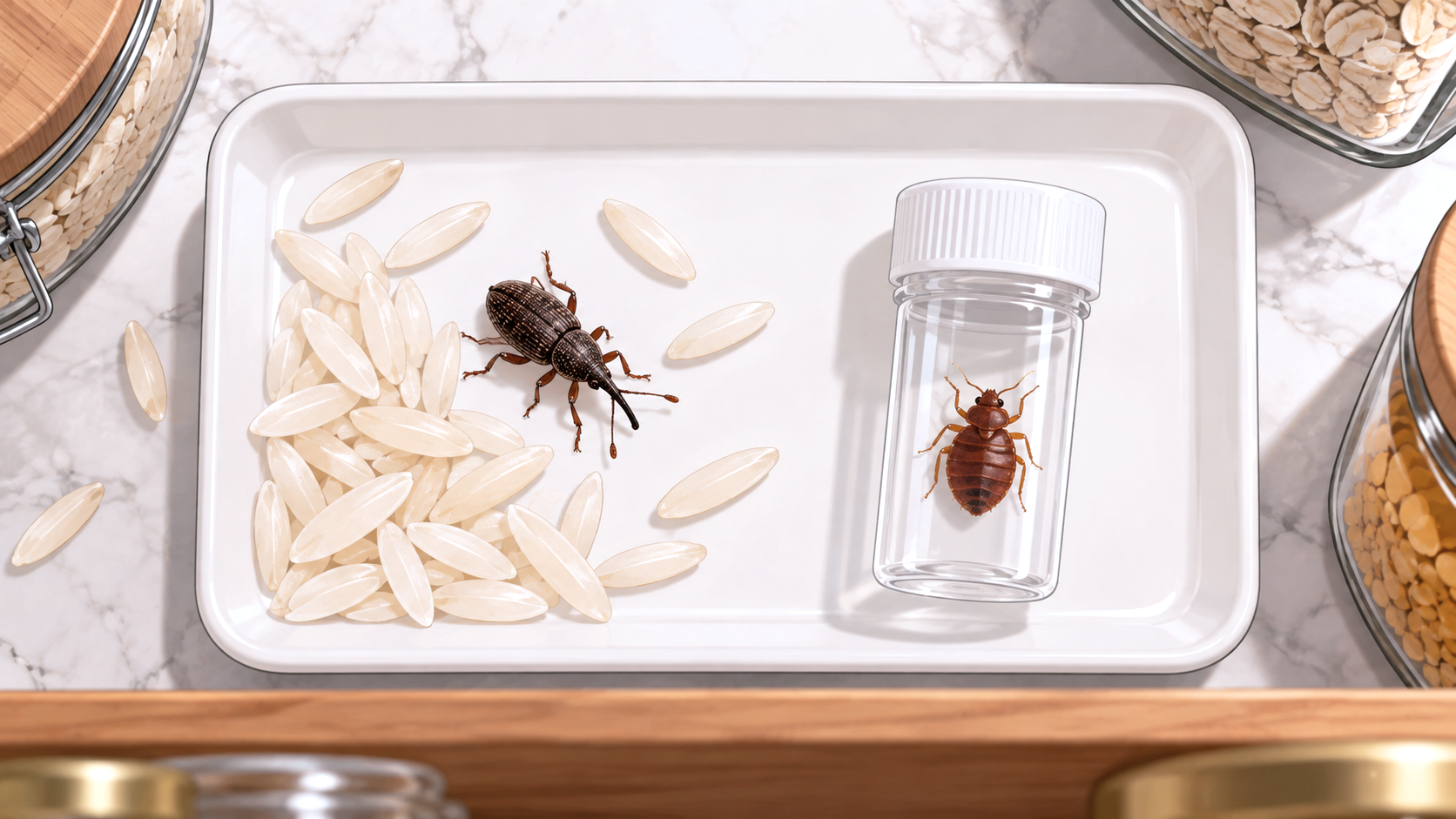
Weevils and bed bugs can both appear as tiny brown insects indoors, particularly when viewed quickly, but their anatomy and source are very different. Most household grain weevils are small hard-bodied beetles with a projecting snout, while bed bugs have no snout and have a broad, flattened oval body. Finding the insect in rice, grain, birdseed, or another dry food strongly favors a weevil; repeated insects around a mattress or upholstered sleeping area point toward bed bugs.
| Feature | Weevil | Bed Bug |
|---|---|---|
| Insect type | Beetle | True bug |
| Body | Hard, cylindrical to oval | Broad, flat, oval |
| Head | Usually has an obvious snout | Short head, no snout |
| Adult wings | Present in some common grain weevils | Functionally wingless |
| Typical food | Grains, seeds, dried plant products | Blood |
| Common indoor source | Pantry, grain, seed, pet food | Beds, couches, nearby crevices |
| Bites people | No | Yes |
| Typical evidence | Damaged kernels, round exit holes, beetles in food | Fecal spots, shed skins, eggs, live bugs near resting areas |
The Snout Is the Fastest Way to Recognize a Grain Weevil
Rice, maize, and granary weevils belong to Sitophilus, a group of beetles with a narrow projection extending from the front of the head. The University of Minnesota describes these common pantry weevils as slender, dark-brown insects with a conspicuous forward-projecting snout, generally measuring less than 3/16 inch long. Rice and maize weevils may also have four lighter reddish or yellowish marks on their hardened wing covers. USDA identifies the rice weevil as a small snout beetle averaging roughly 3/32 inch long, which puts it within a size range that can initially cause confusion with small bed bugs.
A bed bug has no elongated snout and no beetle-like wing covers. EPA describes adults as approximately 5–7 mm long with a flat, oval body and reddish-brown coloration. Their abdomen is visibly segmented but does not have the rigid central seam formed by a beetle’s paired wing covers. The characteristic shape of a bed bug is broad relative to its length, whereas a typical grain weevil looks narrower and more cylindrical.
Size alone is not enough. Some weevils are smaller than adult bed bugs, while young bed bugs can be considerably smaller than either. A visible snout and hard beetle shell provide much stronger evidence.
A Weevil in the Bedroom May Still Have Come From the Pantry
The room where an insect is found does not always reveal where it developed. Stored-product beetles can leave infested food and crawl or fly into other parts of a house. Minnesota Extension notes that pantry pests are often discovered on countertops, in cupboards, around dishes, and at windows after leaving the food they developed in. A weevil appearing on a bedroom wall or windowsill can therefore have originated in a bag of rice, grain, corn, seeds, dry pet food, or birdseed elsewhere.
Common Sitophilus weevils develop inside whole kernels. Females bore into grain, deposit an egg inside, and seal the opening. The larva remains concealed while feeding within the kernel before the adult eventually emerges through a round hole. Kentucky entomologists describe grain weevils as internal feeders of whole stored kernels, while Colorado State lists rice, maize, and granary weevils among important stored-grain pests.
Bed bugs are tied to hosts instead of stored food. CDC describes infestations as concentrated around places where people sleep or remain at rest, including mattresses, box springs, bed frames, headboards, upholstered furniture, and nearby cracks. Their diet consists of blood, so dry food does not provide a food source for bed bugs.
Wing Covers Make Adult Weevils Look More Like Beetles
Adult weevils have the structural features of beetles. The front pair of wings forms hardened covers called elytra over the abdomen. Rice and maize weevils have functional flight wings underneath and can fly, while granary weevils cannot fly despite retaining the hard outer wing covers. USDA research includes the rice weevil among the common stored-grain beetles identified by body and head shape.
Bed bugs have no functional wings at any life stage. Their reduced wing pads do not cover the abdomen and cannot support flight. A small brown beetle that opens hardened wing covers and flies is therefore not a bed bug. Bed bugs move by crawling and by being transported in belongings; they neither fly nor jump.
Movement without visible flight is less decisive. Both can crawl across walls, floors, and furniture, so identification should come from anatomy and surrounding evidence rather than how quickly the insect moves.
The Evidence Around the Insect Usually Identifies the Infestation
A weevil infestation leaves evidence in food. Whole kernels may contain hidden larvae, while older infestations often produce adults inside packages and small round emergence holes in rice, corn, wheat, or other grains. Pantry pests may spread among susceptible stored products, and sealed glass, metal, or heavy plastic containers are recommended after infested products are removed.
Bed bug evidence is concentrated around harborages rather than food packages. EPA recommends looking for live insects, tiny pale eggs, shed skins, dark fecal spots, and rusty stains around mattresses and furniture. Those early physical signs of bed bugs are much more persuasive than an unexplained skin reaction or a single unidentified brown insect.
A cupboard containing beetles and perforated grain kernels does not indicate bed bugs, even if one beetle later appears in a bedroom. Conversely, repeated flattened insects accompanied by fecal spotting and shed skins around a bed cannot be explained by pantry weevils.
Do Not Use Bed Bug Treatment on a Weevil Problem
The two pests require completely different control strategies. Household grain-weevil control begins by finding the infested food, discarding contaminated products, vacuuming spilled grains and cupboard crevices, and storing susceptible foods in insect-resistant containers. Minnesota Extension advises against routine insecticide treatment inside food cupboards because sprays do not reach insects developing within packaged food and cannot replace removal of the source.
A confirmed bed bug infestation requires treatment of harborages associated with sleeping and resting areas. Applying a bed bug spray to pantry shelves does not solve a grain infestation, while throwing away rice or cereal will have no effect on bed bugs living around a bed frame. Correct identification should therefore come before any bed bug control program.
When the specimen is difficult to identify, preserve it intact in a small sealed container or on clear tape and inspect it under magnification. A visible snout, hardened wing covers, and association with stored grain strongly support a weevil. A broad flattened body accompanied by other evidence that confirms bed bugs supports a bed bug infestation instead. Many small household insects can be mistaken for bed bugs, so treating solely from a blurry photograph can lead to unnecessary pesticide use.