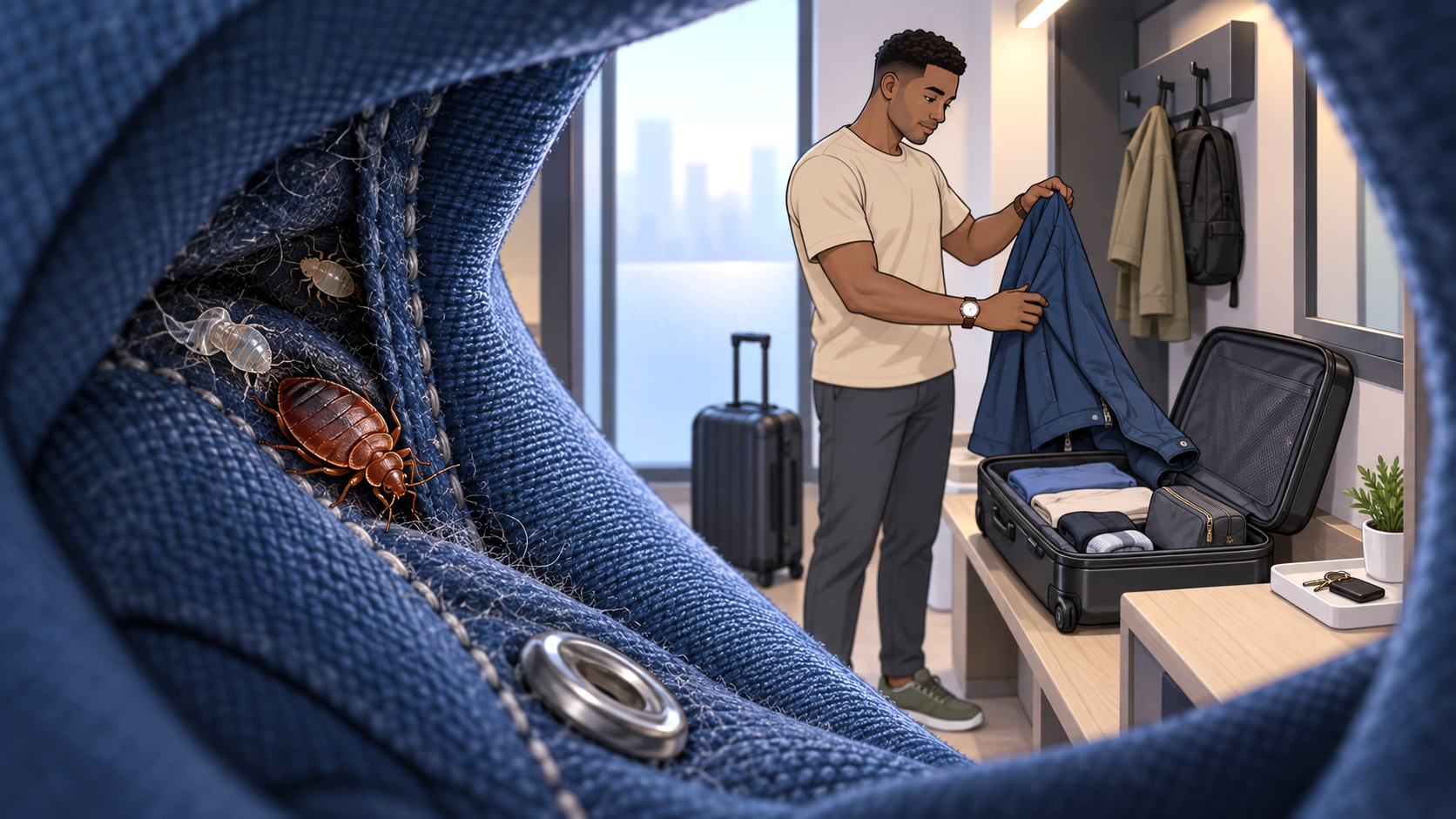
A jacket draped across an infested hotel bed and the shirt you are currently wearing are both clothing, but they present very different situations to a bed bug. One is an undisturbed object with seams and folds. The other is attached to a moving person. That difference explains much of the confusion about whether bed bugs can live on clothes and follow you somewhere else.
Bed bugs can hide in clothing and travel with it, but they do not normally live on your body or remain on the clothes you are actively wearing. They are more likely to hitchhike in folded clothes, luggage, bags, or other belongings, then leave those items after reaching a new location.
So the answer is not simply “bed bugs live on clothes.” Clothing is better understood as potential transportation. That is one reason bed bugs have become such successful hitchhikers.
The Shirt on Your Back Is Usually a Poor Hiding Place
Bed bugs feed on people, but they are not adapted to remain attached to us afterward. Unlike lice, they do not normally spend their lives living on the human body. After feeding, bed bugs generally return to protected hiding places around sleeping and resting areas. The University of Minnesota specifically notes that bed bugs may hitch a ride on clothing but do not travel directly on people in the way lice do. Bed bugs may hitchhike on clothing without living on the person
Think about what happens to clothes while you wear them. Fabric bends, stretches, rubs against other surfaces, and moves constantly as you walk or sit. A bed bug that wants a protected crevice can find much quieter options in mattress seams, bed frames, furniture, luggage, or clothing that has been left undisturbed. The fact that bed bugs can hide in extremely small spaces helps explain why those sheltered locations work so well.
None of this makes a bed bug on worn clothing impossible. A stray bug can crawl onto a person or garment, especially when someone is leaving an infested environment. The more precise point is that your body and the clothes moving around on it are not where bed bugs normally establish themselves. If you are worried that they are remaining directly on you, our guide to whether you can get bed bugs in your hair covers another version of the same concern.
Take the Clothes Off, and Their Role Changes
A pair of trousers folded inside an open suitcase no longer has the constant movement of clothing being worn. Neither does a sweater lying on a bed, a coat hanging beside an infested chair, or yesterday’s clothes sitting in a pile beside the mattress. Seams, pockets, cuffs, folds, and layers can give a wandering bed bug somewhere to remain concealed.
Public-health guidance recognizes this transportation route directly. Bed bugs can get into folded clothes along with luggage, bedding, furniture, and other belongings, allowing people to move them without realizing it. The CDC also notes that frequent travel and shared sleeping spaces increase opportunities for exposure. Bed bugs can hide in folded clothing and other belongings
This makes the location of your clothing more useful than simply asking whether bed bugs “like clothes.” A clean shirt sealed inside a bag has a different exposure history from a shirt left on an infested mattress overnight. Clothing that has spent time close to known bed bug activity deserves more attention because it has actually had an opportunity to pick up a hitchhiker.
That same principle applies beyond clothing. Bed bugs can use many movable possessions to reach another place, which is why our broader article on where bed bugs actually come from focuses heavily on transportation rather than dirt or poor housekeeping.
A Bed Bug Does Not Need to Stay in Your Clothes for Long to Travel With You
Suppose someone spends a night in an infested room. A bed bug crawls into the fold of a garment inside an open suitcase. The next morning, that suitcase goes into a car, through an airport, and eventually into another bedroom. The insect has crossed a distance it could never realistically cover by walking from one property to the other.
That is the practical meaning of bed bugs traveling with people. The person provides the transportation indirectly by moving the object in which the insect is hiding. The CDC recognizes luggage and clothing as ways bed bugs can be transported, while EPA guidance describes them as excellent hitchhikers capable of moving to new homes on clothing and other belongings. Travelers can transport bed bugs in luggage and clothing
Once the journey ends, the bed bug does not have to remain in the garment. It can crawl away and eventually find a protected hiding place near where people rest. That is how a temporary ride can contribute to an entirely new infestation.
Travel is therefore one of the situations where clothing deserves particular attention. Our guide to bed bugs in luggage goes deeper into the suitcase itself, because treating every garment while ignoring the bag that carried them would leave a major part of the travel problem unexamined.
The Closet Is Not Automatically the Center of an Infestation
Once people learn that bed bugs can hide in clothes, it is easy to picture an entire closet full of infested garments. That can exaggerate the role clothing usually plays. Bed bug infestations are normally concentrated around or near places where people sleep, with hiding sites commonly found in mattresses, box springs, frames, headboards, furniture, and nearby cracks.
Clothing becomes more relevant when it is stored close to those areas or when an infestation has become more widespread. A pile on the bedroom floor, clothes under a bed, or garments stored in furniture near the sleeping area offer different opportunities from clothing kept well away from known activity. EPA guidance also recommends reducing clutter because fewer hiding places make bed bugs easier to find and manage.
This is why discovering a bed bug on a shirt should lead to a wider search rather than a wardrobe-only investigation. Check the places where bed bugs are more likely to be established. Our guide to checking for bed bugs walks through that broader inspection, while the presence of bed bugs on a mattress can provide much stronger evidence about where an infestation is centered.
Your Laundry Bag Has a Journey of Its Own
Laundry introduces a transportation problem in both directions. Dirty clothing from an infested room can carry a bed bug toward a shared laundry area, while clean clothes can potentially be exposed if they are placed around contaminated belongings or surfaces. EPA guidance therefore recommends transporting laundry carefully rather than carrying loose potentially infested clothing through different areas.
For someone dealing with a known infestation, sealed bags can keep potentially infested clothing contained on the way to treatment. EPA guidance also recommends using a new bag for the trip home from a shared laundry facility when an active infestation is involved, rather than returning treated clothing to the same potentially contaminated container. EPA guidance for handling laundry when bed bugs are a concern
This is particularly relevant in apartment buildings and other settings where laundry machines are shared. A laundromat or laundry room does not need to support a bedroom-style infestation to become part of the transportation chain. The EPA notes that bed bugs can hitchhike between homes through laundromats and recommends keeping clean clothing protected.
Our article about bed bugs at the laundromat looks specifically at that environment. The goal is not to become afraid of shared laundry facilities. It is to avoid giving a hidden insect an easy ride from one set of belongings to another.
Washing and Drying Do Not Do the Same Job
Putting exposed clothing in the laundry is sensible, but the washer and dryer should not be treated as interchangeable bed bug treatments. EPA travel guidance states that high-temperature dryer exposure kills bed bugs and specifically cautions that washing alone generally does not. For items that can tolerate the treatment, the dryer is therefore an important part of the process. EPA travel guidance recommends high-temperature drying after possible exposure
For a confirmed infestation, EPA guidance recommends heat-treating clothing, bedding, and other dryer-safe items on high heat for 30 minutes, then storing cleaned items in sealed plastic bags so they remain free of bed bugs. Fabric care still matters, so the item must be able to tolerate the temperature being used.
The containment before and after treatment matters almost as much as getting the clothes into the machine. Carrying loose suspect laundry through the home can create opportunities for bugs to escape, while placing treated clothes back into a contaminated hamper can undo the separation you just created. If you are working through an established infestation rather than a single travel concern, our broader guide to getting rid of bed bugs puts laundry into the larger control plan.
Coming Home From a Trip Is the Moment to Break the Ride
Bed bug prevention after travel works best before luggage and clothing are distributed around the bedroom. EPA recommends inspecting luggage after returning home, unpacking directly into a washing machine, using high-temperature drying, and storing suitcases away from the bedroom rather than beneath the bed. EPA’s bed bug precautions for returning travelers
If you already saw bed bugs or convincing evidence at your accommodation, be more deliberate with your belongings. Keep suspect items contained until they can be inspected or treated rather than opening the suitcase on the bed and sorting everything there. The EPA specifically recommends sealing items in plastic bags when exposure is a concern and unpacking clothing directly into the washer or dryer.
A trip does not automatically mean you brought bed bugs home, even if the hotel later turns out to have had them. Exposure creates an opportunity, not a certainty. Checking your belongings and watching for physical evidence at home is more useful than assuming every itch after travel means an infestation. If you are unsure what evidence would actually count, our guide to the early signs of bed bugs provides a better starting point than bite marks alone.
If You Find a Bed Bug on Your Clothes, Do Not Spray the Clothes You Are Wearing
Finding a confirmed bed bug on a garment can trigger an understandable urge to spray whatever is nearby. Pesticides should not be applied to clothing unless the product label specifically permits that use. EPA also warns against applying bed bug pesticides or repellents to the human body. EPA safety guidance for bed bug pesticides
Instead, contain the suspect clothing and deal with it using a method appropriate for the material. If the item can safely tolerate a hot dryer, heat treatment is one established option. Other belongings may need different handling, and a larger infestation requires attention to the room rather than repeatedly treating whatever clothes happen to be worn that day.
Most importantly, a bug found on clothing should not be interpreted as proof that bed bugs are living all over your body. Confirm the insect if possible, contain the garment, and investigate the environment from which it came. That sequence deals with both sides of the problem without turning the person wearing the clothes into the supposed infestation site.
Questions About Bed Bugs Traveling on Clothes
Can you bring bed bugs to someone’s house on your clothes?
Yes, it is possible for a bed bug to hitchhike on clothing and be transported to another location. That does not mean a person coming from an infested home will always carry one. Bed bugs do not normally live directly on people, so the risk is better understood as accidental transportation on clothing, bags, or other belongings.
Should you change clothes after being somewhere with bed bugs?
If you know or strongly suspect that your clothing was exposed to an active infestation, containing the garments and treating them appropriately can reduce the chance of transporting a hitchhiker farther. Avoid dropping suspect clothing onto beds, couches, or carpeting while sorting it. Clothing that can tolerate appropriate dryer heat can be handled using established laundry guidance.
Can bed bugs stay in clothes hanging in a closet?
A bed bug can potentially hide in clothing, particularly if the garments have been exposed to an infestation. However, closets are not automatically where bed bugs establish themselves simply because they contain fabric. Their typical hiding areas remain closely associated with places where people regularly sleep or rest.
Do you need to throw away clothes after getting bed bugs?
No. Clothing generally does not need to be discarded simply because a home has bed bugs. Washable and dryer-safe items can be handled using appropriate laundering and heat procedures, while cleaned belongings can be kept sealed during the treatment process to prevent reinfestation.
Can bed bugs travel on shoes as well as clothes?
Shoes are another movable belonging, so they can potentially transport a hiding bed bug if they have been exposed to an infested environment. Their materials and construction also mean they cannot all be treated exactly like washable clothing. Our separate guide to whether bed bugs can live in shoes covers that situation without assuming every pair from an infested room contains bugs.
2 thoughts on “Can Bed Bugs Live on Your Clothes and Travel With You?”