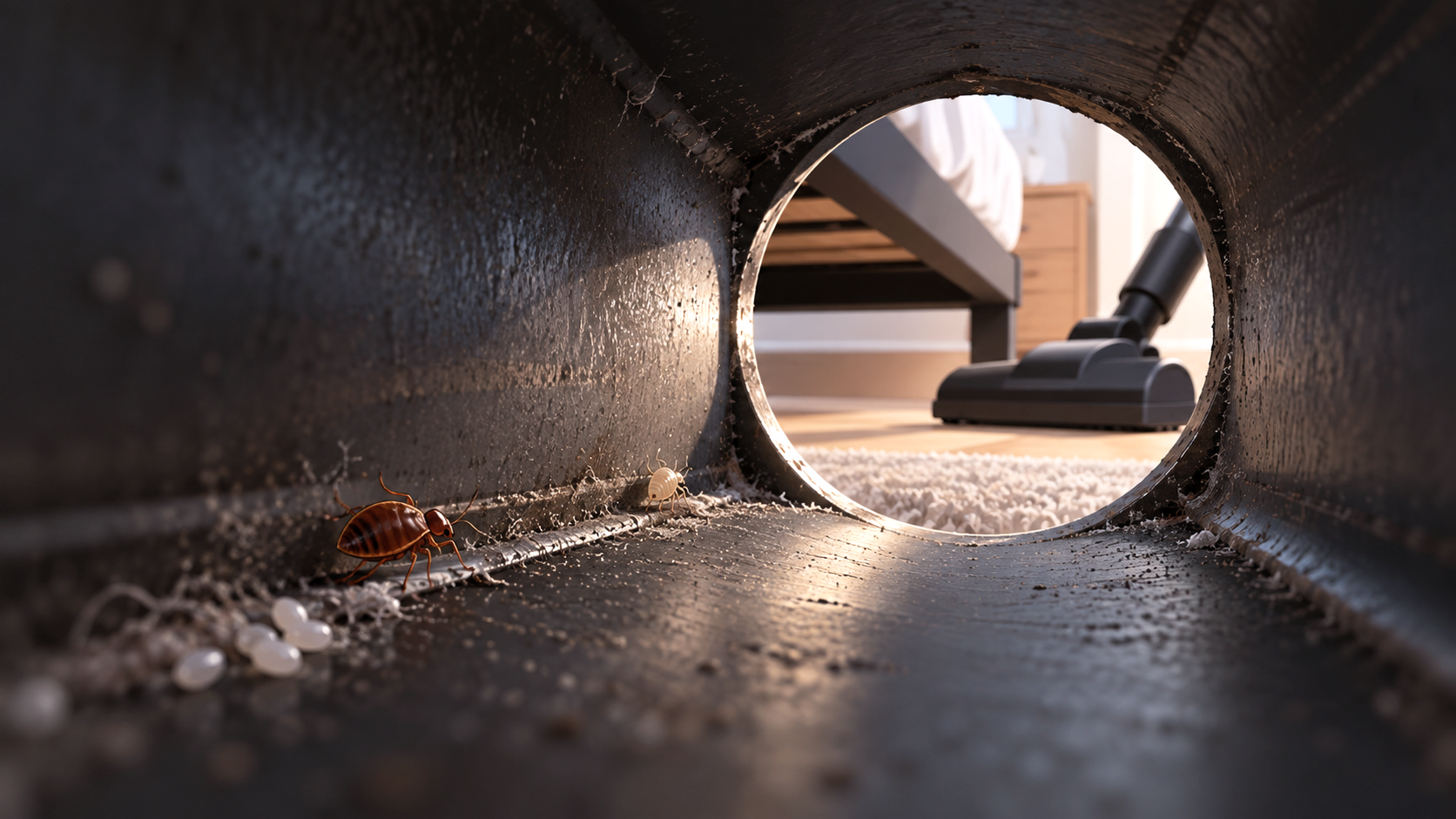
Bed bugs became uncommon in many developed countries during the middle of the 20th century, helped substantially by widespread insecticide use and improvements in pest control. Their return decades later exposed a problem that is much harder to solve: modern bed bug populations can combine insecticide resistance with excellent hiding ability, long survival without feeding, rapid reproduction, and life stages that don’t always respond equally to the same treatment.
Bed bugs are hard to get rid of because no single weakness reliably exposes the entire infestation. They hide in tiny inaccessible spaces, some populations are highly resistant to commonly used insecticides, eggs may survive treatments that affect mobile stages, and surviving bugs can remain without feeding for extended periods. Successful control therefore usually requires several methods used together and careful follow-up.
Resistance is an important part of that explanation, but it isn’t the whole story.
Bed Bugs Can Resist Insecticides in Several Different Ways
Insecticide resistance doesn’t simply mean a bed bug has become “used to” a pesticide. It involves inherited biological traits that allow some populations to survive exposures that would kill susceptible bed bugs.
A major review of insecticide resistance in bed bugs describes several mechanisms that have been documented in Cimex lectularius. One is target-site resistance. Mutations can alter the biological target on which an insecticide normally acts, reducing the chemical’s ability to disrupt the insect’s nervous system. Knockdown-resistance mutations affecting voltage-gated sodium channels are particularly important in resistance to pyrethroids.
Bed bugs can also use metabolic resistance. Elevated activity or expression of detoxification systems, including cytochrome P450 monooxygenases and other enzymes, can help metabolize insecticides before enough of the active ingredient reaches its target.
A third mechanism involves the insect’s cuticle. Research comparing resistant and susceptible strains has found evidence that cuticular changes can slow insecticide penetration, giving internal detoxification mechanisms additional time to act.
These defenses don’t have to occur separately. Resistant populations can possess multiple mechanisms at once, which helps explain why resistance can become exceptionally strong.
Our separate examination of why bed bugs are becoming resistant to pesticides covers that evolutionary problem in more detail.
Resistance Doesn’t Mean Every Pesticide Has Stopped Working
The extent of resistance varies between bed bug populations and insecticide classes. Finding strong pyrethroid resistance in one population doesn’t prove that every registered pesticide will fail against that population, much less that the same resistance level exists everywhere.
The EPA currently recognizes several pesticide classes registered for bed bug control, including pyrethrins, pyrethroids, desiccants, biochemicals, pyrroles, neonicotinoids, and insect growth regulators. Some products combine active ingredients from different classes.
Resistance does mean that repeatedly applying an insecticide to which a population has low susceptibility can produce disappointing results even when the product is otherwise capable of killing bed bugs.
It also helps explain why changing brand names isn’t necessarily enough. Two differently branded products may rely on the same insecticide class or mode of action. Product selection should therefore be based on the actual active ingredients, label directions, infestation conditions, and resistance considerations rather than the assumption that a different package means an entirely different treatment.
Eggs Can Survive Some Treatments That Kill Mobile Bed Bugs
An infestation also contains more than adults. Eggs, five nymphal stages, and adults can be present at the same time, and a treatment isn’t successful simply because the visible bugs disappear.
Eggs can be more difficult to eliminate with some insecticides. A study comparing several commonly used bed bug insecticides found substantial differences in their ability to prevent eggs from hatching. Some treatments produced high egg mortality, while others performed poorly against eggs despite having activity against mobile bed bugs.
That makes it inaccurate to say bed bug eggs simply survive pesticides as a rule. Their susceptibility depends on the active ingredient, formulation, exposure, resistance status, and treatment conditions.
The practical difficulty is that surviving eggs can hatch after an application. If the treatment doesn’t provide effective residual control against emerging nymphs, or if those nymphs avoid treated areas, the infestation can continue even after many adults and nymphs were initially killed.
This is one reason follow-up inspection matters. Whether another pesticide application is required, and when it can legally be made, depends on the product label and the treatment strategy rather than a universal schedule based solely on egg hatch.
Their Hiding Places Protect Them From Treatment
Even a pesticide capable of killing a susceptible bed bug can’t work properly if the insect never receives an effective exposure.
Bed bugs can occupy mattress seams, box springs, bed-frame joints, screw holes, headboards, upholstered furniture, baseboards, wall cracks, and other narrow harborages. As infestations expand, bugs may also be found farther from the bed.
Their flattened bodies allow them to enter very small spaces, creating a straightforward treatment problem: reaching the exposed surface of a bed or piece of furniture isn’t the same as reaching every bug concealed inside its construction.
This is especially important with products that depend heavily on direct contact. A spray may kill an exposed insect while doing little to a bed bug several centimeters deeper inside a protected crevice.
It also explains why seeing dead bugs immediately after treatment doesn’t establish that the infestation has been eliminated. The survivors are the ones that matter.
Bed Bugs Can Survive a Long Time Without Feeding
Waiting for bed bugs to starve is rarely a practical household control strategy.
How long they survive without a blood meal varies with life stage, temperature, humidity, prior feeding, and the population being studied. Under favorable conditions, older nymphs and adults can survive for months without feeding, and unusually long survival has been recorded under cooler conditions.
Our detailed look at how long bed bugs can live without feeding explains why there isn’t one universal starvation figure.
For control, the consequence is more important than the record. Temporarily leaving a bedroom or even vacating a property doesn’t guarantee the infestation will starve before people return. Surviving bugs can remain hidden for extended periods and resume host-seeking when a suitable host becomes available again.
Moving to another room can create another problem. Bed bugs can move in search of a host, so abandoning the infested bed isn’t a dependable way to contain them.
Their Life Cycle Gives Survivors a Chance to Rebuild the Infestation
Missing only a few bed bugs can matter because an infestation isn’t static.
A fed adult female can continue producing eggs, while nymphs that survive treatment can mature after additional blood meals. Eggs that escape a treatment can introduce another wave of nymphs after the adults you were seeing have disappeared.
This creates one of the most frustrating patterns in bed bug control: an apparent improvement followed by renewed activity. That doesn’t necessarily mean the insects mysteriously returned from outside the home. Surviving bugs or eggs from the original infestation can account for renewed sightings.
The overlapping bed bug life cycle is therefore part of the control problem. A successful treatment has to account for the population that is visible today and the life stages capable of maintaining it afterward.
The Bed Bug Resurgence Has More Than One Explanation
Insecticide resistance is strongly implicated in the modern resurgence of bed bugs, but it shouldn’t be presented as the sole reason they returned.
A historical review of the resurgence describes several factors that likely contributed, including resistance to insecticides, increased international travel and movement, changes in pest-management practices, and difficulties associated with detecting and controlling small infestations.
DDT is part of that history. Bed bugs had already developed resistance to DDT in some locations while the insecticide was still being widely used. Later resistance to pyrethroids and other insecticides added another challenge.
For that reason, reducing the resurgence to the banning of DDT misses much of what happened. DDT’s withdrawal changed pest-control options, but resistance, human movement, changing control practices, and bed bug biology all contributed to the conditions under which populations re-established themselves.
Why Combining Control Methods Makes More Sense
All of these traits point toward the same control principle: don’t make the entire outcome depend on one product finding and killing every bed bug.
The EPA recommends an integrated pest management approach to bed bugs, combining appropriate chemical and nonchemical measures rather than relying exclusively on pesticides. Depending on the infestation, that can include inspection, reducing clutter, vacuuming, interceptors, encasements, laundering and dryer heat, steam, heat treatment, sealing appropriate cracks, and carefully selected pesticides used according to their labels.
Different methods attack different weaknesses. Heat, for example, doesn’t depend on the same nerve targets involved in pyrethroid resistance. Properly conducted bed bug heat treatment can kill resistant and susceptible insects alike when lethal temperatures reach the bugs and eggs for sufficient time. Heat still has its own limitations, particularly achieving and maintaining lethal temperatures throughout every potential harborage.
The goal isn’t to find a magical method bed bugs cannot resist. It’s to make it increasingly difficult for any part of the population to escape every part of the treatment.
Our complete guide to getting rid of bed bugs covers how those methods fit together.
Questions About Why Bed Bugs Are So Persistent
Does pesticide resistance mean bed bug sprays no longer work?
No. Resistance varies between populations and active ingredients. Some registered products remain effective, while particular populations may show substantially reduced susceptibility to others. The pesticide label, active ingredients, resistance considerations, and treatment method all matter.
Are bed bugs resistant everywhere?
Resistance is widespread, particularly to pyrethroids, but its level and underlying mechanisms vary among populations. Results from one city or laboratory strain shouldn’t automatically be applied to every infestation.
Did banning DDT cause bed bugs to come back?
The modern resurgence has multiple likely causes. Changes in insecticide use were part of the history, but researchers also point to insecticide resistance, increased travel and movement, changes in pest-management practices, and the difficulty of detecting and controlling small infestations. Bed bug resistance to DDT had already been documented decades before the modern resurgence.
Can bed bugs become resistant to heat?
Documented insecticide resistance doesn’t make bed bugs immune to sufficiently lethal temperatures. Heat works through broad physiological damage rather than the specific insecticide targets altered by common resistance mechanisms. The challenge with heat treatment is delivering a lethal temperature for sufficient time to every place where bugs and eggs are hiding.
Will leaving a home empty starve bed bugs?
Not reliably. Bed bugs can survive without feeding for extended periods, with survival strongly affected by temperature, life stage, and other conditions. Vacating a property for a short period shouldn’t be treated as a dependable eradication method.
10 thoughts on “Why Are Bed Bugs So Hard to Get Rid Of?”