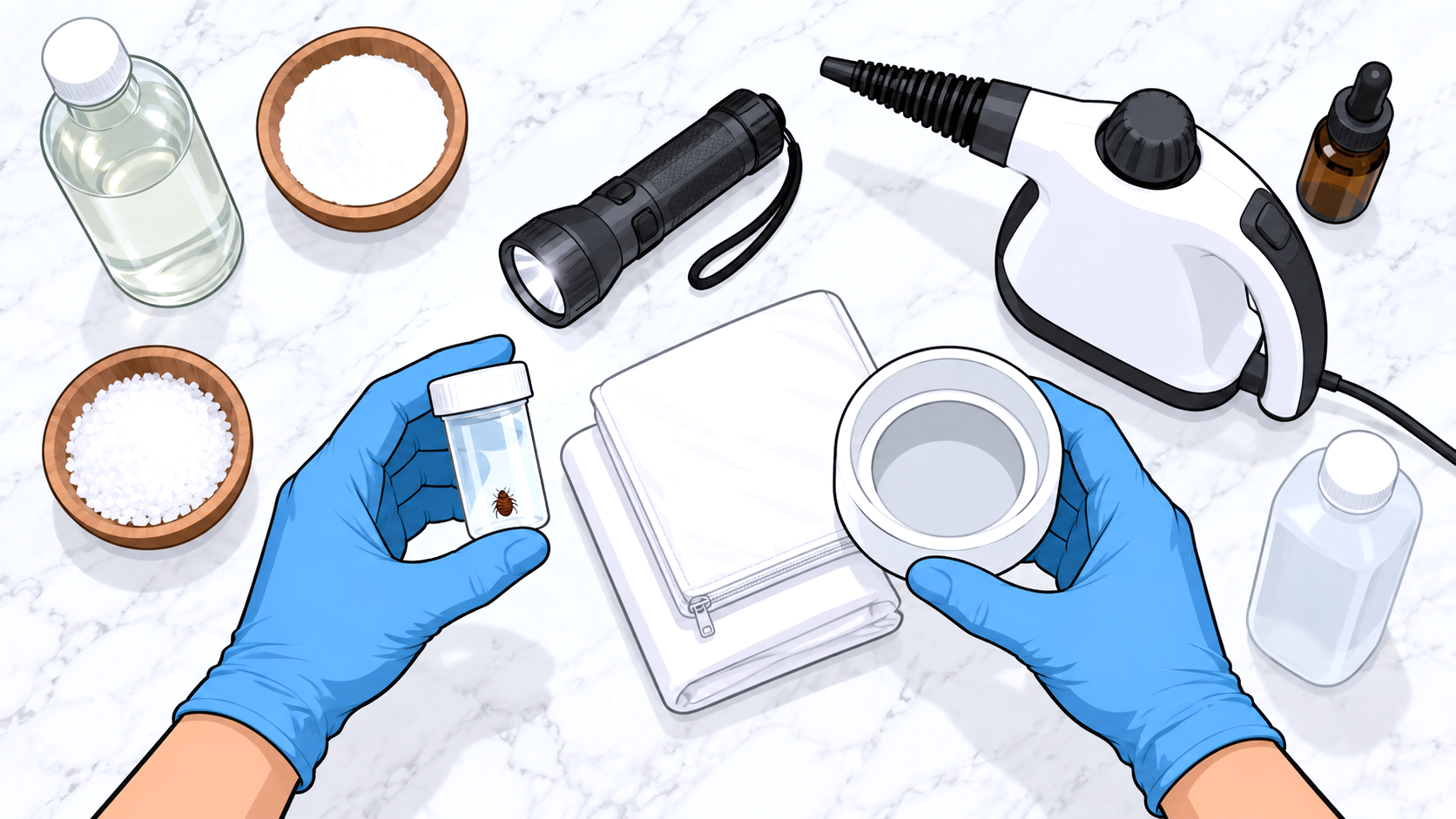
A kitchen cupboard contains plenty of substances that can injure an insect on direct contact. That does not make them useful bed bug treatments. Home remedies for bed bugs range from methods with legitimate evidence behind them to substances that have failed controlled testing and DIY treatments that introduce unnecessary fire or chemical hazards. The useful dividing line is not whether something is “natural.” It is whether the method has been tested against bed bugs, can reach enough of the infestation to matter, and can be used safely.
Some home remedies can help control bed bugs, but many popular ones are poorly supported or ineffective. EPA-registered desiccants and properly applied heat have legitimate roles in bed bug control, while rubbing alcohol creates a fire hazard and baking soda has performed poorly in controlled testing. No single home remedy should be expected to eliminate an established infestation by itself.
Baking Soda Has Been Tested, and the Results Aren’t Good
Baking soda has a plausible-sounding reputation as a desiccant that supposedly dries bed bugs out. Controlled testing gives us a much better reason not to rely on it.
In a comparison of insecticidal dusts, sodium bicarbonate produced little to no bed bug mortality under the tested conditions. That puts baking soda for bed bugs in a different category from a remedy that simply lacks good evidence. It has actually been placed against bed bugs in controlled research and performed poorly.
Sprinkling it around a bed therefore adds mess without giving you a dependable control method.
Boric Acid Works if a Bed Bug Ingests It, Not as a Useful Contact Dust
Boric acid is an excellent example of why a substance that kills one household pest may fail against another.
Researchers comparing bed bugs with German cockroaches found that bed bugs survived contact with high concentrations of boric acid dust. German cockroaches were susceptible through contact because their grooming behavior leads to ingestion.
Bed bugs were highly susceptible when boric acid was mixed directly into a blood meal. The difficulty is getting the substance inside a bed bug through feeding. Sprinkling boric acid or using borax against bed bugs does not reproduce that experimental route.
The laboratory finding is scientifically interesting, but it does not turn borax from the laundry aisle into a practical bed bug treatment.
Rubbing Alcohol Can Kill on Contact, but the Fire Risk Ends the Argument
Rubbing alcohol is one of the home remedies we would leave out of a bed bug treatment plan completely.
Alcohol can kill insects it directly contacts, but it evaporates rapidly and provides no dependable way to reach the bed bugs hidden throughout an infestation. More importantly, rubbing alcohol is flammable and has caused house fires when people used it against bed bugs.
That makes spraying rubbing alcohol for bed bugs a poor trade. A treatment that creates a meaningful fire hazard to kill exposed insects is not made sensible by being cheap or readily available.
Gasoline and kerosene belong even further outside the conversation. Flammable household liquids should never be used to treat bed bugs.
Bleach Creates a Different Chemical Hazard
Bleach is another household chemical that does not belong in improvised bed bug treatment.
The immediate problem is not just whether bleach can injure a bed bug on direct contact. Bed bugs spend much of their time concealed in cracks, furniture joints, mattress areas, baseboards, and other protected spaces. Wetting exposed surfaces with bleach does not solve that structural problem.
There is also a serious safety issue when household cleaners are combined. Bleach should never be mixed with ammonia because the reaction can release toxic chloramine gases. More broadly, household disinfectants should be used for the purposes and surfaces specified on their labels, not repurposed as improvised insecticides.
We would rather see someone spend that effort on a treatment method that can actually contribute to infestation control.
Cold-Pressed Neem Oil Is a Real Bed Bug Pesticide
Neem is the unusual member of the home-remedy conversation because a specific form of it crosses over into regulated pesticide territory.
Cold-pressed neem oil is the only biochemical pesticide EPA identifies as registered for bed bug control. Performance trials conducted at approved label rates showed control of adults, nymphs, and eggs.
The wording matters. This does not mean any bottle labeled “neem oil” is interchangeable with a registered bed bug pesticide. Cosmetic neem products, gardening products, homemade mixtures, and EPA-registered formulations should not be treated as the same thing.
If you choose a neem product for bed bugs, use one that is specifically registered and labeled for that use and follow its current label. The evidence applies to the formulated pesticide used at its approved rates, not to homemade neem recipes.
Diatomaceous Earth Works, but Use the Right Product
Diatomaceous earth is another case where the general idea is legitimate but the product choice matters.
Desiccant dusts damage the protective outer layer of bed bugs and cause them to lose moisture. Because this is a physical mode of action, desiccants remain useful against populations that may resist conventional insecticides.
Laboratory comparisons have also shown that desiccant performance can vary substantially. In one study, silica gel produced 100% mortality across three different exposure methods, while the tested diatomaceous earth formulations performed considerably worse after brief exposure.
The safety distinction is especially important. Do not assume that “food grade” automatically means a diatomaceous earth product should be scattered around a bedroom. EPA advises using only desiccant pesticide products that are registered and labeled for bed bug control, with applications restricted according to the label to reduce inhalation exposure.
So diatomaceous earth can have a legitimate place in bed bug control, but the product and application method matter as much as the ingredient name.
Essential Oils Have More Complicated Evidence Than the Internet Suggests
Essential oils cannot sensibly be grouped into one verdict because different compounds produce different effects.
Laboratory research has found that geraniol, eugenol, carvacrol, and citronellic acid can cause bed bugs to avoid treated areas. The same experiments revealed the limitation that matters most in a home: treated barriers did not prevent hungry bed bugs from reaching a warmed blood source and feeding.
Other research has found direct insecticidal activity from certain essential-oil constituents. Carvacrol and thymol were among the more active compounds in topical and fumigant testing against bed bugs, but conventional insecticides used as comparisons were dramatically more potent.
That is a long way from showing that dripping household essential oil around a bed will eliminate an infestation. The difference between an isolated active compound under controlled experimental conditions and a DIY bottle of essential oil is substantial.
Our deeper look at essential oils that repel bed bugs reaches the same practical problem: detecting biological activity is not the same as demonstrating reliable infestation control.
Heat Is One of the Most Useful Nonchemical Options
Heat has something most kitchen remedies lack: established lethal conditions for bed bugs and their eggs.
A clothes dryer on high heat can be used for suitable clothing and bedding, while larger items can be treated with appropriate heat equipment. For infested objects and areas that cannot go in a dryer, EPA describes heating them to at least 120°F for 90 minutes as a way to ensure eggs are killed.
That does not make improvised whole-room heating safe. Space heaters, fireplaces, and other DIY attempts to raise an entire home’s temperature can create a fire hazard without heating every bed bug harborage sufficiently.
Heat works when the required temperature reaches the insects for the necessary time. Simply making a room or object feel hot is not enough.
The Biggest Weakness of Most Home Remedies Is Reach
Suppose a household liquid killed every bed bug you sprayed directly. You would still have a serious problem if most of the infestation never encountered it.
Bed bugs hide in mattress seams, bed frames, furniture joints, baseboards, cracks, and other narrow spaces. Eggs may be concealed in the same protected areas. A contact-only remedy reaches the insects you find, not automatically the insects you miss.
Residual treatments and properly applied desiccants address that problem differently because bed bugs can encounter the treatment after it has been placed. Heat can address it when lethal temperatures penetrate the entire treated item or space.
That distinction is more useful than asking whether vinegar, alcohol, an essential oil, or another household liquid can kill one exposed bed bug. A method needs to contribute to controlling the infestation, not merely demonstrate that an insect can die when directly soaked in something.
A Bed Bug Treatment Plan Needs More Than One Trick
Bed bugs are difficult enough to control that integrated pest management combines chemical and nonchemical methods rather than betting everything on a single substance.
That can include reducing clutter, laundering or heat-treating suitable belongings, vacuuming, monitoring, using encasements where appropriate, applying properly labeled desiccants or pesticides, and repeating inspections to catch remaining activity.
The exact combination depends on the infestation and the home. Our broader guide to getting rid of bed bugs covers that process rather than trying to make one home remedy carry the entire job.
For us, that is the useful standard for judging any DIY suggestion. A remedy should earn its place by adding something reliable to the treatment plan without creating a larger safety problem.
Questions About Home Remedies for Bed Bugs
Can vinegar kill bed bugs?
We would not use vinegar as a bed bug treatment. Household vinegar is not an EPA-registered bed bug pesticide, and spraying an infestation with it does not address the hidden insects and eggs that make bed bugs difficult to eliminate.
What about hydrogen peroxide or household disinfectants?
Household cleaners and disinfectants should be used for their labeled purposes rather than improvised as bed bug pesticides. Even if a liquid injures an exposed insect, that does not establish it as an effective treatment for an infestation.
Does “natural” mean a bed bug treatment is safer?
No. The source of a substance does not determine its safety. Natural dusts can create inhalation hazards, plant-derived compounds can be biologically active, and registered pesticides can have specific precautions that must be followed. Judge the actual product, evidence, exposure route, and label rather than the word “natural.”
Can home remedies make an infestation harder to deal with?
They can waste valuable treatment time, spread bugs if belongings are moved unnecessarily, damage household materials, or create hazards when flammable liquids and incompatible cleaners are involved. A poorly chosen remedy can therefore add problems without meaningfully reducing the infestation.
3 thoughts on “Do Home Remedies for Bed Bugs Actually Work? An Honest Look”