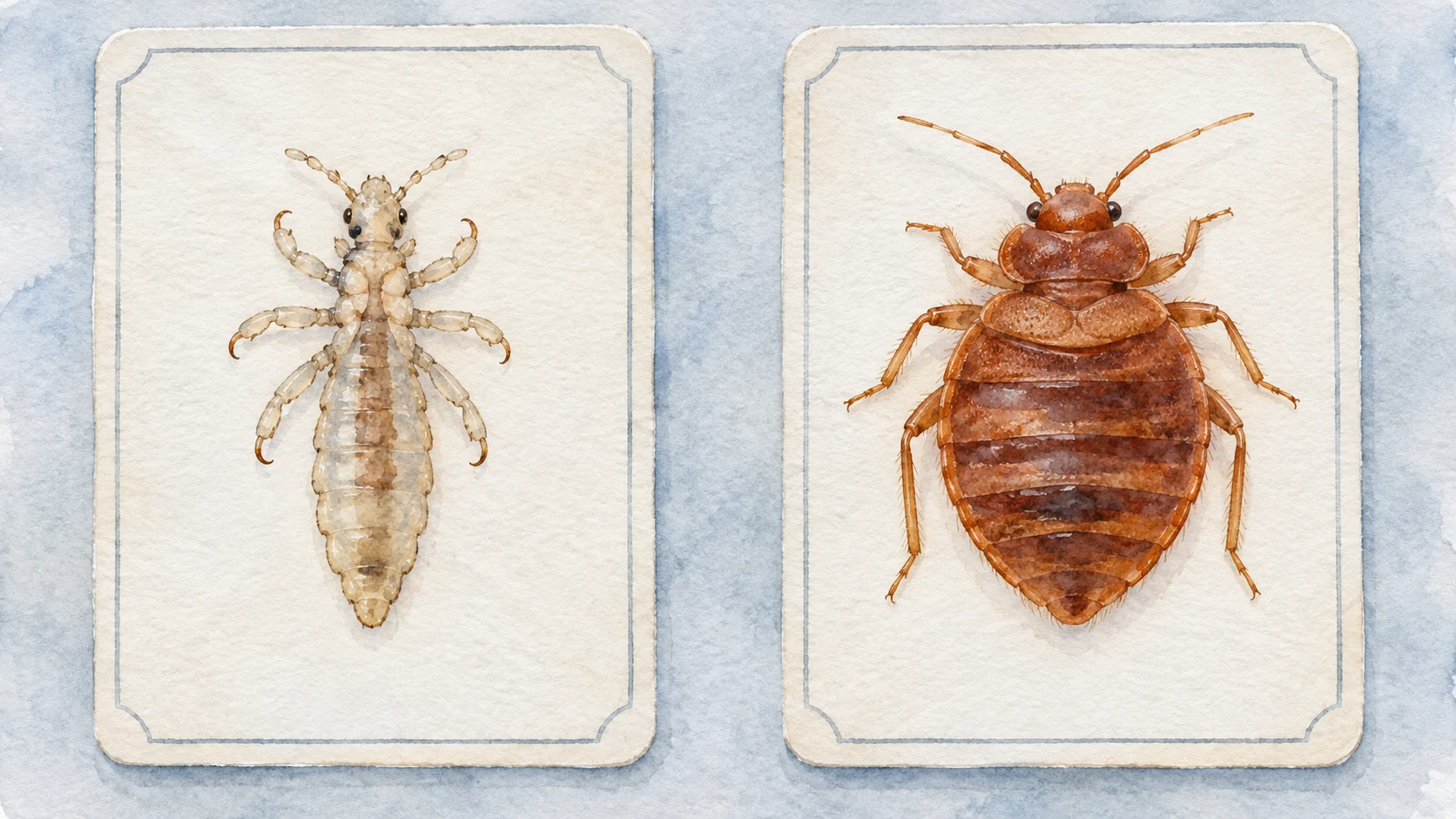
Head lice live in human scalp hair, while bed bugs hide in mattresses, bed frames, furniture, and other sheltered places near where people rest. Both insects feed on blood, but head lice remain on their human host between meals, whereas bed bugs usually leave their hiding places to feed and then retreat.
Their eggs, movement between people and places, and physical evidence are different as well. Head lice attach their eggs directly to hair shafts. Bed bugs deposit their eggs in protected locations around their hiding places. Finding a small insect in someone’s hair therefore suggests a different problem from finding insects, dark fecal spots, and shed skins around a mattress seam. The biology and living habits of head lice differ substantially from those of bed bugs, despite both being small, wingless, blood-feeding insects.
Where Head Lice and Bed Bugs Actually Live
Head lice are parasites that live directly on humans. They spend most of their lives among scalp hairs, gripping individual strands with their legs and staying close to the skin to obtain blood meals.
They may move around the scalp, but they do not normally establish populations in mattresses, furniture, carpets, or cracks in walls. Their survival depends on regular access to a human host.
Bed bugs have a different relationship with people. They are temporary visitors to the skin rather than permanent residents. Between blood meals, they typically shelter in narrow cracks and crevices near sleeping or resting areas.
Common hiding places include mattress seams, box springs, bed frames, headboards, furniture joints, and gaps around nearby furnishings. Bed bugs can also occupy more distant hiding places, particularly as an infestation grows.
The range of places where bed bugs hide reflects their ability to shelter away from the host. Their flattened bodies allow them to enter narrow spaces that would not serve as normal living environments for head lice.
A person who discovers a crawling insect among scalp hairs is therefore dealing with a different type of evidence from someone who finds insects emerging from a bed frame.
Why Head Lice Stay on Hair Instead of Hiding in Beds
Head lice have specialized claws that help them grip individual human hairs. Their body structure and feeding requirements suit life on the scalp, where blood meals are readily available.
An adult head louse generally dies within about two days after falling off a person if it cannot feed. Its limited ability to survive away from the scalp helps explain why household furniture is not its normal habitat.
The places where head lice remain on the scalp include areas behind the ears and near the nape of the neck, although lice can occupy other scalp regions.
Bed bugs are better adapted to living away from the host. They can remain hidden between meals and survive considerably longer without feeding, depending on their life stage and environmental conditions.
This difference is especially important when interpreting a suspected infestation. A head louse found on a pillow may have become detached accidentally. A bed bug found inside a mattress seam may be occupying one of its normal hiding places.
What Do Head Lice Look Like Compared With Bed Bugs?
Adult head lice are small, elongated insects, usually about 2 to 3 millimeters long. They have six legs equipped with gripping claws, a relatively narrow head, and an abdomen that may appear grayish, tan, or brown.
Adult bed bugs are generally larger and broader. They have flattened, oval bodies, short antennae, and a reddish-brown appearance. An unfed adult bed bug is often compared to an apple seed, although its precise size and appearance vary.
The physical appearance of bed bugs includes a broad, flattened abdomen that can become more elongated and swollen after feeding.
Head lice also change in appearance after feeding, but their overall body structure remains different. The narrow body and gripping legs of head lice are suited to moving through scalp hair rather than hiding in furniture crevices.
Size alone is not always enough to distinguish them. Young bed bugs, called nymphs, can be much smaller and paler than adults. A small bed bug nymph may overlap in size with a head louse.
The size and appearance of newly hatched bed bugs can therefore complicate comparisons based only on a brief glimpse of a tiny insect.
Both insects have six legs and lack functional wings. Neither can jump or fly. Their different body shapes and usual locations are more useful identification clues than the mere absence of wings.
How Their Blood-Feeding Habits Differ
Head lice feed repeatedly while living on the scalp. They use piercing mouthparts to obtain human blood and remain closely associated with their host throughout their lives.
Bed bugs typically emerge from hiding places to feed, often while a person is sleeping or resting. After taking a blood meal, they generally return to a sheltered location.
The difference is not simply that head lice feed during the day and bed bugs feed at night. Head lice can feed at different times, while bed bugs are primarily nocturnal but may feed during daylight when circumstances allow.
The feeding behavior of bed bugs includes leaving a hiding place, locating a host, feeding for several minutes, and returning to shelter.
Bed bugs can feed on humans and other warm-blooded animals. Human head lice, by contrast, are adapted specifically to humans. Dogs and cats do not carry or spread human head lice.
A second difference concerns how long the insects can remain without feeding. Head lice have a relatively short survival period away from a human host. Bed bugs may survive for months without a blood meal under suitable conditions.
The ability of bed bugs to survive without feeding helps explain why an unoccupied room can still contain living bed bugs, while an empty bedroom does not ordinarily sustain a head lice population.
Head Lice Eggs Are Attached to Hair, but Bed Bug Eggs Are Hidden in the Environment
Egg placement provides one of the clearest distinctions between the two pests.
Female head lice attach their eggs, commonly called nits, to individual scalp hairs using a strong adhesive. The eggs are usually deposited close to the scalp, where temperature and humidity support development.
The attachment and appearance of head lice eggs explain why they may remain on a hair even after the contents have hatched or become nonviable.
Bed bug eggs are deposited in sheltered locations around their hiding places. They may be found in mattress seams, furniture joints, cracks, and other protected surfaces. Their eggs are small, pale, and coated with an adhesive that helps them remain in place.
The appearance and location of bed bug eggs differ from the characteristic attachment of head lice eggs to individual hairs.
A tiny white object cemented to a scalp hair is therefore more consistent with a head lice nit than a bed bug egg. Conversely, pale eggs found in a furniture crevice alongside bed bugs are more consistent with a bed bug infestation.
Neither egg type should be identified from color alone. Both can appear pale, and unrelated debris can resemble insect eggs.
What Physical Evidence Does Each Pest Leave Behind?
The strongest evidence of head lice is usually found on the person. Living lice may be visible crawling among scalp hairs, and attached nits may be present close to the roots.
Bed bug evidence is more commonly associated with the sleeping environment. Live insects may be found in mattress seams or furniture crevices, along with dark fecal spots, shed skins, and eggs.
The physical signs of bed bug activity include reddish or rusty stains, dark fecal marks, eggs, eggshells, and the skins left behind as immature insects grow.
These signs do not all have the same meaning. A dark spot alone could have another explanation, while a recognizable bed bug found with several characteristic traces provides stronger evidence.
Dark Spots and Stains
Bed bug fecal spots may appear as small, dark marks on fabric, wood, or other surfaces. On absorbent materials, they can spread into the fibers and resemble ink marks.
Rusty or reddish stains may also occur when a blood-fed bed bug is crushed.
The appearance of bed bug stains and smears can help distinguish these environmental traces from ordinary household marks.
Head lice also produce fecal material, but their droppings are tiny and generally much less useful for recognizing an infestation. The limitations of identifying head lice droppings mean that visible insects and attached nits are usually more informative.
Shed Skins
Bed bug nymphs shed their outer coverings as they grow. These cast skins can remain in hiding places and may resemble pale, hollow versions of the insects.
The appearance of bed bug shed skins provides another form of evidence that can accumulate in the environment.
Head lice also molt during development, but their shed coverings are not usually a practical household identification clue. They are much more closely associated with scalp hair than with the environmental hiding places used by bed bugs.
A cluster of cast skins, eggs, and fecal marks inside a mattress seam is therefore a different evidence pattern from attached nits and living lice on scalp hairs.
How Head Lice Spread Compared With Bed Bugs
Head lice spread primarily through direct contact between the hair of an infested person and another person’s hair.
Because they cannot jump or fly, they must crawl from one suitable host to another. This commonly occurs during close activities involving children, family members, or other people whose heads come into contact.
Transfer through recently shared hats, brushes, or bedding is possible but less common than direct hair-to-hair contact.
Bed bugs spread differently. They can be transported in luggage, clothing, furniture, bedding, boxes, and other belongings. They may also move between neighboring rooms or apartments through structural openings.
The ability of bed bugs to travel in belongings helps explain why people may encounter them after travel or after bringing infested items into a building.
The spread of bed bugs between rooms and homes can occur without direct physical contact between the people involved.
Head lice, on the other hand, do not establish persistent populations in luggage or furniture. The usual transmission of head lice between people depends mainly on direct contact with infested hair.
This difference also explains why a person can bring bed bugs into a home without realizing it, while head lice generally require a much more direct route to a new human host.
Head Lice vs. Bed Bugs: The Main Differences
| Characteristic | Head lice | Bed bugs |
|---|---|---|
| Scientific identity | Pediculus humanus capitis | Primarily Cimex lectularius and Cimex hemipterus |
| Normal habitat | Human scalp hair | Sheltered locations near sleeping or resting areas |
| Adult appearance | Small, narrow, elongated | Broader, flattened, oval |
| Typical adult size | About 2–3 mm | Commonly about 5–7 mm |
| Feeding pattern | Repeated feeding while remaining on the scalp | Usually leaves shelter to feed, then returns |
| Host relationship | Human-specific | Can feed on humans and other warm-blooded hosts |
| Egg placement | Cemented to scalp hairs | Deposited in protected environmental locations |
| Main evidence | Living lice and attached nits | Live bugs, fecal spots, eggs, and shed skins |
| Main transmission | Direct hair-to-hair contact | Transport in belongings and movement between hiding places |
| Survival away from a person | Usually less than two days for adults without feeding | Can survive for months under suitable conditions |
| Ability to jump or fly | Neither | Neither |
| Known disease transmission | No established transmission | No established transmission to humans |
The comparison shows why the location of evidence is so important. Head lice are primarily a parasite of scalp hair. Bed bugs are primarily an infestation of the surrounding environment, even though they feed on people.
Can Bed Bugs Live in Your Hair Like Head Lice?
Bed bugs can crawl onto a person’s head or become temporarily caught in hair, but they do not normally live or reproduce among scalp hairs.
Their body structure and behavior are adapted to hiding in protected environmental locations and emerging to feed. They are not specialized for remaining attached to individual hairs.
Head lice are adapted to the opposite arrangement. Their gripping claws allow them to remain among scalp hairs while feeding and reproducing.
A bed bug discovered on someone’s head does not mean the scalp has become its normal habitat. The insect may have crawled there temporarily while seeking a blood meal.
Likewise, finding a head louse on a pillow does not mean it has established a bed bug-like population in the bedding.
The distinction becomes especially important when someone notices an insect after waking. Its presence near a bed is not enough to identify it. Body shape, hair attachment, and evidence in the surrounding environment provide a more reliable picture.
Does Finding Bugs in a Bed Mean They Are Bed Bugs?
Not necessarily. A head louse can occasionally fall from a person’s hair onto a pillow or sheet. Other insects may also appear in bedding by chance.
A single insect found on a pillow does not establish that it is a bed bug. The specimen’s shape and the presence or absence of other characteristic signs should be considered.
A small, elongated insect with gripping claws may be consistent with a head louse, particularly if living lice are also present in someone’s scalp hair.
A broader, oval insect found near dark fecal spots, shed skins, or eggs in mattress seams is more consistent with a bed bug.
The circumstances are also relevant. An insect discovered on a pillow immediately after someone with head lice has used it may be a detached louse. An insect repeatedly emerging from a bed frame is more consistent with the normal behavior of bed bugs.
Neither conclusion should be based on location alone.
Can Head Lice and Bed Bugs Cause Similar Symptoms?
Both can cause itching and discomfort because both feed on blood. However, symptoms are not a dependable way to distinguish the insects.
Head lice commonly cause scalp itching, although some people have no noticeable itching, especially during an early infestation.
Bed bug bites may produce itchy skin reactions, but some people do not react visibly. Reactions can also appear after a delay.
The variation in symptoms caused by bed bug bites means that skin marks cannot reliably identify an infestation without supporting evidence.
The possibility of having head lice without itching creates a similar limitation.
A person may have an itchy scalp without head lice, or wake with skin irritation without bed bugs. Physical evidence of the insect is more useful than attempting to identify it from a skin reaction.
Neither head lice nor bed bugs are known to transmit infectious disease to humans. Both can nevertheless cause discomfort, sleep disruption, and skin damage from scratching.
Why the Distinction Matters
Head lice and bed bugs require different interpretations because they occupy different environments.
Finding living head lice among scalp hairs indicates a parasite associated directly with the person. Finding bed bugs and their characteristic traces in furniture indicates an environmental infestation.
The distinction also changes how exposure is understood. Head lice spread mainly through direct hair contact, while bed bugs can move in belongings and between living spaces.
Confusing the two may lead someone to focus on the wrong evidence. A bed bug infestation is not established by scalp itching, and a head lice infestation is not established by unexplained stains on a mattress.
When an insect cannot be identified confidently, a clear photograph or safely contained specimen can help a qualified pest identification professional determine what it is.
Questions About Head Lice and Bed Bugs
Can someone have head lice and bed bugs at the same time?
Yes. They are unrelated infestations with different habitats. Having head lice does not prevent bed bugs from being present in the home, and having bed bugs does not mean anyone has head lice.
Can bed bugs lay eggs in human hair?
Bed bugs do not normally deposit their eggs in human scalp hair. They lay eggs in protected locations such as cracks, seams, and crevices. Head lice attach their eggs directly to hair shafts.
Can head lice survive in a mattress?
A detached head louse may temporarily be present on a mattress or pillow, but it cannot establish a sustained population there. Without access to a human host for feeding, adults generally die within about two days.
Are bed bugs more likely to be found at night?
Bed bugs are primarily active at night, when people are sleeping, although they can feed during daylight. Head lice remain on the scalp regardless of the time of day and do not need to emerge from furniture to feed.
Can a bed bug crawl from one apartment to another?
Yes. Bed bugs can move through cracks, gaps, and other openings between rooms or neighboring units. Head lice do not normally spread through buildings in this manner.
Does a clean home rule out either pest?
No. Head lice are not caused by dirty hair, and bed bugs can infest clean, well-maintained homes. Cleanliness alone cannot establish whether either insect is present