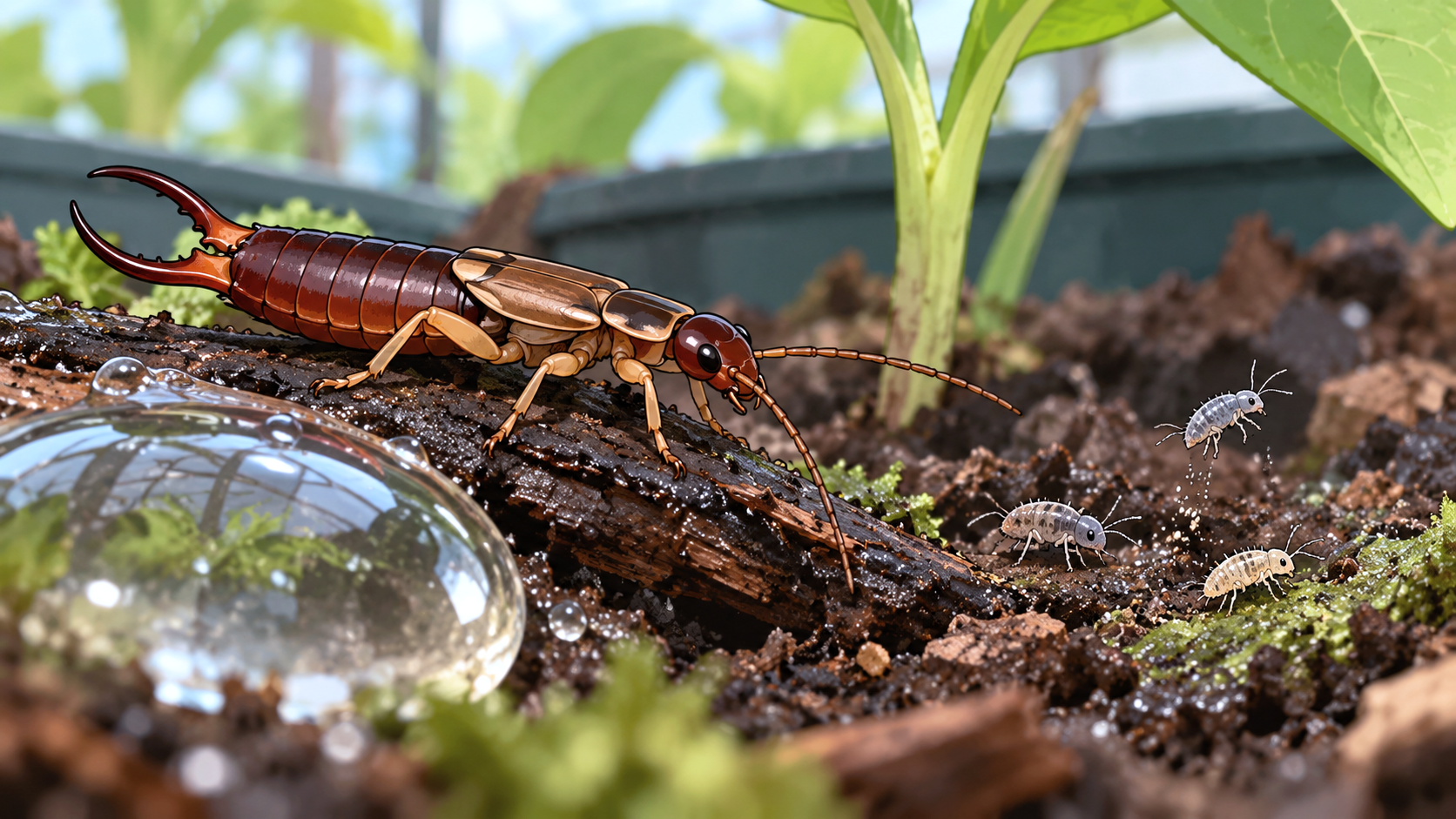
An earwig and a springtail can turn up in the same damp corner of a home, but they are difficult to confuse once you watch them move. Springtails are tiny, usually only 1/16 to 1/8 inch long, and many spring into the air when disturbed. Earwigs are much larger, do not jump like springtails, and have conspicuous forceps at the rear of the abdomen.
That combination makes this an identification problem you can often solve without examining tiny anatomical details. Instead of starting with color, disturb the creature gently and watch what happens. Then look at its size and rear end. Those three observations usually tell you which one you found.
The Jump Test Is the Fastest Earwig vs. Springtail Clue
Many household pests run when something approaches them. Springtails have a much more distinctive escape method. Most have a specialized forked structure called a furcula folded beneath the abdomen. When released, the furcula strikes against the surface and propels the springtail into the air.
The jump can look surprisingly dramatic because the animal itself is so small. Springtails found around homes are commonly only 1 to 2 millimeters long, yet they can suddenly disappear from the spot where you were watching them.
Earwigs do not have this spring-loaded movement. They walk and run on six legs. An earwig disturbed under a flowerpot or in a basement may scurry for cover, but it will not launch itself several inches through the air using a furcula.
We think movement is especially useful here because it avoids a common problem with tiny-pest identification. You do not need to decide whether something is dark gray, brown, or black while it is moving across a wet sink. A sudden jump narrows the possibilities immediately.
There is one qualification worth knowing. Not every springtail jumps. Some springtail species lack a functional furcula. Therefore, failure to jump does not prove that the creature is an earwig. When that happens, size becomes the better clue.
A Springtail Can Look Tiny Beside an Earwig
The scale difference between these animals is substantial. Household springtails are generally between 1/16 and 1/8 inch long. Some species are elongated, while others have a rounder, stouter appearance.
A European earwig is much larger, typically around 5/8 inch long. Its body is elongated and flattened, with a clearly defined head and the paired rear appendages responsible for the familiar “pincher bug” appearance. You can see a more detailed breakdown in our guide to how big earwigs get.
That means a creature that looks like a moving speck deserves closer consideration before you call it an earwig. Even a young earwig nymph has the basic earwig body plan rather than the minute appearance typical of household springtails.
Size also changes how these pests appear in groups. A collection of springtails can resemble scattered grains or dots until individual animals begin moving. Earwigs remain individually recognizable insects even when several gather in the same hiding place.
Look for Forceps on an Earwig, Not a Springtail
When the animal stays still long enough for a close look, move your attention to the end of its body. Earwigs have paired cerci that form the characteristic rear forceps. These structures are so useful for identification that they matter more than small differences in earwig color.
The forceps do not always have the exaggerated curved appearance shown in photographs of male earwigs. Female European earwigs generally have straighter forceps, while males tend to have more strongly curved ones. Our male and female earwig comparison shows why relying only on dramatically curved pincers can cause identification mistakes.
Springtails lack those earwig-style forceps. Their famous abdominal structure is instead the furcula, and it is normally held underneath the body rather than projecting backward like a pair of pincers. That distinction matters because both structures involve the rear portion of the animal but serve completely different purposes.
For a very small specimen, however, trying to inspect the underside for a furcula is unnecessary. The absence of visible earwig forceps, combined with minute size and jumping behavior, already makes a springtail a much stronger match.
Moisture Is Where the Two Pests Overlap
A bathroom floor is one of the places where habitat alone can mislead you. Springtails require high-moisture environments. Outdoors they occur in soil, leaf litter, mulch, beneath bark and around decaying organic material. Indoors they commonly appear around sinks, bathtubs, floor drains, damp basements, crawl spaces and houseplants.
Earwigs also favor protected, moist environments. They hide during the day in dark, cool places and may shelter beneath mulch, boards, vegetation and other objects. That preference can also bring earwigs into bathrooms and other damp parts of a building.
So finding the animal beside a drain does not settle an earwig vs. springtail identification. Moisture explains why either might be there.
The numbers can provide another clue. Springtails can appear in very large aggregations where moisture supports them. Seeing dozens or hundreds of extremely small crawling and jumping creatures around a damp area is much more characteristic of a springtail problem than finding a few recognizable earwigs.
Repeated Springtails Indoors Make Moisture Worth Investigating
The most useful difference between these pests may appear after identification rather than before it. A persistent springtail population indoors can tell you something about the environment.
Springtails need moisture to survive. Their continued presence inside a building is an indicator of moist conditions. Leaks, excessive humidity, damp crawl spaces, wet plant soil or other moisture sources can allow them to persist.
That makes repeatedly spraying the visible creatures a poor way to think about the problem. Reducing excess moisture is the central control measure. Springtails that enter a dry indoor environment generally do not survive for long.
Earwigs can also wander indoors because of outdoor conditions, and reducing moisture and hiding places around a structure can help discourage them. However, an earwig sighting does not carry exactly the same diagnostic value as a persistent concentration of springtails. Our guide to why earwigs enter houses covers the reasons for those indoor invasions separately.
This is why we would not stop at identifying a springtail. When tiny jumping creatures keep returning to the same sink, basement wall or window area, the more useful question becomes why that particular location stays favorable to them.
What to Do After You Know Which One You Found
For a springtail problem, start with water rather than pesticide. Check the immediate area for excessive moisture and correct the source where possible. That can mean repairing a leak, improving ventilation, reducing excessive watering of houseplants or allowing persistently wet areas to dry. Indoor springtails can also be vacuumed or swept up.
For an earwig, the priorities are somewhat different. A few individuals indoors can simply be removed, while repeated entry makes exterior hiding places and access points more important. Sealing openings and reducing damp organic debris against the building can help. Our complete guide to getting rid of earwigs covers that problem without turning this identification article into a treatment guide.
The practical distinction is straightforward. Tiny creatures that jump and keep appearing around moisture point toward springtails. A much larger crawling insect with obvious rear forceps points toward an earwig. Once you know which animal you have, you can address the conditions associated with that pest instead of treating two very different creatures as the same problem.
Other Questions About Earwigs and Springtails
Are springtails actually insects?
Springtails belong to the order Collembola and are commonly described as insect-like arthropods rather than true insects. Earwigs, by contrast, are insects in the order Dermaptera. The distinction is taxonomic and usually matters less to a homeowner than their obvious differences in size and movement.
Can springtails come from houseplant soil?
Yes. Moist potting soil can support springtails, particularly when it contains abundant organic material. Seeing tiny jumping creatures around a frequently watered houseplant therefore fits springtail behavior particularly well.
Do springtails have wings?
No. Springtails are wingless and cannot fly. When one suddenly becomes airborne, it has jumped rather than flown. The movement comes from the furcula on the underside of the abdomen.
Can springtails live in a swimming pool?
Springtails can collect on the surface of swimming pools and around other consistently damp outdoor areas. Their presence around a pool does not mean they are aquatic pests living permanently in the water.
Can earwigs and springtails occur in the same yard?
Yes. Their preferred habitats can overlap because both can occur in moist areas with organic material and sheltered spaces. Finding both therefore is possible, but their dramatic difference in size and the earwig’s rear forceps make separating them straightforward once you inspect them individually.